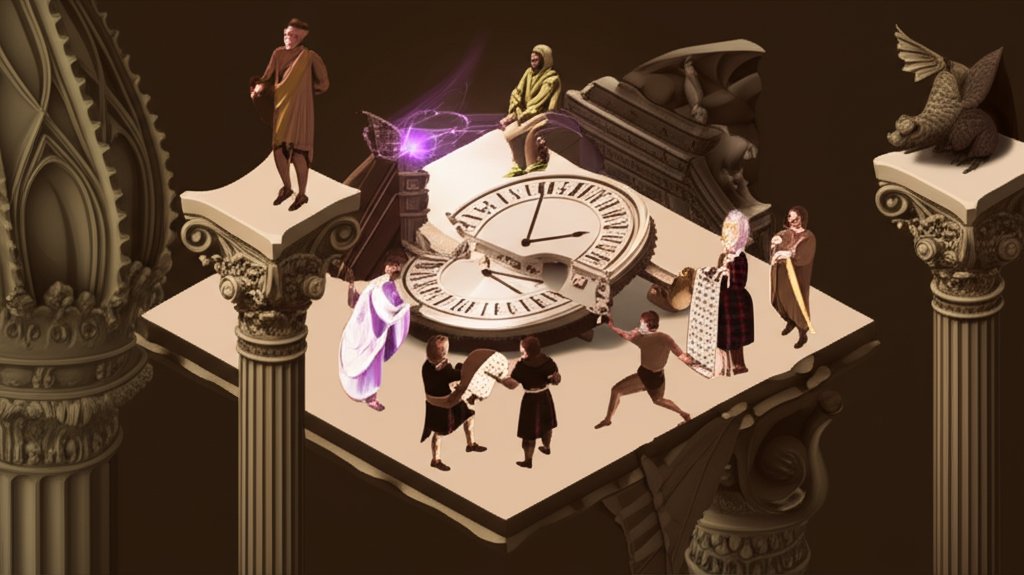
History isn’t just a timeline of dusty dates and solemn treaties. It’s the messy, hilarious, and often downright unbelievable story of us. When you peel back the layers of formal records, you find a world filled with moments so strange they sound made up—from wars fought against birds to popes putting corpses on trial. These aren’t just trivia; they’re windows into the unpredictable, resourceful, and wonderfully weird nature of humanity.
The past is a treasure trove of incredible tales, proving that truth is often stranger than fiction. These stories show us how people in different eras solved problems, made catastrophic mistakes, and navigated life in ways that can be both alien and strikingly familiar. To get started, you can Explore interesting history stories that reveal the human side of major events.
When Conflict Got Weird
War is often portrayed as a grim affair, but it has also been the backdrop for some of history’s most absurd events. Faced with chaos and desperation, human ingenuity—and sometimes sheer luck—has led to some truly bizarre outcomes. These moments highlight resilience and the strange twists of fate that can change everything.
During the Korean War’s brutal Battle of Chosin Reservoir, besieged U.S. Marines mistakenly received a massive air-drop of Tootsie Rolls instead of 60mm mortar rounds, which had the same code name. Miraculously, the candy became a lifesaver. It provided much-needed calories, and because it didn’t freeze in the sub-zero temperatures, soldiers found they could chew it into a putty to patch bullet holes and fuel lines. The sheer unpredictability of warfare is full of such stories, and you can Discover interesting facts about WW1 to see how the Great War also had its share of bizarre innovations and strange events.
This trend of military absurdity wasn’t a one-off.
- The Great Emu War: In 1932, the Australian military declared war on its emu population, which was devastating crops. Armed with machine guns, the soldiers were outmaneuvered by the surprisingly tactical birds and forced into a humiliating retreat.
- A Bear in the Army: During WWII, soldiers of the Polish II Corps adopted a Syrian brown bear cub named Wojtek. To get him on a British transport ship, they officially enlisted him as a private, complete with a serial number and paybook. He famously helped carry heavy artillery shells during the Battle of Monte Cassino.
These conflicts gave rise to incredible heroes, including the all-female Soviet 588th Night Bomber Regiment, dubbed the “Night Witches” by the Germans for their terrifyingly stealthy nighttime raids in outdated biplanes. Their story is just one of many, and you can Discover fascinating World War 2 facts from that era.
Questionable Decisions and Their Strange Consequences
History is a long series of choices, from monumental political shifts to outright baffling judgments. Some of these decisions were surprisingly effective, while others descended into pure farce. They remind us that even the most powerful people are capable of making some very odd calls.
One of the most ghoulish examples comes from 897 AD when Pope Stephen VI ordered the corpse of his predecessor, Pope Formosus, to be exhumed and put on trial. The deceased pontiff, propped up on a throne, was found guilty, had his fingers of blessing cut off, and his body was thrown into the Tiber River. This “Cadaver Synod” is a prime example of the strange but true stories in history that often get overlooked.
Other decisions, while less gruesome, were equally strange:
- The Persian Method: The ancient Greek historian Herodotus noted that ancient Persians would debate important matters twice: once while drunk and once while sober. They believed drunkenness encouraged honesty. If a decision still seemed good the next morning, they’d adopt it. This unique approach to governance is a fascinating tidbit, and you can Explore fun facts about Greece to learn more about the world Herodotus chronicled.
- The Great Traffic Jam: On September 3, 1967, at 4:50 a.m., the entire nation of Sweden switched from driving on the left side of the road to the right. Known as “Dagen H” (H Day), it required all traffic to stop, cautiously move to the other side, and wait for a signal to proceed.
- A Self-Made Nation: In 1968, Italian engineer Giorgio Rosa built a 400-square-meter platform in the Adriatic Sea and declared it the independent “Republic of Rose Island.” The Italian government, viewing it as a tax-evasion scheme, destroyed it with dynamite 55 days later.
Understanding why these events happened requires a deeper look into their context. When you Learn About Historical Significance, you see how even the strangest choices reflect the values and pressures of their time.
When Animals Changed the Course of History

Humans don’t have a monopoly on making history. Time and again, animals have played unexpected and often hilarious roles in major events, from bringing empires to their knees to becoming decorated war heroes.
Perhaps no one learned this lesson more embarrassingly than Napoleon Bonaparte. In 1807, after signing a major treaty, he decided to celebrate with a rabbit hunt. His chief of staff, however, gathered hundreds of tame rabbits instead of wild ones. When released, the rabbits didn’t flee; they charged Napoleon and his men, swarming them in a fluffy onslaught until the emperor was forced to retreat. You can find more moments like this when you explore funny historical events.
But it wasn’t just rabbits. Consider these other animal trailblazers:
- Jack the Signalman: For nine years in the 1880s, a baboon named Jack worked as a railroad signal operator in South Africa. He was an official employee who never made a mistake, earning 20 cents a day and half a bottle of beer a week.
- Andrew Jackson’s Parrot: At President Andrew Jackson’s funeral in 1845, his pet parrot, Poll, had to be removed from the ceremony because it wouldn’t stop swearing loudly.
- The Cat Catastrophe: In the 13th century, Pope Gregory IX issued a papal bull associating cats with witchcraft, leading to their mass killing across Europe. Some historians suggest the resulting decline in the cat population allowed the rat population to explode, potentially worsening the Black Death a century later.
Everyday Life Was Weirder Than You’d Think
It’s easy to imagine the past as a simpler time, but daily life for our ancestors was filled with bizarre customs, strange social clubs, and odd beliefs that have since faded away. These details paint a rich and sometimes comical picture of how people lived, worked, and had fun.
In the late 19th and early 20th centuries, for instance, “Fat Men’s Clubs” were popular social organizations in the U.S. These exclusive clubs had a minimum weight requirement of 200 pounds, and their meetings were celebrated with feasts and weigh-ins. This peculiar trend is one of many interesting unknown historical events that challenge our modern perceptions.
And there are plenty more oddities where that came from:
- The Origin of “OK”: The common term “OK” is believed to have started as a joke in 1830s Boston, as a deliberately misspelled abbreviation for “Oll Korrect” (all correct).
- Christmas Was Canceled: In 1659, Puritans in the Massachusetts Bay Colony banned the celebration of Christmas, considering it a decadent and pagan festival. The ban lasted for 22 years.
- Shoelace Spies: During the Cold War, spies from Eastern Bloc countries allegedly used a secret communication system based on how they tied their shoelaces. Different patterns, colors, or knots could convey messages to other agents in plain sight.
These tidbits are just the beginning. The past is brimming with countless oddities just waiting to be rediscovered, and you can Discover surprising history facts to see just how deep the rabbit hole goes.
Legacies Carved in Stone and Starlight
From ancient wonders that defy explanation to artistic masterpieces with hidden secrets, history has left behind a legacy that continues to inspire and mystify us. These accomplishments show a level of ingenuity and vision that stands the test of time.
Thousands of years before Stonehenge, around 11,000 to 12,000 years ago, hunter-gatherers built Göbekli Tepe in modern-day Turkey. This complex temple site suggests organized religion may have developed before agriculture, upending our understanding of early civilization. The timeline of human achievement is truly staggering, especially when you consider that a small population of woolly mammoths still existed on Wrangel Island while the 12 facts about egyptian pyramids were being built.
Even more recently, artists and engineers have left clues to their genius:
- Van Gogh’s Star Chart: Vincent van Gogh’s painting Café Terrace at Night is astronomically precise. By analyzing the position of the stars, particularly the Big Dipper, modern astronomers determined it was painted on the night of September 16 or 17, 1888. These are the kinds of discoveries that highlight the truly cool moments in history.
- The World’s First Skyscraper: Shrewsbury Flaxmill Maltings, built in England in 1797, is considered the “Grandfather of Skyscrapers.” It was the first building in the world to feature a load-bearing iron frame, the architectural innovation that would make modern high-rises possible.
These stories, along with the Great London Beer Flood of 1814 and the mysterious Dancing Plague of 1518, are just a few of the many events that seem too strange to be real. As you dive deeper, you’ll Uncover bizarre events in history that are even more shocking.
History is Happening Every Day
The past is not a static, distant land; it’s a living collection of human experiences that informs our present and future. Each day adds a new layer to this incredible story, filled with its own triumphs, tragedies, and peculiarities. By exploring these forgotten corners of history, we don’t just learn about what happened—we connect with the people who lived it.
Every day has its own incredible stories, and if you want to make the past more accessible, you can explore events on this day in history for kids and adults alike. The more we look, the more we realize that our shared human story is more bizarre, entertaining, and fascinating than any of us could ever imagine.










