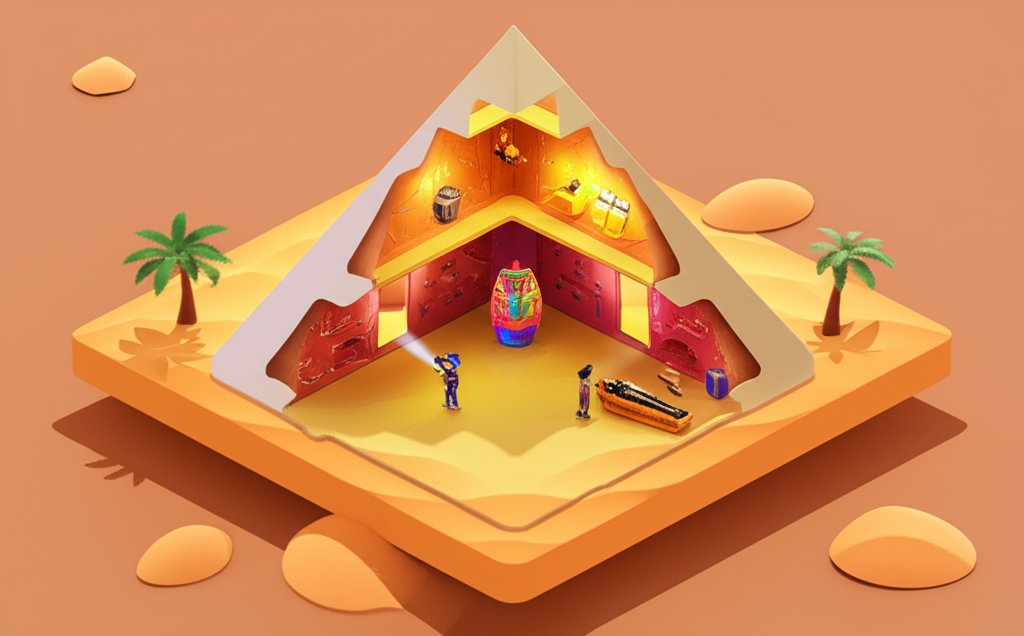
The Egyptian pyramids have stood for over 4,500 years, cutting a jagged, iconic line against the desert sky. They are more than just ancient tombs; they’re monuments to human ingenuity, ambition, and a profound belief in the afterlife. But beyond the post-card images lie stories of incredible engineering, lost rivers, and astronomical secrets. To help you truly grasp their significance, we’ve compiled 12 facts about Egyptian pyramids that peel back the layers of sand and time.
These structures were so masterfully built that they challenge our modern understanding of ancient capabilities. They were born from an obsession with eternity, designed to be the ultimate launchpad for a pharaoh’s soul. Let’s explore the wonders they still hold.
The Pyramids at a Glance
Before we dive deep, here are the key takeaways you should know:
- Tombs, Not Granaries: The pyramids were built as sophisticated and sacred tombs to protect the pharaohs and their treasures for the afterlife.
- Built by Pros, Not Slaves: Evidence strongly indicates the pyramids were constructed by a skilled, well-fed, and paid labor force.
- The Original Bling: They were originally covered in polished white limestone, making them gleam like brilliant jewels under the Egyptian sun.
- A Feat of Engineering: The Great Pyramid of Giza was the tallest man-made structure in the world for an astonishing 3,800 years.
- Cosmic Connection: Their design incorporates remarkable mathematical and astronomical precision, aligning with cardinal directions and specific stars.
The Genesis of an Icon: From Simple Steps to Smooth Slopes
The classic, smooth-sided pyramid we all recognize wasn’t a design that appeared overnight. It was the result of generations of architectural innovation, trial, and sometimes, near-catastrophic error.
1. The First Pyramid Was a Revolutionary “Step” Up
Long before the Great Pyramid of Giza, there was the Pyramid of Djoser. Built around 2670 BCE at Saqqara, this structure is considered the world’s first large-scale stone building. It didn’t have smooth sides but was built as a series of six stacked mastabas (flat-roofed rectangular tombs), one on top of the other.
The genius behind this “Step Pyramid” was the pharaoh’s vizier and chief architect, Imhotep. He essentially created a stairway to the heavens, a physical representation of the pharaoh’s ascent. This design was a radical leap forward, setting the stage for every pyramid that followed.
2. They Perfected the Design Through Trial and Error
The road from the Step Pyramid to the smooth-sided perfection at Giza was bumpy. Architects experimented, and their learning curve is literally built in stone. A prime example is the Bent Pyramid at Dahshur, built for Pharaoh Sneferu.
About halfway up, the builders abruptly changed the angle of incline from a steep 54 degrees to a more gradual 43 degrees. Why? Egyptologists believe the original angle was too ambitious and was causing structural instability. Rather than risk collapse, they adjusted on the fly, leaving behind a uniquely “bent” monument. Sneferu learned from this, and his next project, the Red Pyramid, became the first successful true, smooth-sided pyramid.
Unpacking the Engineering: How Did They Actually Build Them?

The sheer scale of the pyramids, particularly those at Giza, boggles the mind. How did an ancient civilization, without modern machinery, quarry, transport, and assemble millions of tons of stone with such precision?
3. The Great Pyramid of Giza Is a Statistical Wonder
Let’s just focus on the Great Pyramid, built for Pharaoh Khufu. The numbers are staggering:
- It’s composed of an estimated 2.3 million stone blocks.
- Each block weighs an average of 2.5 tons—the equivalent of a large SUV.
- The total mass is nearly 6 million tons.
- Its base covers 13 acres.
For over 3,800 years, it remained the tallest man-made structure on Earth. Think about that: it held that record from its completion around 2560 BCE until the Lincoln Cathedral was finished in England in 1311 CE. Even the granite sarcophagus in the King’s Chamber is a puzzle; it’s too large to fit through the passageways, meaning it had to be placed deep inside the pyramid during construction.
4. Construction Was Done by a Skilled, Paid Workforce—Not Slaves
The long-held Hollywood trope of slaves toiling under the whip is one of the biggest myths about the pyramids. Archaeological evidence, including the discovery of workers’ villages near the pyramids, paints a very different picture.
Excavations have revealed that the builders were skilled Egyptian laborers. They lived in organized communities, received rations of meat, bread, and beer, and had access to medical care. The ultimate sign of respect? They were buried in honored tombs near the very pyramids they helped build—an honor that would never have been granted to slaves. The project was a massive national undertaking, likely employing rotating crews of skilled workers from across the kingdom.
5. A Lost Branch of the Nile River Was Their Superhighway
Moving multi-ton blocks from quarries—some, like the granite for the inner chambers, located over 500 miles away—required an ingenious solution. Researchers have discovered evidence of a long-lost arm of the Nile River that once flowed much closer to the Giza plateau.
This ancient waterway served as a liquid highway. Workers would transport the massive blocks by boat to a harbor built right at the base of the construction site. From there, they dragged the stones on large wooden sleds. A fascinating study published in Physical Review Letters confirmed that Egyptian workers likely wet the sand in front of the sleds, a simple trick that reduced friction by up to 50% and made the impossible task of moving the blocks manageable.
More Than a Pile of Rocks: A Universe in Stone
The pyramids weren’t just brute-force construction projects. They were intricate, multi-faceted structures designed with a deep understanding of science, spirituality, and symbolism.
6. The Pyramids Originally Gleamed in the Sun
The pyramids you see today are the rough, structural core of the original monuments. In their heyday, they were encased in a layer of highly polished, white Tura limestone. These casing stones were cut with incredible precision and fitted together so seamlessly that they created a smooth, brilliant surface.
Imagine how they must have looked, reflecting the bright Egyptian sun. They would have been visible for miles, shining like divine beacons. Most of these casing stones were later repurposed for other building projects in Cairo after being loosened by earthquakes. You can still see a few of the original stones at the very top of Khafre’s pyramid, giving a hint of its former glory.
7. They Are Aligned with Baffling Astronomical Precision
The pyramids at Giza are a testament to the Egyptians’ advanced knowledge of astronomy. The Great Pyramid is aligned to the cardinal directions (north, south, east, west) with an accuracy of within one-fifteenth of a single degree. This is a level of precision that is difficult to achieve even with modern technology.
Furthermore, internal shafts that extend from the main chambers point directly toward specific stars or constellations, such as Orion and Ursa Major. The ancient Egyptians believed these shafts were pathways for the pharaoh’s soul to ascend to the heavens and join the gods among the “imperishable stars.” It’s just one of many Interesting pyramid facts that continue to fascinate researchers.
8. They Also Functioned as Giant Sundials
The purpose of the pyramids was primarily religious, but their precise design had practical applications. Their shadows acted like a massive sundial, allowing the Egyptians to accurately mark solstices and equinoxes. This was crucial for determining the length of the solar year and planning their agricultural cycle of planting and harvesting, which revolved around the annual flooding of the Nile. The pyramid wasn’t just a tomb; it was a clock, a compass, and a calendar all in one.
Unlocking the Secrets: What’s Inside and What’s Still Hidden
For all we know about the pyramids, they continue to guard their secrets closely. Modern technology is just beginning to peek behind the veil, revealing that there is still much more to discover.
9. The Interior Temperature Is Naturally Climate-Controlled
One of the most remarkable and mysterious properties of the Great Pyramid is its ability to maintain a constant internal temperature. Regardless of the scorching desert heat outside, which can fluctuate wildly, the temperature deep within the pyramid’s chambers remains at a steady 20°C (68°F).
How it achieves this perfect, natural climate control is not fully understood, but it speaks to the incredible insulation properties of the massive stone structure and the sophistication of its design.
10. Hidden Chambers Are Still Being Discovered
Think we’ve found everything there is to find? Think again. In recent years, an international project called ScanPyramids has used advanced cosmic-ray imaging (muography) to scan the pyramids without any physical intrusion.
In 2017, this technology led to the stunning discovery of a massive, previously unknown void inside the Great Pyramid, located above the Grand Gallery. Dubbed the “Big Void,” this chamber is at least 30 meters (98 feet) long. Its purpose is still a complete mystery, proving that these ancient wonders haven’t given up all their secrets just yet.
11. They Were the Centerpiece of Vast “Cities of the Dead”
A pyramid never stood alone. It was the main event in a sprawling complex, essentially a city dedicated to the dead. The Giza plateau, for example, includes:
- The Great Sphinx: A colossal limestone statue with the body of a lion and the head of a human, believed to represent Pharaoh Khafre. It was carved from a single outcrop of bedrock.
- Smaller Queens’ Pyramids: Pharaohs were often buried with their wives and family members in smaller, adjacent pyramids.
- Mortuary and Valley Temples: These were places for performing religious rituals and preparing the pharaoh’s body for burial.
- Causeways: Covered walkways connected the temples to the pyramids.
- Mastaba Tombs: Hundreds of tombs for other high-ranking officials and nobles who wanted to be buried near their king.
12. The Mortar They Used Is Stronger Than the Stone Itself
While many of the pyramid’s blocks were cut to fit together without any adhesive, a gypsum-based mortar was used to fill gaps and bind the core stones. This ancient cement is of such high quality that it has remained intact for millennia.
In fact, the chemical composition of the mortar is so complex and durable that scientists are still working to fully understand and replicate it. In many places, the mortar has held so strong that the surrounding stone has eroded away first, leaving the ancient joints intact—a final, enduring testament to the genius of the pyramid builders.
Your Questions, Answered
Let’s clear up a few more common queries about these ancient marvels.
How many pyramids are there in Egypt?
Archaeologists have identified between 118 and 138 pyramids in Egypt, though many are smaller or in a state of ruin compared to the iconic structures at Giza and Saqqara.
Why were they built on the west bank of the Nile?
The ancient Egyptians associated the east, where the sun rises, with life and new beginnings. The west, where the sun sets, was symbolically known as the “land of the dead.” Placing tombs and funerary complexes on the west bank was a crucial part of their religious worldview.
What was actually found inside the pyramids?
Though most pyramids were looted in antiquity, they were originally filled with everything a pharaoh would need for the afterlife. This included the pharaoh’s mummified body (often in a stone sarcophagus), furniture, jewelry, food, weapons, and sacred texts known as the Pyramid Texts, which contained spells to guide the deceased. The discovery of Tutankhamun’s largely intact tomb (though not in a pyramid) gives us a glimpse of the incredible wealth these tombs once held.
The Pyramids: A Conversation Through Millennia
The Egyptian pyramids are far more than a checklist item for tourists. They are a profound statement about the human capacity for vision, collaboration, and a desire to conquer eternity itself. They stand as a silent, powerful dialogue between our world and one that vanished thousands of years ago.
Every block tells a story of a worker who lifted it; every precise alignment speaks to an astronomer who charted the stars. The next time you see an image of the pyramids, look beyond the simple shape and see the complex, brilliant, and deeply human civilization that dared to build a stairway to the heavens.










