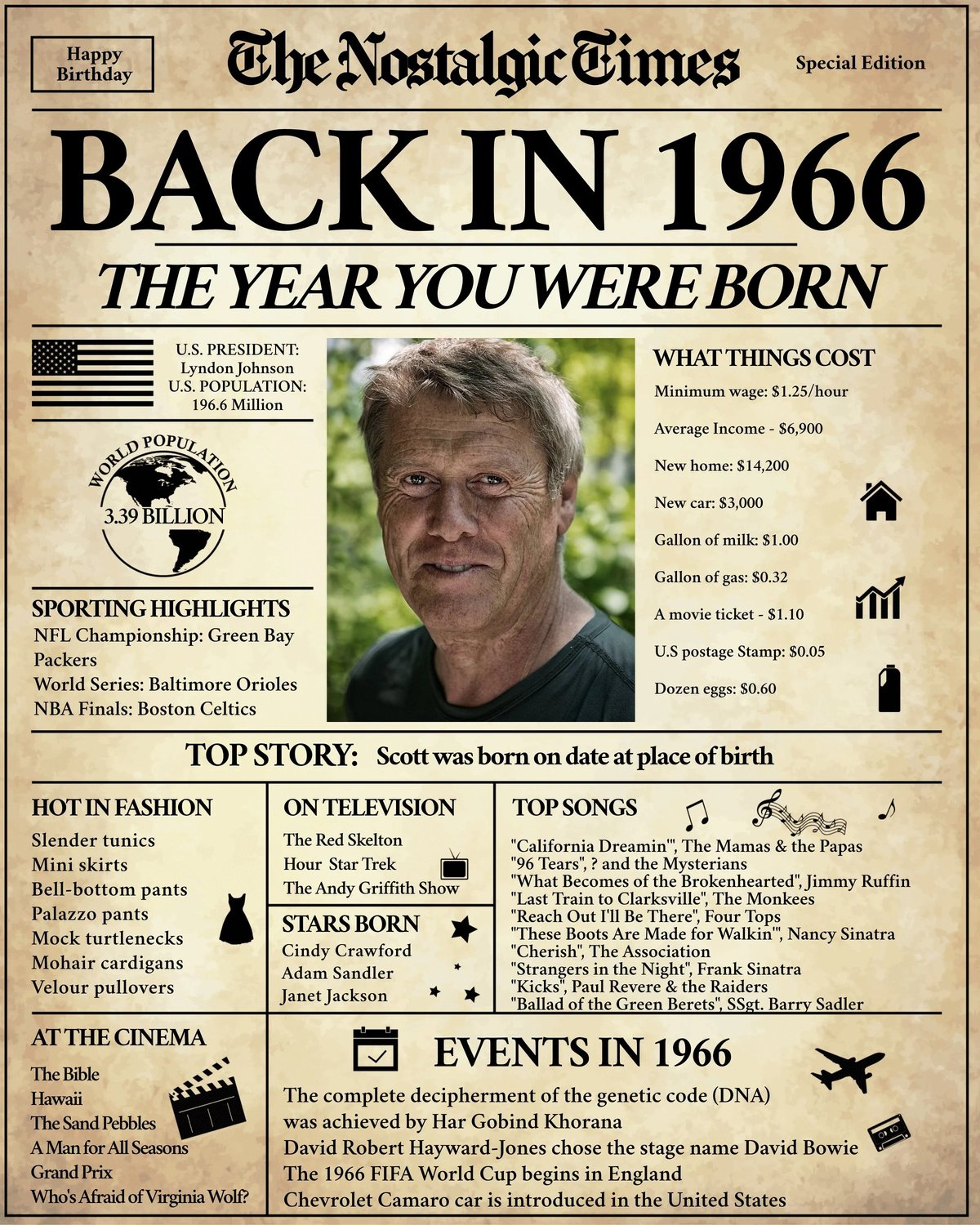
The year began with Simon & Garfunkel’s haunting “The Sound of Silence” hitting number one on the charts—a deeply ironic anthem for a year that was anything but quiet. To understand What happened in 1966, you have to picture a world of explosive contradictions: a nation reaching for the moon while being torn apart on the streets, a cultural revolution of peace and love set against the backdrop of a brutal war, and a fight for basic human rights that turned increasingly violent.
1966 wasn’t just another year; it was an inflection point. The postwar optimism of the early ’60s gave way to a hardened realism as the body count in Vietnam climbed and the Civil Rights Movement faced a fractured, uncertain future. From landmark Supreme Court rulings to the birth of iconic sci-fi, this year laid the groundwork for decades of political and cultural change.
1966: The Year at a Glance
Before we dive deep, here’s a snapshot of the pivotal moments that defined 1966:
- Vietnam War Escalation: The number of U.S. troops in Vietnam more than doubled, and bombing campaigns expanded to include Hanoi and Haiphong, fueling massive anti-war protests.
- Civil Rights Movement Shifts: The call for “Black Power” emerged, and the Black Panther Party was founded in Oakland, signaling a militant new phase in the struggle for racial equality.
- Landmark Legal Precedents: The Supreme Court’s Miranda v. Arizona decision established the right to remain silent and the right to an attorney, forever changing police procedure in America.
- The Space Race Reaches the Moon: The Soviet Union achieved the first soft lunar landing with Luna 9, while the U.S. followed with Surveyor 1, capturing thousands of images from the moon’s surface.
- Cultural Touchstones Are Born: Star Trek premiered on television, The Beach Boys released the groundbreaking album Pet Sounds, and Walt Disney passed away, marking the end of an era.
- Global Political Turmoil: China’s Cultural Revolution began, several African nations gained independence, and the architect of South African apartheid was assassinated.
The Civil Rights Movement at a Crossroads
By 1966, the unified, nonviolent strategy that had led to the Civil Rights Act of 1964 was showing signs of strain. The struggle moved north, confronting a more subtle but equally entrenched racism, and a younger generation of activists grew impatient with the slow pace of change. These are some of the Defining moments of 1966 that marked this pivotal transition.
King Takes the Fight to Chicago
In January, Dr. Martin Luther King Jr. launched the Chicago Freedom Movement, aiming to dismantle the city’s systemic housing segregation. For the first time, King’s Southern Christian Leadership Conference (SCLC) took its fight to a major northern city. The resistance was ferocious. During one march in a white neighborhood on August 5, King was struck by a rock. He later remarked, “I have never seen, even in Mississippi and Alabama, mobs as hostile and hate-filled as I’ve seen in Chicago.”
The March Against Fear and the Rise of “Black Power”
The fault lines within the movement burst into public view in June. Activist James Meredith, who had integrated the University of Mississippi in 1962, began a solitary “March Against Fear” from Memphis, Tennessee, to Jackson, Mississippi. On the second day, he was shot and wounded by a white sniper.
In response, leaders from every major civil rights organization—including Dr. King (SCLC), Stokely Carmichael (SNCC), and Floyd McKissick (CORE)—rushed to Mississippi to continue his march. It was during this tense, defiant march that Stokely Carmichael, frustrated with the violence and slow progress, first rallied a crowd with the electrifying chant: “We want Black Power!” The phrase marked a profound ideological split, emphasizing self-defense, racial pride, and political and economic independence over the integrationist, nonviolent approach.
The Black Panther Party Is Born
That call for self-determination found its most potent expression in October. In Oakland, California, two community college students, Huey P. Newton and Bobby Seale, founded the Black Panther Party for Self-Defense. Armed with law books and shotguns, they began “policing the police,” monitoring officers for brutality in the Black community. Their Ten-Point Program demanded full employment, decent housing, and an end to police violence, creating a revolutionary new force in 1966 in American History.
An Escalating War and a Divided Nation
While America fought a war over its soul at home, the war in Southeast Asia spiraled. President Lyndon B. Johnson, committed to preventing a communist takeover of South Vietnam, dramatically deepened U.S. involvement. It was one of the most important events in 1966.
In March, Secretary of Defense Robert McNamara announced a massive troop increase, and by the end of the year, nearly 400,000 American soldiers were on the ground. On June 29, U.S. bombers struck targets on the outskirts of major North Vietnamese cities Hanoi and Haiphong for the first time. This escalation signaled a devastating new phase of the war.
As casualties mounted, so did opposition. On March 26, massive, coordinated anti-war demonstrations took place in cities across the United States and the world. For the first time, Dr. Martin Luther King Jr. publicly condemned the war, linking the fight for civil rights at home with the struggle against imperialism abroad. This was a hugely controversial move that alienated many of his allies in the Johnson administration. This context is critical to understanding Discover 1966 America.
Landmark Laws That Shaped Modern America
Away from the protests and battlefields, 1966 saw the passage of laws and Supreme Court rulings that continue to shape American life. It was truly Americas pivotal year: 1966, as foundational changes were implemented.
“You Have the Right to Remain Silent”
Arguably the most significant legal development was the Supreme Court’s 5-4 decision in Miranda v. Arizona on June 13. The ruling established that police must inform criminal suspects of their constitutional rights before interrogation, including the right to an attorney and the right against self-incrimination. The “Miranda warning” became a cornerstone of American criminal procedure and a fixture in police dramas for generations to come.
Other Foundational Shifts
- End of the Poll Tax: In Harper v. Virginia Board of Elections, the Supreme Court declared that poll taxes—fees levied on voters that disproportionately disenfranchised Black and poor citizens—were unconstitutional in state elections.
- Freedom of Information: President Johnson signed the Freedom of Information Act (FOIA) on July 4, establishing a public right of access to government documents and promoting transparency.
- Safer Roads and Skies: In response to growing concerns about auto safety, highlighted by Ralph Nader’s book Unsafe at Any Speed, Congress passed the National Traffic and Motor Vehicle Safety Act. The same year, the Department of Transportation was created to oversee America’s sprawling infrastructure. The full list of What happened in US 1966 shows just how formative this year was.
Reaching for the Stars: The Space Race Hits the Moon
Amid the turmoil on Earth, humanity took its first tentative steps onto another world. The U.S. and the Soviet Union were locked in a fierce competition to prove their technological supremacy, and in 1966, the Moon became the primary stage for these 1966 big events.
The Soviets struck first. On February 3, their Luna 9 probe made the first-ever controlled “soft landing” on the lunar surface and transmitted the first photos from another world. Two months later, Luna 10 became the first spacecraft to orbit the Moon.
But the United States was closing the gap.
- On March 16, Gemini 8, commanded by Neil Armstrong, performed the first-ever docking of two spacecraft in orbit—a critical maneuver for any future lunar mission.
- On June 2, Surveyor 1 became the first American spacecraft to make a soft landing on an extraterrestrial body, touching down on the Moon and sending back over 11,000 detailed photographs.
- Finally, in August, Lunar Orbiter 1 captured a breathtaking and now-iconic image: the first photograph of Earth as seen from lunar orbit. This powerful image gave humanity a new perspective on its fragile, isolated home. These key events in 1966 demonstrated incredible technological progress.
A Cultural Tsunami: Music, Media, and Revolution
The seismic shifts in politics and society were matched by a revolution in arts and culture. The year 1966 was a creative crucible, producing works that challenged norms and defined a generation.
The Sound of a Generation
Music was at the heart of this cultural explosion.
- The Beach Boys released Pet Sounds on May 16, a symphonic, melancholy masterpiece that redefined what a pop album could be and directly inspired The Beatles’ Sgt. Pepper’s.
- The Beatles themselves sparked global outrage in March when John Lennon casually told a reporter, “We’re more popular than Jesus now.” The comment led to radio bans and album burnings across the American Bible Belt. On August 29, the band played their final commercial concert at San Francisco’s Candlestick Park, retreating to the studio to create their most experimental work.
- In New York City, Simon & Garfunkel’s “The Sound of Silence” captured a feeling of thoughtful alienation, while on the West Coast, bands like The Doors were forging a darker, more psychedelic sound.
New Frontiers on the Small Screen
Television also broke new ground. On September 8, a low-budget science fiction series with a hopeful, utopian vision of the future premiered on NBC. Star Trek offered a multicultural crew exploring the galaxy, tackling complex social issues through sci-fi allegory. A few days later, The Monkees debuted—a madcap show about a fictional band that became a real-life pop sensation. And on December 18, Dr. Seuss’s How the Grinch Stole Christmas! aired for the first time, instantly becoming a beloved holiday classic. So much of What happened in 1966 continues to influence us today.
The Counter-Culture and Global Upheaval
Beneath the mainstream, the counter-culture was bubbling. LSD was made illegal in the U.S. on October 6, pushing its use further underground. In San Francisco, Anton LaVey founded the Church of Satan on April 30. And halfway across the world, China’s Chairman Mao Zedong formally launched the Great Proletarian Cultural Revolution in May, a chaotic and violent decade-long campaign to purge the country of capitalist and traditional elements, resulting in mass persecution and the destruction of cultural artifacts. Reviewing the Key events of 1966 shows a world in flux.
Tragedy, Triumph, and a Changing World
Beyond the major headlines, the year was filled with events that brought both sorrow and celebration. These Major Events from 1966 paint a fuller picture of the year’s character.
Moments of Tragedy:
- The Aberfan Disaster: On October 21 in Wales, a colliery spoil tip collapsed, engulfing a school and homes in a river of mud and rock, killing 116 children and 28 adults.
- The University of Texas Tower Shooting: On August 1, Charles Whitman climbed a clock tower in Austin and opened fire, killing 16 people in one of the deadliest mass shootings in U.S. history up to that point.
- The Death of a Visionary: On December 15, Walt Disney, the animator and entertainment mogul who had shaped American childhood for decades, died of lung cancer at age 65.
Moments of Progress and Change: - Political Firsts: In November’s midterm elections, Edward Brooke of Massachusetts became the first African American popularly elected to the U.S. Senate. In California, former actor Ronald Reagan was elected governor, launching a political career that would lead to the White House.
- New Nations: The wave of decolonization continued, with Guyana (May), Botswana (September), Lesotho (October), and Barbados (November) all gaining independence from the United Kingdom.
- A New Holiday: On December 26, Dr. Maulana Karenga held the first celebration of Kwanzaa, a week-long holiday created to honor African heritage and culture.
These were just some of the major events in 1966, each adding another layer to a complex and transformative year.
Frequently Asked Questions About 1966
What was the single most significant event of 1966?
While many events were transformative, the Supreme Court’s decision in Miranda v. Arizona had the most immediate and lasting impact on the daily lives of Americans by fundamentally changing the balance of power between citizens and law enforcement. The What happened in 1966 is full of such pivotal moments.
How did the Vietnam War really change in 1966?
1966 was the year the conflict transformed from a limited “advisory” role to a full-scale American war. The massive increase in troops, the launch of major bombing campaigns near civilian centers, and the corresponding rise of the anti-war movement meant there was no turning back.
What was the cultural mood in 1966?
The mood was deeply divided. On one hand, there was incredible creative energy in music, television, and pop art. On the other, there was growing anxiety, division, and anger over the war and social injustice. It was a year of both psychedelic optimism and grim realism. The answer to What happened in 1966 is really a story of these competing tensions.
The Enduring Echoes of a Turbulent Year
Looking back on What happened in 1966 is like examining a cultural and political fault line. It was the year the tensions simmering beneath the surface of American society finally erupted. The arguments that began in 1966—over the limits of police power, the cost of foreign wars, the meaning of patriotism, and the struggle for racial justice—are the very same arguments we are having today.
The year’s events set in motion forces that would lead to the explosive protests of 1968, the end of the Vietnam War, and decades of political realignment. It was a time of profound loss and incredible invention, of brutal violence and boundless hope. More than half a century later, we are still living in the world that 1966 created. The What happened in 1966 serves as a powerful reminder that history is not just a collection of dates, but a living story that continues to shape our present.










