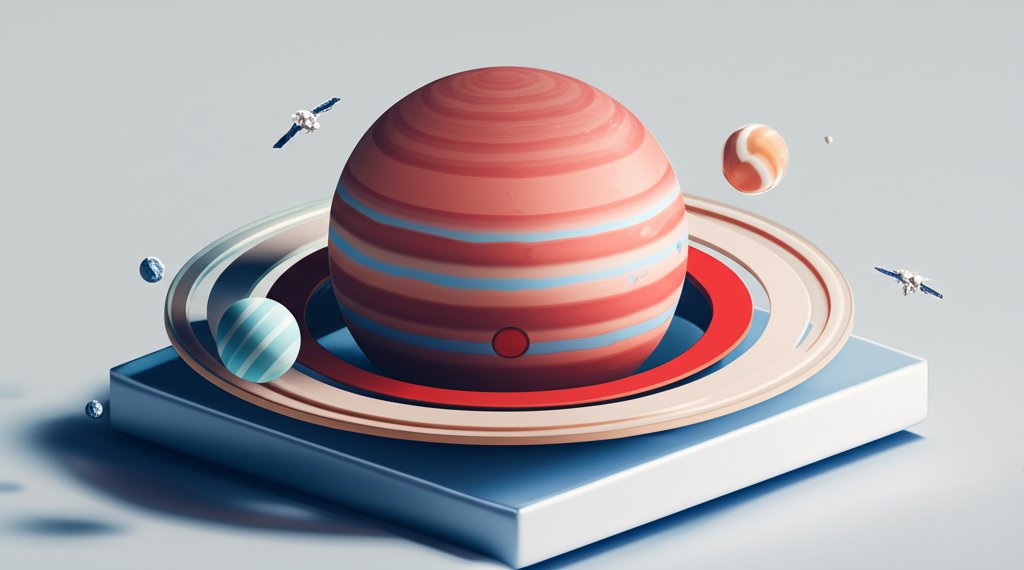
Imagine a planet so massive it doesn’t even orbit the sun’s center. Welcome to Jupiter, the solar system’s behemoth, where questions about Jupiter’s Rotation and Orbit lead to fascinating discoveries. From its surprisingly short days to its influence on the entire solar system, Jupiter is a planet of extremes.
At a glance:
- Jupiter’s day is less than 10 Earth hours.
- A year on Jupiter is almost 12 Earth years.
- Jupiter is so massive, it affects the sun’s orbit.
- Jupiter has very weak seasons due to its small axial tilt.
- Jupiter’s fast rotation causes a noticeable bulge at its equator.
Jupiter: King of the Planets
Jupiter, named after the king of the Roman gods, dominates our solar system. Ancient astronomers recognized it as a “wanderer,” tracking its motion and brightness. But it was Galileo Galilei who revolutionized our understanding in 1610. Using his telescope, he discovered Jupiter’s four largest moons – Io, Europa, Ganymede, and Callisto – proving that not everything revolves around Earth. This discovery cemented Jupiter’s place not just as a planet, but as a pivotal point in our understanding of the cosmos. The planet’s astronomical symbol, ♃, is fittingly interpreted as a stylized lightning bolt, a sign of its powerful presence.
Orbital Dance: Jupiter’s Journey Around the Sun
Jupiter’s orbit is an elliptical path around the Sun, at an average distance of 778 million kilometers (5.2 AU). However, it’s not quite that simple. Because Jupiter is so massive, the center of mass between Jupiter and the Sun, called the barycenter, actually lies outside the Sun’s surface. This means Jupiter, and technically the Sun, orbit this point in empty space. Planet-hunting scientists use this wobble in other stars to detect massive exoplanets. It takes Jupiter 11.86 Earth years to complete one orbit, making Jupiters Year: A Cosmic Comparison. Since it takes the sun the same amount of time to travel around the barycenter, this affects the other planets and objects in the solar system.
Jupiter’s orbital path isn’t a perfect circle; it’s an ellipse. Its eccentricity, a measure of how much an orbit deviates from a perfect circle, is 0.048. Because of this, the distance between Jupiter and the Sun varies by about 75 million kilometers between its closest point (perihelion) and farthest point (aphelion). This also forms a 5:2 orbital resonance with Saturn, because it is 2/5 the orbital period of the planet.
A Tilted View: Jupiter’s Axial Tilt and Seasons
Unlike Earth with its noticeable seasons, Jupiter experiences very little seasonal variation. Jupiters Tilt: The Full Story, its rotational axis is tilted by only 3.13 degrees relative to its orbital plane. This small tilt means that different parts of Jupiter don’t experience significant changes in the amount of sunlight they receive throughout its year.
The Speedy Giant: Jupiter’s Rapid Rotation
Jupiter is the fastest-spinning planet in our solar system. It completes one rotation in just under 10 hours. More specifically, Jupiters day: surprisingly short, averaging about 9 hours and 55 minutes! This rapid spin has a profound effect on the planet’s appearance, creating an equatorial bulge that’s easily visible through a telescope. This bulge is a direct result of the centripetal force generated by the planet’s rotation, stretching its shape at the equator.
Because Jupiter is not a solid body, differential rotation occurs in its upper atmosphere, with its equatorial atmosphere rotating roughly five minutes faster than the rest of the planet.
Understanding Jupiter’s Rotation: System I, II, and III
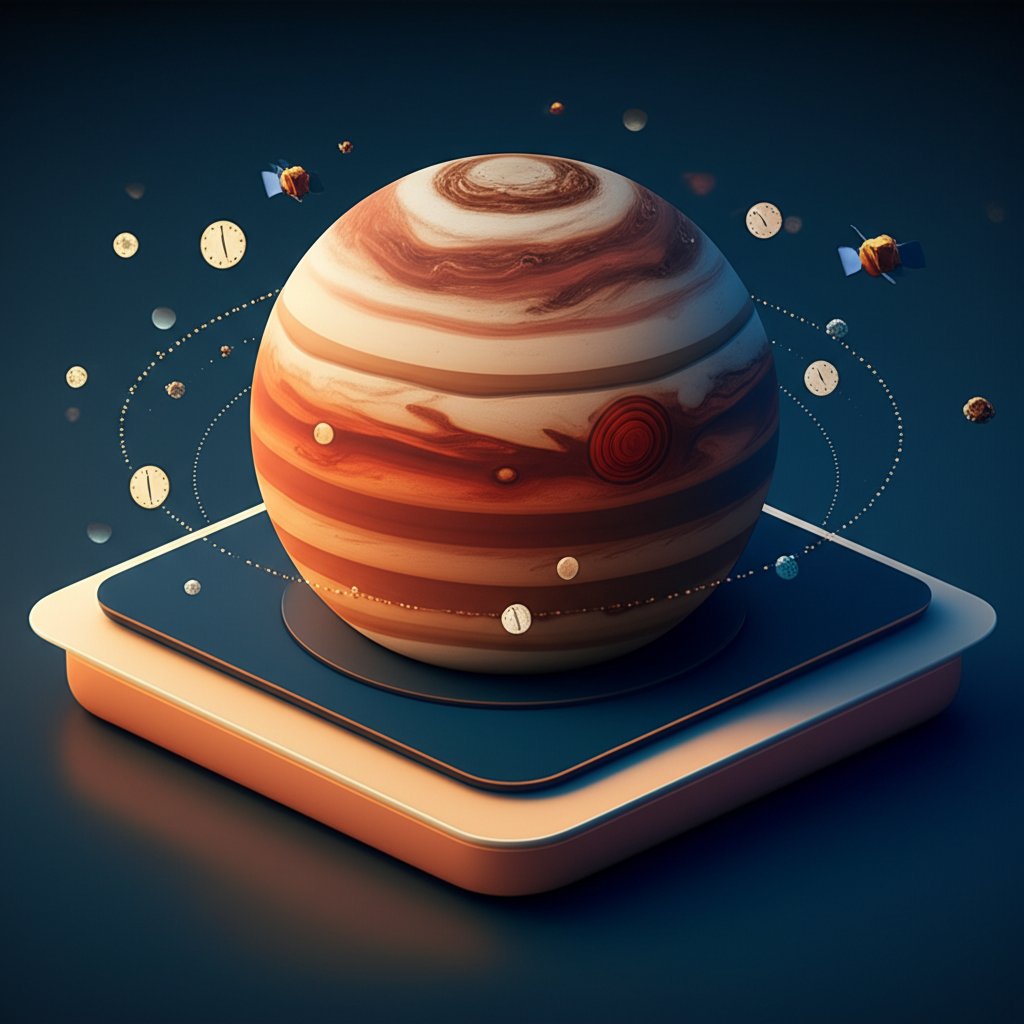
To map and track the features on Jupiter, astronomers use three different systems of reference. These systems define latitudes on Jupiter’s surface and help in charting the movements of its atmospheric features:
- System I: Applies to the equatorial region, extending to latitudes of 10° North and South.
- System II: Covers latitudes beyond System I, both North and South.
- System III: Based on the planet’s magnetic field, this system is used to refer to the rotation of Jupiter’s interior.
The Greatness of Jupiter: Size and Mass
To put Jupiter’s size into perspective, imagine Earth as a grape. In that scale, Jupiter would be the size of a basketball. Its diameter is about one-tenth of the Sun’s. While its diameter is impressive, its mass is even more so. Despite being a tenth the size of the sun, it is only about one-thousandth of the Sun’s mass!
Inside Jupiter: Composition and Structure
Jupiter is primarily composed of hydrogen (about 90%) and helium (about 10%), with trace amounts of other elements like methane, ammonia, and water. As you descend into Jupiter’s atmosphere, the pressure and temperature increase dramatically. Eventually, the hydrogen transitions into a metallic state, creating a vast ocean of liquid metallic hydrogen. It would need to be about 80 times more massive in order to ignite sustained hydrogen fusion.
Jupiter’s Excess Heat: Internal Energy
Intriguingly, Jupiter radiates about 1.6 to 1.7 times more energy than it receives from the Sun. This excess heat is generated by the planet’s slow gravitational contraction, a process known as the Kelvin-Helmholtz mechanism, and likely from helium rain falling toward deeper layers.
Weather on a Giant: Atmospheric Dynamics
Both sunlight and internal heat drive Jupiter’s dynamic weather patterns. The atmosphere is organized into alternating belts (darker, descending air) and zones (lighter, rising air). Wind speeds in these jets can reach astonishing speeds, sometimes exceeding 150 meters per second. Lightning storms are common and incredibly powerful. Even with such rapid activity, Jupiters short days explained given the planet’s overall size, particularly in comparison to earth.
One of the most iconic features is the Great Red Spot, a high-pressure storm larger than Earth. While it has shrunk compared to the 19th century, it remains a vigorous storm with winds exceeding 400 kilometers per hour around its perimeter.
Mighty Magnetosphere: Jupiter’s Magnetic Field
Jupiter’s magnetic field is the strongest of any planet in the solar system, several times stronger than Earth’s. It extends millions of kilometers sunward and stretches to near one astronomical unit on the night side. This magnetosphere traps high-energy particles, creating intense radiation belts that pose a challenge for spacecraft. Interactions with Io’s volcanic plumes create a dense plasma torus, and auroras crown both poles in ultraviolet, infrared, and even X-rays. These auroras are powered not only by the solar wind but also by rotation-driven currents and plasma from Io.
Rings and Moons: Jupiter’s Entourage
Jupiter has a faint ring system composed of dust particles. These particles are constantly replenished by micrometeoroid impacts on the small inner moons Metis and Adrastea. As of August 2025, Jupiter has 97 confirmed moons.
Exploration of Jupiter: Past and Future Missions
Numerous missions have explored Jupiter, each adding to our understanding of this giant planet.
- Pioneer 10 & 11 (1970s): Provided the first close-up images and radiation measurements.
- Voyager 1 & 2 (1979): Revealed the complex atmosphere, ring system, and Io’s volcanoes.
- Ulysses (1992): Sampled the magnetic environment during a gravity assist maneuver.
- Galileo (1995-2003): The first orbiter, it deployed an atmospheric probe that measured unexpected dryness and strong winds.
- Cassini (2000) & New Horizons (2007): Acquired high-resolution images and data during gravity assists.
- Juno (arrived 2016): Maps gravity and magnetic fields, measures deep atmospheric water and ammonia, and provides polar views. Jupiters Fast Spin Explained, and close passes of the Galilean moons.
Future missions include: - JUICE (launched 2023, arrival 2031): ESA’s Jupiter Icy Moons Explorer will focus on Ganymede, including the first orbit around a moon other than Earth’s.
- Europa Clipper (launched 2024, arrival ~2030): Will conduct close flybys of Europa, probing its ice shell, ocean, and chemistry.
Jupiter’s Influence: Shaping the Solar System
Jupiter’s mass has a significant influence on the entire solar system. Its gravity sculpts populations of comets, asteroids, and centaurs. It likely helped establish the present asteroid belt structure and limited the growth of super-Earths in the inner Solar System. Some models even suggest that Jupiter’s early movements contributed to the delivery of water and organics to early Earth.
Observing Jupiter: A Celestial Spectacle
Jupiter is a readily visible object in the night sky, often the brightest planet after Venus. Around opposition (when Earth passes between Jupiter and the Sun), it shines brightly and appears largest. Even binoculars can reveal the Galilean moons. With a telescope, you can observe the belts, zones, and even the Great Red Spot.
Frequently Asked Questions About Jupiter
Is Jupiter a failed star?
No. Jupiter would need roughly 80 times its current mass to ignite sustained hydrogen fusion and become a red dwarf star. It emits excess heat from slow contraction and helium rain, not from nuclear burning.
Does Jupiter have a solid surface?
No. The atmosphere transitions gradually to supercritical fluids, metallic hydrogen, and eventually a deep region with heavy elements.
What causes the colors on Jupiter?
The colors come from varying chemistry, cloud altitude, and aerosols called chromophores. Photochemistry and upwelling or downwelling affect composition, particle sizes, and thus color.
When is the best time to see Jupiter?
Jupiter is at opposition roughly every 13 months. Each opposition offers the best brightness and largest apparent size for observations for anyone who wants to Explore Jupiters Wonders.
Which of Jupiter’s moons is most likely to harbor life?
Europa is the leading candidate due to its global subsurface ocean in contact with a rocky seafloor. Ganymede and Callisto likely host deep oceans as well.
Taking Your Next Steps
Jupiter’s rapid rotation and its impact on weather and magnetic fields are subjects of ongoing research. Consider exploring the websites of NASA, ESA, and other space agencies for the latest findings and images. Whether you’re an amateur astronomer with a telescope, or a student looking to research our solar system, there’s something new to learn about this goliath.










