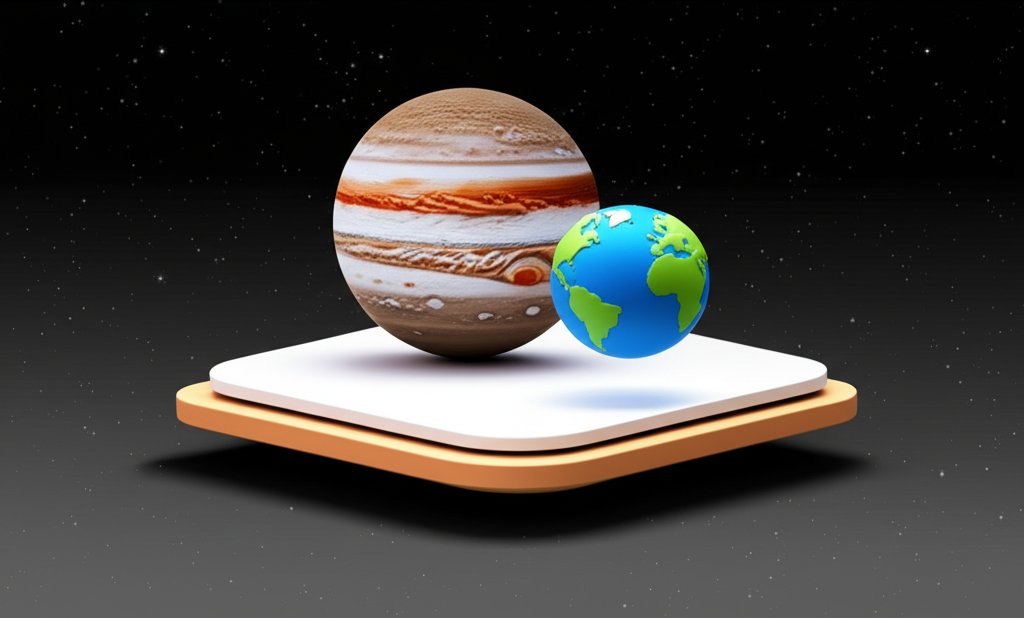
Untuk gambaran yang lebih besar dan konteks penuh, pastikan Anda membaca panduan utama kami tentang Jupiters Rotation And Orbit: A Deep Dive Into The Gas Giant.
Imagine planning a birthday party on Jupiter. You’d need to wait almost 12 Earth years for the next celebration! Understanding the difference between a Jupiter year compared to Earth’s is key to grasping the scale of our solar system and the fascinating orbital mechanics at play.
At a glance:
- A Jupiter year is equivalent to approximately 11.86 Earth years.
- Jupiter takes much longer to orbit the Sun due to its greater distance.
- This difference impacts the seasons (or lack thereof) on Jupiter.
- Understanding Jupiter’s orbital period helps us compare it to other planets, including newly discovered exoplanets.
- Planning for future space missions requires accounting for the length of a Jupiter year.
Why Does Jupiter’s Year Last So Long?
The primary reason a Jupiter year is so lengthy boils down to two factors: distance and orbital mechanics. Jupiter is much further from the Sun than Earth. Its mean distance is 778 million kilometers, while Earth’s is a mere 150 million kilometers. This vast distance directly impacts the length of its orbital path.
Think of it like running a race. If you’re on the inside track (Earth), you complete the loop much faster than someone on the outer track (Jupiter). Kepler’s Third Law of Planetary Motion dictates that a planet’s orbital period (the length of its year) is directly related to the size of its orbit.
Secondly, gravitational forces come into play. While the Sun’s gravity keeps Jupiter in orbit, the planet’s distance means the gravitational pull is weaker compared to Earth. Slower orbital speed combined with a longer path results directly in a longer year.
Jupiter’s Year vs. Earth’s: A Side-by-Side Comparison
| Feature | Earth | Jupiter |
|---|---|---|
| Orbital Period | 365.25 days (1 Earth year) | 4,332.59 days (11.86 Earth years) |
| Distance from Sun | ~150 million kilometers | ~778 million kilometers |
| Orbital Speed | ~29.8 km/s | ~13.1 km/s |
| This table underscores the considerable differences between the two planets. Jupiter’s slower speed and greater orbital distance account for the massive disparity in year length. |
The Impact of a Long Year: Seasons (or Lack Thereof)
Earth experiences distinct seasons because its axis is tilted at approximately 23.5 degrees relative to its orbital plane. This tilt causes different hemispheres to receive varying amounts of sunlight throughout the year. But you won’t be needing your winter coat on Jupiter. Explore Jupiter’s Rotation & Orbit to learn more about its features.
Jupiter, however, has a very small axial tilt of only 3.13 degrees. This minimal tilt means that Jupiter experiences virtually no seasonal changes. The amount of sunlight received at different latitudes remains relatively constant throughout its long year.
Jupiter’s Year in the Context of Exoplanets
The discovery of exoplanets, planets orbiting stars other than our Sun, has further highlighted the range of “year” lengths possible in the universe. Some exoplanets, like the ultrahot Jupiter TOI-2109b, complete an orbit in a matter of hours. Its “year” lasts only 16 hours as research has found. This extreme example showcases the diversity of planetary systems and the factors influencing orbital periods.
Planning Space Missions: Year Length Matters
When planning missions to Jupiter, scientists must carefully consider the length of a Jupiter year. Mission timelines, data collection periods, and even the positioning of spacecraft relative to Jupiter and Earth are all affected.
For example, the Juno mission, currently orbiting Jupiter, has a multi-year mission to study Jupiter’s atmosphere, magnetic field, and internal structure. The mission duration is planned with Jupiter’s orbital period in mind, to allow for comprehensive data gathering across multiple Jovian “seasons” (though, as we know, the seasonal changes are minimal).
Practical Playbook: Thinking in Jupiter Years
Here are some simple ways to conceptualize the length of a Jupiter year:
- Relate it to Human Milestones: A child born on Earth would be nearly 12 years old before Jupiter completes a single orbit. Think of all the changes and growth that occur in a human life over that period.
- Consider Geological Time: While 12 Earth years is a significant amount of time for humans, it’s a blink of an eye on a geological timescale. Jupiter’s slow orbit highlights the vastness of cosmic time.
- Use Visual Aids: Online tools that simulate planetary orbits can provide a visual representation of the relative speeds of Earth and Jupiter. These visualizations make the difference in orbital periods more tangible.
Quick Answers: Common Questions About Jupiter’s Year
Q: Is a day on Jupiter also longer than a day on Earth?
A: No, quite the opposite! Jupiter has the fastest rotation in the solar system. A day on Jupiter is only about 10 Earth hours long. Its year is long, but its days are short.
Q: Does the length of Jupiter’s year affect its weather patterns?
A: Yes, although Jupiter doesn’t have seasons in the same way Earth does, the length of its year influences long-term atmospheric circulation and the stability of features like the Great Red Spot.
Q: Could humans ever live through a full Jupiter year?
A: While technically possible with current lifespans, living through a full Jupiter year would be a significant undertaking! The lack of a solid surface, extreme temperatures, and intense radiation would pose major challenges for long-term human habitation.
Actionable Close: A Cosmic Perspective
Understanding the length of a Jupiter year compared to Earth’s isn’t just about memorizing a number. It’s about gaining a deeper appreciation for the scale of our solar system and the diversity of planetary environments. It allows us to appreciate how incredibly unique our own planet is in the context of the cosmos and helps us plan for future exploration of the outer planets. By understanding these fundamental differences, we expand our understanding of planetary science and our place in the universe.