
Ever wonder how your day compares to a day on another planet? On Jupiter, you’d barely have time to finish your morning coffee before the sun starts thinking about setting again. The speed at which Jupiter spins is truly remarkable, resulting in a surprisingly short day.
At a glance:
- Discover why Jupiter’s “day” is so short compared to Earth’s and other planets.
- Understand how Jupiter’s rotation affects its shape and atmosphere.
- Learn about the challenges in defining a precise “day” for a gas giant.
- Explore the implications of Jupiter’s rapid rotation on its magnetic field and weather patterns.
- Get quick answers to common questions about Jupiter’s rotation.
Why Jupiter’s Day Flies By
Jupiter boasts the shortest day in our solar system among planets. How long is a day on Jupiter, exactly? It clocks in at approximately 9 hours and 55 minutes. Compare that to Earth’s leisurely 24 hours, and you can see why it’s a gas giant in a hurry. This rapid spin is a fundamental characteristic that shapes much of what we observe about this massive planet. Its fast rotation is due to the conservation of angular momentum from its formation, spinning faster as the initial cloud of gas and dust collapsed to form the planet.
The Consequences of a Speedy Spin
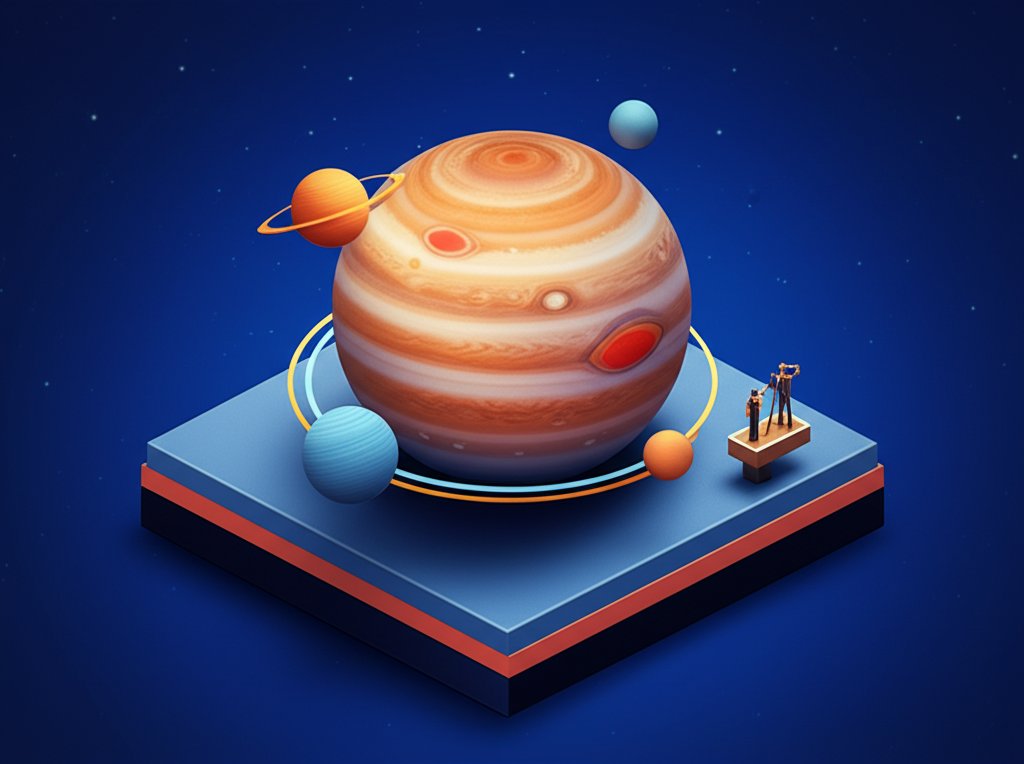
Jupiter’s rapid rotation isn’t just a fun fact; it has profound effects on the planet’s shape, atmosphere, and even its magnetic field.
A Bulging Planet
One immediate consequence of Jupiter’s fast spin is its oblate shape. Unlike Earth, which is nearly spherical, Jupiter bulges noticeably at its equator. This equatorial diameter is significantly larger than its polar diameter. The centrifugal force caused by the planet’s rotation flattens it at the poles and causes it to expand at the equator.
A Whirlwind Atmosphere
Jupiter’s atmosphere is characterized by distinct bands of clouds, known as zones and belts. These are created by strong east-west winds called jet streams, which are themselves driven by the planet’s rapid rotation. The Coriolis effect, a consequence of the rotation, deflects these winds, creating the banded structure we see.
A Mighty Magnetic Field
Jupiter possesses the largest and most powerful planetary magnetic field in the solar system. This magnetic field is generated by the motion of liquid metallic hydrogen within the planet’s interior, and the rapid rotation amplifies its strength. The magnetic field traps charged particles, creating intense radiation belts.
Defining Jupiter’s “Day”: A Tricky Task
Given Jupiter’s gaseous nature, defining a precise rotational period – and therefore “how long is a day on Jupiter” – presents a challenge. There’s no solid surface to use as a fixed reference point. Therefore, scientists use different methods to measure rotation, each with its own nuances.
System I, II, and III Rotational Periods:
To account for differences in rotation at different latitudes, astronomers have defined three “systems” to measure Jupiter’s rotation:
- System I: Applies to the equatorial region (between latitudes 10°N and 10°S). Its period is about 9 hours, 50 minutes, and 30 seconds.
- System II: Applies to latitudes north and south of the System I zone. Its period is about 9 hours, 55 minutes, and 41 seconds.
- System III: This system is based on radio emissions from the planet’s magnetosphere and is considered to represent the rotation of Jupiter’s interior. Its period is about 9 hours, 55 minutes, and 29.7 seconds. This is the value most often cited as Jupiter’s “day” length.
This is similar to how Earth has sidereal and solar days, each measuring slightly different phenomena.
Tracking Features
Another method involves tracking the movement of specific features in Jupiter’s atmosphere, such as the Great Red Spot or smaller storms. This can provide valuable information about atmospheric dynamics. However, these features aren’t fixed and drift over time, making them unreliable for long-term rotational measurements.
Jupiter’s Rotation: A Playbook for Understanding

Want to impress your friends with your knowledge of Jupiter’s rotation? Here’s your playbook:
- Remember the Numbers: Jupiter’s System III rotation period is approximately 9 hours and 55 minutes. This is the closest we get to a standard “day” on Jupiter.
- Explain the Oblateness: Show how Jupiter’s rapid spin causes it to bulge at the equator. You can calculate the oblateness using the formula: (Equatorial diameter – Polar diameter) / Equatorial diameter.
- Discuss the Zones and Belts: Explain how Jupiter’s rotation drives the strong jet streams that create the banded structure of its atmosphere.
- Mention the Magnetic Field: Highlight the link between Jupiter’s rapid rotation and its powerful magnetic field.
To gain a more detailed understanding of the broader system including Jupiter’s path around the Sun, Explore Jupiter’s Rotation and Orbit.
Quick Answers About Jupiter’s Day
Here are answers to common questions about how long is a day on Jupiter:
Q: Why doesn’t Jupiter have a solid surface?
A: Jupiter is a gas giant, primarily composed of hydrogen and helium. The pressure and temperature increase dramatically with depth, eventually turning the hydrogen into a metallic liquid, but there’s no distinct solid surface like Earth’s.
Q: Could you stand on Jupiter if it did have a surface?
A: No. Even if Jupiter had a solid surface, the immense gravity (more than 2.4 times Earth’s) and crushing atmospheric pressure would make it impossible for a human to survive.
Q: Does Jupiter’s rotation speed change?
A: While the overall rotation rate is relatively constant, the speeds of different atmospheric features can vary. That’s why there are different “systems” used to measure its rotation.
Q: How does Jupiter’s short day affect its weather?
A: Jupiter’s rapid rotation is a major driver of its intense weather patterns, including the powerful jet streams and massive storms like the Great Red Spot.
Your Next Step: Dive Deeper
Understanding how long is a day on Jupiter opens a window into understanding the complex dynamics of this fascinating gas giant. From its shape and atmosphere to its magnetic field, Jupiter’s rapid rotation plays a crucial role. Take what you’ve learned here and use it as a springboard to explore other aspects of this intriguing planet.










