Ask a friend, a family member, or even a stranger on the street, “what is the United States birthday?” and you’ll almost certainly get a confident, one-word answer: “July 4th.” While that’s the day we celebrate with fireworks and barbecues, the real story of America’s beginning is far more layered. The date you choose as the nation’s true birthday reveals a lot about whether you’re defining a country by its ideals, its laws, or its cultural origins.
Digging into this question isn’t just an academic exercise. It helps clarify the very nature of the American experiment—an ongoing project with multiple, valid starting points.
At a Glance: Pinpointing America’s Birthday
Here’s what you need to know to navigate the debate around the U.S. birthday:
- The Ideological Birthday (1776): July 4, 1776, is the most accepted date because it marks the adoption of the Declaration of Independence—the moment the idea of America was born.
- The Governmental Birthday (1788): The U.S. Constitution was ratified on June 21, 1788, creating the actual framework for the federal government that exists today. This is the nation’s legal birthday.
- The First Union (1781): The Articles of Confederation were ratified on March 1, 1781, representing the first, albeit flawed, attempt to legally bind the 13 states into a single entity.
- The Colonial Seed (1607): The founding of Jamestown, Virginia, marks the beginning of the continuous English-speaking settlement that would ultimately shape the culture and institutions of the United States.
- A Deeper Context: Acknowledging the thousands of years of Indigenous history before European arrival is crucial for a complete understanding of the land’s story.
The Official Answer: Why We All Celebrate July 4th
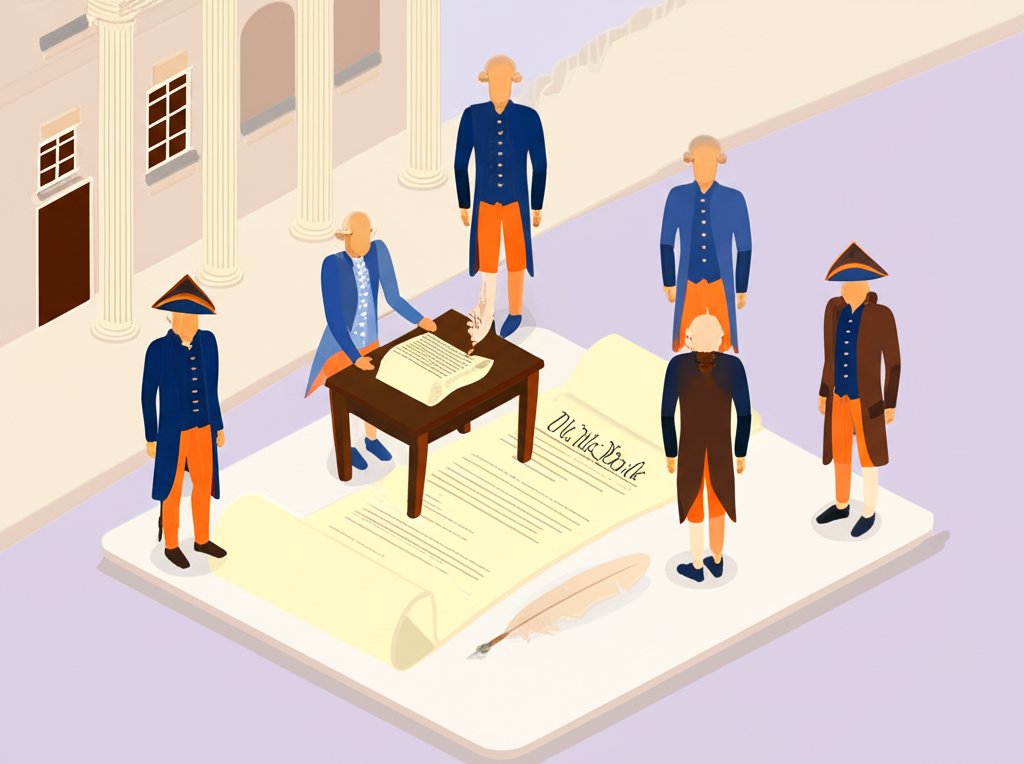
When we celebrate on the Fourth of July, we’re celebrating the moment the Second Continental Congress formally adopted the Declaration of Independence. This document was, in essence, a revolutionary mission statement. It was a bold, public announcement to King George III and the world that the 13 colonies no longer considered themselves British subjects but a new, independent nation.
Interestingly, John Adams, a key figure in the push for independence, believed a different day would be remembered. He wrote to his wife Abigail that July 2, 1776—the day Congress actually voted to declare independence—would be “the most memorable Epocha, in the History of America.”
So why July 4th? That’s the date the final wording of the Declaration was approved and sent to the printer. It became the date emblazoned at the top of the distributed copies, cementing it in the public mind. Choosing 1776 as the birthday means we prioritize the birth of the American ideal—the principles of liberty and self-governance—over the practical, messy work of forming a government that would come later.
The Contenders: Four Other Dates That Could Be America’s Birthday
While July 4th holds the title, a strong case can be made for several other “birthdays,” each marking a different, critical phase in the nation’s formation. Understanding these alternatives gives a much clearer picture of how the U.S. evolved from an idea into a functioning country. The journey from a declaration to a durable government is complex; for a high-level view of how these milestones factor into the nation’s age, you can Unravel US’s complicated age.
The Governmental Birth: 1788 and the Constitution
If a nation is defined by its system of law, then the United States wasn’t truly born until June 21, 1788. On this day, New Hampshire became the ninth of the 13 states to ratify the U.S. Constitution, meeting the threshold required to make it the law of the land.
- The Argument: The Declaration was a promise, but the Constitution was the operating manual. It created the three branches of government, established the system of checks and balances, and forged a “more perfect Union” that could actually function. Without the Constitution, the United States as we know it would not exist.
- Case Snippet: A constitutional lawyer arguing a case before the Supreme Court would almost certainly trace the legal authority of the federal government back to the ratification in 1788, not the philosophical statement of 1776. For legal purposes, 1788 is the foundational year. The new federal government officially commenced operations on March 4, 1789.
The First Union: 1781 and the Articles of Confederation
Before the Constitution, there was the Articles of Confederation. Ratified on March 1, 1781, this document was the first governing charter of the United States. It officially united the states under one name and gave a central government the power to declare war and manage foreign affairs.
- The Argument: This was the first legal framework that brought the 13 sovereign states together as “The United States of America.” It represented the transition from a loose wartime alliance to a formal confederacy. Though weak and ultimately replaced, it was the nation’s first attempt at self-government.
- Why It’s Overlooked: The government under the Articles was notoriously ineffective. It couldn’t levy taxes, regulate commerce, or enforce its own laws, leading to crises like Shays’ Rebellion and proving the need for a stronger central government.
The Colonial Seed: 1607 and Jamestown
To understand the cultural DNA of the United States, some historians argue you must go back much further, to the founding of the first permanent English settlement at Jamestown, Virginia, in 1607.
- The Argument: This date marks the beginning of the 169-year colonial period during which the language, legal traditions, and economic systems that would define the future United States took root. It was the start of a continuous English-speaking presence on the continent that grew into the 13 colonies.
- Context: Choosing 1607 as a starting point frames the U.S. as the culmination of a long colonial project rather than a sudden revolutionary birth. This perspective is central to initiatives like The New York Times’ 1619 Project, which instead centers the arrival of the first enslaved Africans in Virginia as the nation’s true founding.
The Nation Reborn: 1865 and the End of the Civil War
A more provocative argument suggests the United States had a second birthday in 1865 with the end of the Civil War and the passage of the Reconstruction Amendments.
- The Argument: The Civil War was the ultimate test of whether the nation conceived in 1776 could survive. The Union victory and the subsequent abolition of slavery (13th Amendment), along with the establishment of birthright citizenship and equal protection (14th Amendment), fundamentally remade the country. In his Gettysburg Address, Abraham Lincoln spoke of a “new birth of freedom,” suggesting a national rebirth.
- Significance: This perspective sees the original founding as incomplete and flawed by the institution of slavery. The “second founding” in 1865 corrected this original sin and set the nation on a new path toward fulfilling the promises of the Declaration of Independence for all its citizens.
A Practical Framework: Choosing the Right “Birthday” for the Conversation
The “correct” birthday is entirely dependent on the context of your discussion. Are you talking about ideals, laws, or culture? Use this table as a guide.
| If You’re Discussing… | The Best “Birthday” to Use Is… | Because… |
|---|---|---|
| National Identity & Values | July 4, 1776 | It marks the birth of the American ideal and the aspirational principles of liberty and equality. |
| Legal & Constitutional Law | June 21, 1788 | It’s the date the current system of government was legally established and became operational. |
| International Diplomacy | September 3, 1783 | The Treaty of Paris was signed, marking Great Britain’s formal recognition of U.S. independence. |
| Cultural & Social History | May 14, 1607 | It represents the start of the English colonial project that deeply shaped American culture and institutions. |
| Indigenous History | Pre-1492 | It acknowledges the thousands of years of civilization that existed before European arrival, reframing the question entirely. |
Beyond Eurocentric Timelines: Acknowledging a Deeper Past
It’s vital to recognize that the question “what is the United States birthday?” is itself framed from a Eurocentric perspective. The land on which the United States was formed was inhabited for thousands of years before the first Europeans arrived.
Scientific estimates suggest the first peoples arrived in North America between 15,000 and 40,000 years ago. By the time of European contact, the continent was home to countless complex societies with sophisticated systems of government, trade, and culture. The Iroquois Confederacy, for instance, operated under a constitution known as the Great Law of Peace, which some historians believe influenced Benjamin Franklin and other Founders.
Acknowledging this deep history doesn’t erase the significance of 1776 or 1788. Instead, it places the founding of the United States within a much longer historical timeline, reminding us that the nation’s story didn’t begin with a ship from Europe but is one chapter in a much older book.
Quick Answers to Common Questions
Q: So, what is the United States birthday in simple terms?
A: July 4, 1776. This is the universally celebrated date, marking the day the Declaration of Independence was adopted. Think of it as America’s ideological birthday—the day its core principles were announced to the world.
Q: Was the USA an actual country on July 4, 1776?
A: Not in the way we think of it today. It was a declaration of intent by 13 colonies to become a new country. The Revolutionary War was still being fought to win that independence, and a formal, functioning national government wouldn’t be established for more than a decade.
Q: How old will the US be in 2026?
A: Based on the 1776 date, the US will celebrate its 250th birthday, known as the Semiquincentennial, on July 4, 2026. This major milestone will be marked by celebrations across the country.
Q: Why don’t we celebrate the day the Constitution was signed as the birthday?
A: While the Constitution (ratified 1788) created the government we have now, the Declaration (1776) represents the birth of the nation’s spirit and its dramatic break from British rule. We celebrate the revolutionary act and the bold ideals of freedom, which feel more like a “birth” than the technical process of forming a government.
Ultimately, the answer to “what is the United States birthday?” depends entirely on what you’re really asking. Are you interested in the birth of an idea, the creation of a legal system, the start of a cultural project, or the rebirth of a nation?
The popular celebration of July 4, 1776, honors the powerful ideals that sparked a revolution. But acknowledging the other key dates—1607, 1781, 1788, and even 1865—doesn’t diminish the Fourth of July. It enriches our understanding, revealing how a revolutionary idea evolved through conflict and compromise into the complex, enduring nation we know today.










