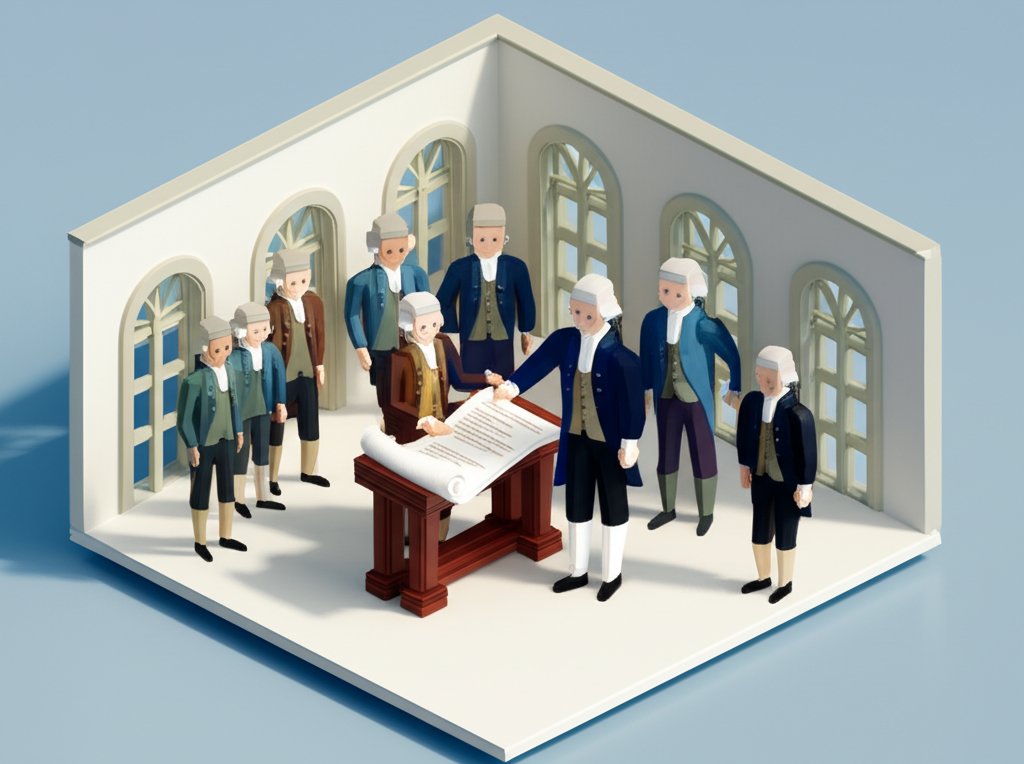
It’s an image burned into the American consciousness, a scene so monumental it graces the back of the two-dollar bill. A room of powdered wigs, buckled shoes, and solemn purpose. Yet, the famous John Trumbull Declaration of Independence painting is one of the most misunderstood works of art in our nation’s history. It’s not the glorious signing on July 4th, as millions assume.
Instead, it’s a carefully constructed masterpiece of historical memory, a brilliant fabrication that prioritizes people over a single moment in time. Trumbull, a veteran of the Revolutionary War and an artist with a purpose, wasn’t trying to be a photojournalist. He was building a monument on canvas, and in doing so, he shaped how generations of Americans would envision the birth of their country.
At a Glance: What You Really See in Trumbull’s Painting
Before we dive deep, let’s clear up the biggest misconceptions. Here’s the truth behind the iconic canvas:
- The Event: The painting depicts the presentation of the draft of the Declaration on June 28, 1776, not the official signing.
- The Main Action: The Committee of Five—Thomas Jefferson, John Adams, Benjamin Franklin, Roger Sherman, and Robert Livingston—is shown presenting their work to John Hancock, the President of the Continental Congress.
- The Artist’s Goal: John Trumbull’s stated purpose was not historical accuracy but to “preserve the likenesses of the men who were the authors of this memorable act.” It’s a group portrait, not a snapshot.
- The People: The scene is a composite. It includes 47 figures, but many were not present on June 28. Some who signed the final document are missing, while others who didn’t sign are included.
- The Setting: The room itself is an artistic interpretation, featuring elegant furniture Trumbull added and architectural details based on a flawed sketch Thomas Jefferson drew from memory years later.
More Than a Painting: A National Memory Forged in Oil
To understand Trumbull’s work, you have to understand the difference between history and memory. History is a record of what happened; memory is how we choose to feel about it. Trumbull’s painting is pure, distilled national memory. Commissioned by the U.S. Congress in 1817, the massive 12-by-18-foot version that hangs in the Capitol Rotunda was a post-War of 1812 effort to solidify a heroic, unified origin story for a still-young nation.
It was based on a much smaller version Trumbull began in 1786, turning the project into a lifelong obsession.
The Moment in Time: June 28, Not July 4
The common belief is that the painting captures the dramatic signing on the Fourth of July. The reality is far more procedural, yet just as important. The central focus is on Thomas Jefferson, the tall, red-headed Virginian, presenting the first draft of the Declaration to John Hancock, who is seated at the president’s desk.
This moment on June 28, 1776, kicked off the final debates. The historical timeline actually went like this:
- June 7: Richard Henry Lee of Virginia introduces a resolution for independence.
- June 11-28: The Committee of Five drafts the Declaration.
- June 28: The committee presents the draft to Congress, the scene Trumbull painted.
- July 2: Congress officially votes for independence, the true “birthday” of the resolution.
- July 4: Congress formally adopts the final text of the Declaration of Independence.
- August 2: Most delegates sign the official, engrossed parchment copy of the document.
Trumbull chose the presentation of the draft because it was the moment the idea was made tangible—when the words that would define a nation were first laid on the table for all to see.
Trumbull’s Vision: To “Preserve the Likenesses” of a Generation

John Trumbull wasn’t just an artist; he was a participant in the Revolution, having served as an aide-de-camp to General George Washington. He knew these men, and he felt a profound duty to immortalize them. He explicitly stated that his primary goal was not to document one day but to capture the faces of the individuals responsible for this pivotal act.
A 30-Year Quest for Faces
This goal sent Trumbull on an incredible, decades-long journey. He was a man with a checklist, determined to paint as many of the figures from life as possible. Of the 47 portraits in the final piece:
- 36 were painted from life: Trumbull traveled across the United States and to London and Paris, setting up his easel in front of aging revolutionaries. He painted John Adams in London and Thomas Jefferson in Paris.
- 9 were copied from other portraits: For those who had already passed away, he hunted down existing paintings by artists like Charles Willson Peale.
- 1 was painted from memory.
- 1 was based on a verbal description.
This painstaking process underscores his commitment. He wasn’t just imagining faces; he was curating a definitive gallery of the nation’s founders, a task that took more than 30 years to complete for his original, smaller version.
A Curated Guest List
Because Trumbull’s painting was a commemorative group portrait, he took liberties with the attendance list. He assembled his “team of rivals” and allies in one room, regardless of whether they were actually there on June 28.
His selection reveals his narrative intent. He included 42 of the 56 men who would eventually sign the Declaration. But he also added five prominent patriots who did not sign, most notably John Dickinson of Pennsylvania. Dickinson was a principled opponent of declaring independence at that time, believing the colonies needed foreign alliances first. By including him, Trumbull showed that the decision was not unanimous but the result of serious, high-minded debate. This was an artistic choice to represent the gravity of the moment and the diversity of opinion.
The “Historical Inaccuracies” That Serve a Higher Truth
Critics often point to the painting’s historical inaccuracies as flaws. But for Trumbull, these weren’t mistakes; they were enhancements designed to elevate the scene from a cluttered political meeting to a moment of neoclassical grandeur. He was crafting a civil religion, and his work was to be its first sacred text.
An Assembly Hall Reimagined
The real Assembly Room in Philadelphia’s Independence Hall was a more modest space. Trumbull’s version is more dramatic and opulent.
- Architecture: The soaring, arch-windowed room was based on a sketch Thomas Jefferson drew from memory while in Paris—a memory that proved faulty.
- Furniture: Jefferson also advised Trumbull on the furniture. The chairs and tables are far more elegant than the simple Windsor chairs the delegates actually used.
- Flags: The back wall is famously adorned with captured British military flags. These banners were not in the room in 1776. Trumbull added them as symbolic trophies, a visual reminder of the war being fought and the high stakes of the delegates’ actions.
Every detail in Trumbulls Declaration painting was a deliberate choice to imbue the scene with a sense of destiny and victory.
Who’s In and Who’s Out? A Closer Look at the Figures
The composition of the painting is masterfully organized to guide the viewer’s eye. Here’s a breakdown of the key players:
| Figure(s) | Role & Position | Note |
|---|---|---|
| Thomas Jefferson | Primary Author | The tall, central figure presenting the document. |
| John Adams | Committee Member | Standing next to Jefferson, hand on hip. |
| Benjamin Franklin | Committee Member | Seated to Jefferson’s left, looking on thoughtfully. |
| Roger Sherman | Committee Member | Standing between Adams and Franklin. |
| Robert Livingston | Committee Member | Standing behind Jefferson, completing the Committee of Five. |
| John Hancock | President of Congress | Seated at the desk, receiving the document. |
| While the Committee of Five stands front and center, the rest of the room is filled with recognizable faces, from the fiery Samuel Adams to the wealthy Charles Carroll of Carrollton. It’s a who’s who of the revolutionary elite, assembled for their eternal portrait. |
The Making of an American Icon
Today, Trumbull’s painting is ubiquitous, but its journey from a private project to a national symbol was a long one.
Two Canvases, One Vision
The painting most people know is the monumental version in the U.S. Capitol Rotunda. But its soul lies in the smaller, more intimate original (roughly 21 by 31 inches) that Trumbull began in 1786. He worked on this personal version for decades, carrying it with him on his travels to capture the life portraits. After receiving the congressional commission in 1817, he used this small painting as the definitive model for the large-scale mural, which he completed in 1818 and saw installed in 1826.
How a Painting Became Famous
A painting hanging in the Capitol is prestigious, but it isn’t easily accessible to the public. The image truly entered the American mainstream thanks to technology: the engraver’s burin.
In 1820, Trumbull commissioned artist Asher B. Durand to create a high-quality engraving of the painting. The resulting prints were sold by subscription across the country, allowing middle-class Americans to own a copy of this grand national scene. It was this mass distribution that cemented Trumbull’s vision as the canonical depiction of the nation’s founding.
From there, its legacy was secured. It was chosen for the reverse of the $2 bill in 1976 for the nation’s bicentennial. It has appeared on numerous U.S. postage stamps. When you explore the iconic painting, you are looking at a piece of art that has transcended its canvas to become a cultural touchstone.
Common Questions About Trumbull’s “Declaration”
Even with the facts laid out, the painting’s power and familiarity generate a lot of questions. Here are crisp answers to the most common ones.
Is this the signing of the Declaration of Independence?
No. It depicts the moment on June 28, 1776, when the drafting committee presented the document to the Congress. The actual signing of the final version was a rolling process, with most signatures added on August 2, 1776.
Was everyone in the painting actually in the room on that day?
Absolutely not. Trumbull created a “composite” scene, bringing together 47 key figures he wanted to honor, regardless of whether they were present for that specific event. Think of it as an all-star cast photo rather than a candid shot.
Why did Trumbull include people who didn’t sign it?
He wanted to represent the full story of the debate over independence. By including influential figures like John Dickinson, who argued against the timing of the Declaration, Trumbull added intellectual and political depth to the scene, showing that independence was a contested, hard-won idea.
Where can I see the original painting?
There are two primary “original” versions. The small canvas that Trumbull worked on from 1786 is housed at the Yale University Art Gallery. The huge, 12-by-18-foot version commissioned by Congress is on permanent public display in the Rotunda of the U.S. Capitol in Washington, D.C.
Beyond the Frame: What Trumbull’s Masterpiece Teaches Us
John Trumbull’s Declaration of Independence is not a photograph, and we do it a disservice by judging it as one. It is a work of historical myth-making, designed to inspire a sense of shared heritage and national pride. It collapses weeks of debate, doubt, and division into a single, unified image of solemn purpose.
The painting teaches us that how we remember our past is as important as the past itself. Trumbull’s “inaccuracies” were intentional choices meant to convey a deeper truth about the gravity of the American experiment and the character of the men who led it.
He gave a messy, complicated, and fractious political process a face—or rather, 47 faces. By freezing them in that hallowed room, he created an accessible, powerful story of consensus and courage. It’s a story that continues to shape our understanding of who we are and what it means to be a nation founded on a declaration.










