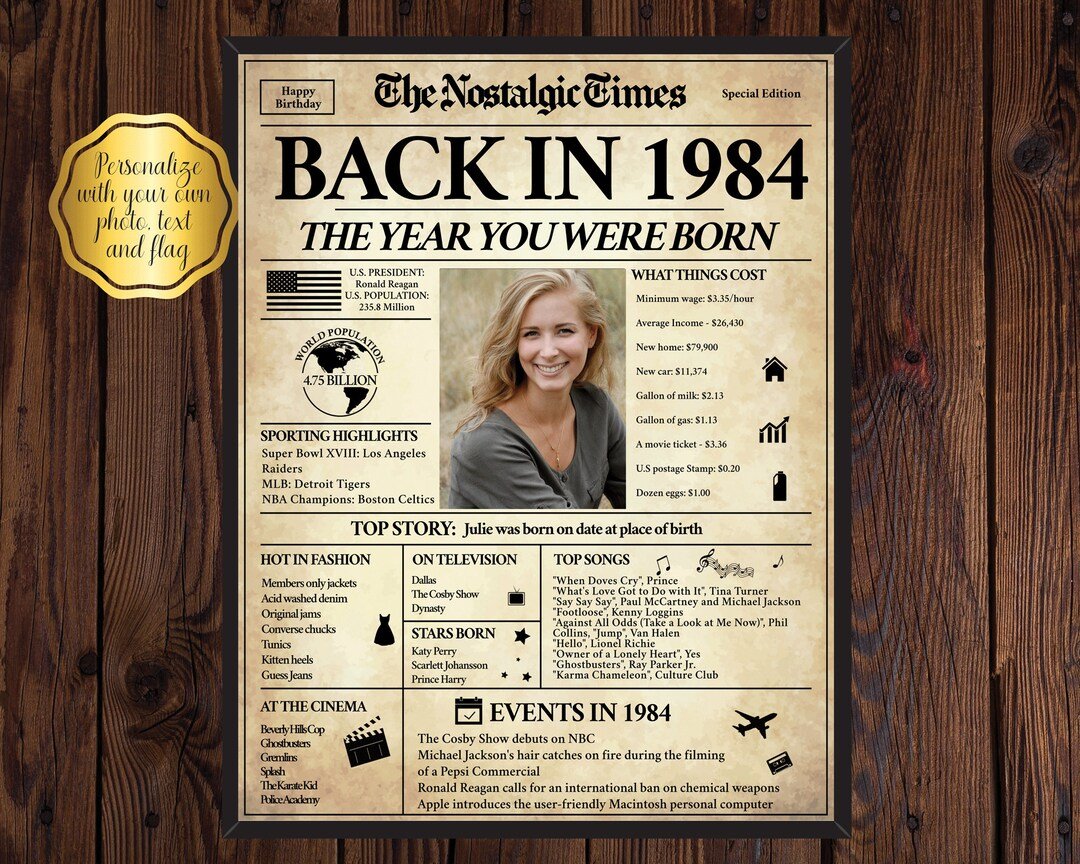
When trying to understand what happened in 1984 USA, you’re looking at a year of profound contrasts. On one hand, the country embraced a confident, optimistic narrative of “Morning in America,” overwhelmingly re-electing Ronald Reagan. On the other, a different kind of revolution was brewing in Silicon Valley, one that promised to put world-changing power not in the hands of governments, but individuals. These two forces—a conservative political mandate and a disruptive technological boom—collided and converged, setting the stage for the modern world.
This wasn’t just a year of headlines; it was a year of fundamental shifts. The decisions made in Washington D.C. and the products launched from Cupertino, California, created ripples that directly influence how we work, communicate, and engage with our economy today.
At a Glance: Key Shifts in 1984
- Political Mandate Solidified: Ronald Reagan won a historic landslide re-election, validating his “Reaganomics” platform of deregulation and supply-side economics.
- The Personal Computer for the Rest of Us: Apple launched the Macintosh, making computing accessible and intuitive with its graphical user interface (GUI) and mouse, forever changing our relationship with technology.
- Economic Crosscurrents: The economy was growing, but this growth came with rising income inequality and the quiet beginnings of the Savings and Loan (S&L) crisis, a direct result of recent deregulation.
- A New Media Landscape: The Supreme Court’s “Betamax” ruling legalized home video recording, while the first commercial cell phone networks appeared, planting the seeds for our on-demand, always-connected culture.
- Historic Firsts: Walter Mondale selected Geraldine Ferraro as his running mate, the first woman nominated for Vice President by a major party, marking a critical milestone in American politics.
“Morning in America”: The Overwhelming Re-election of Ronald Reagan
In 1984, the political landscape was dominated by one theme: Ronald Reagan’s optimism. His campaign slogan, “Morning in America,” perfectly captured the national mood of economic recovery and renewed patriotism after the turbulence of the 1970s. The results of the November presidential election were not just a victory but a political realignment.
Reagan and his running mate, George H.W. Bush, defeated Democratic challengers Walter Mondale and Geraldine Ferraro in a historic landslide. They secured 49 of 50 states, earning an astonishing 525 electoral votes to Mondale’s 13. This wasn’t just a win; it was a massive public endorsement of the president’s first-term policies.
While Mondale’s campaign made history by nominating Geraldine Ferraro, the first female vice-presidential candidate from a major party, it struggled to gain traction. Mondale’s promise to raise taxes to address the growing budget deficit was politically unpopular against Reagan’s message of prosperity. The election solidified the conservative ascendancy that would define the rest of the decade. For a deeper look at how these political shifts fit into the global context, you can Explore 1984’s converging forces.
The Engine of Reaganomics: Growth, Debt, and a Brewing Crisis
The economic story of 1984 is a tale of two realities. On the surface, “Reaganomics”—a policy mix of tax cuts, reduced government spending on social programs, and significant deregulation—was working. The country was experiencing robust economic growth, and inflation, the great enemy of the late 1970s, had been tamed. Median family income stood at $26,430, and consumer confidence was high.
However, beneath the surface, structural issues were developing:
- Deregulation’s Double Edge: The deregulation of the financial industry, particularly the Savings and Loan (S&L) sector in the early 1980s, had unintended consequences. By 1984, S&Ls were making increasingly risky, speculative investments. This set the stage for the massive S&L crisis that would explode later in the decade, costing taxpayers billions.
- Rising National Debt: While social spending was cut, military spending increased dramatically as part of Reagan’s Cold War strategy. Combined with significant tax cuts, this led to a ballooning national debt, a problem that would persist for decades.
- Widening Inequality: The economic recovery was not evenly distributed. The benefits of Reaganomics tended to flow to the wealthiest Americans, and 1984 saw a continued widening of the gap between the rich and the poor.
This economic environment created a sense of boundless opportunity for some, while leaving others feeling left behind—a tension that defined much of the era.
The Revolution in a Beige Box: Apple Launches the Macintosh
While Washington celebrated a conservative victory, a different kind of revolution was unveiled on January 24, 1984. Apple Computer introduced the Macintosh. It wasn’t the first personal computer, but it was the first one that felt personal. It was designed not for hobbyists or programmers, but for everyone.
The Mac’s launch, famously heralded by a Ridley Scott-directed Super Bowl commercial depicting a lone heroine shattering a dystopian, Orwellian screen, was a direct shot at the dominance of IBM’s text-based PCs.
What Made the Macintosh a Game-Changer?
| Feature | The Old Way (IBM PC/DOS) | The Macintosh Way |
|---|---|---|
| Interface | Command-line prompts (e.g., C:\>copy file.txt A:) | Graphical User Interface (GUI) with icons, windows, and menus. |
| Input | Keyboard only for commands. | A mouse to point, click, and drag-a truly intuitive action. |
| Display | “What You See Is What You Get” (WYSIWYG). Text and graphics on screen looked like the printed result. | Monochromatic text characters on a black screen. |
| Accessibility | Required memorizing commands; steep learning curve. | Easy to learn and explore; lowered the barrier to entry for computing. |
| Priced at $2,495 (nearly $7,000 in today’s money), the Macintosh 128K wasn’t cheap, but its impact was immeasurable. It introduced the world to the desktop metaphor, the mouse, and the idea that a computer could be a tool for creativity, not just calculation. It laid the groundwork for every major operating system that followed, from Windows to iOS. |
A Nation Untethered: The Dawn of Mobile and On-Demand Culture
The tech boom of 1984 wasn’t confined to desktop computers. Two other developments began to fundamentally change how Americans communicated and consumed media, breaking the tethers of time and place.
The First Commercial Cell Phone Call
In 1984, the first commercial cellular networks, based on the analog AMPS technology, went live in the United States. The early mobile phones were bulky, incredibly expensive “car phones” or “bricks,” but they represented a monumental shift. For the first time, voice communication was possible without a physical wire. This was the birth of the mobile era, the very first step toward the smartphone in your pocket today.
The VCR and the “Betamax Case”
By 1984, the Video Cassette Recorder (VCR) was becoming a household staple. This technology gave families unprecedented control over their entertainment. You could rent movies, watch them whenever you wanted, and—most controversially—record television shows to watch later.
This practice, known as “time-shifting,” was the subject of a landmark Supreme Court case, Sony Corp. of America v. Universal City Studios, Inc., often called the “Betamax case.” The movie studios argued that recording shows was a form of copyright infringement. In a 5-4 decision in January 1984, the Court ruled that time-shifting for personal use was a “fair use” and therefore legal. This decision was a massive victory for consumers and technology companies, paving the way for everything from the DVR to streaming services.
Quick Answers to Lingering 1984 Questions
Q: Why was Reagan’s 1984 victory so massive?
A: It was a combination of a strong economic recovery, a decline in inflation, and a popular, optimistic message that resonated with a majority of voters. Walter Mondale’s campaign, which included a pledge to raise taxes, struggled to counter the “Morning in America” narrative, despite the historic nature of Geraldine Ferraro’s nomination.
Q: Was the 1984 economy truly as good as it seemed?
A: Yes and no. For many, it felt great. The GDP grew at a phenomenal rate, and unemployment was falling. However, this prosperity was built on a foundation of rapidly increasing national debt and deregulation that led to future crises like the S&L collapse. It was a period of growth, but also one of growing economic disparity.
Q: What was so special about the Macintosh if other computers already existed?
A: Its accessibility. Before the Mac, using a computer meant typing cryptic commands. The Macintosh’s graphical user interface (GUI) and mouse allowed people to interact with the computer in a visual, intuitive way. It changed the fundamental relationship between humans and machines from one of instruction to one of direct manipulation.
Q: Did Geraldine Ferraro’s nomination have a lasting impact?
A: Absolutely. While the Mondale-Ferraro ticket lost the election, her nomination shattered a major political barrier. It demonstrated that a woman could be on a major party’s presidential ticket, paving the way for future female candidates like Sarah Palin, Hillary Clinton, and Kamala Harris.
The Twin Legacies of 1984
The events of 1984 in the USA left us with two powerful, and sometimes conflicting, legacies that continue to shape our world.
Reagan’s re-election cemented a political and economic philosophy centered on deregulation, individualism, and a strong national defense. This movement reshaped the Republican party and set the terms of political debate for a generation, championing a belief that less government intervention would unleash prosperity.
Simultaneously, the technological revolution, spearheaded by the Macintosh, offered a different kind of empowerment. It was a vision of decentralized power, where creativity and information were accessible to anyone with a desktop machine. This was the dawn of the digital age, a force that would ultimately flatten hierarchies, disrupt entire industries, and connect the globe in ways few in 1984 could have imagined. These parallel tracks—one political, one technological—defined the year and created the complex, interconnected world we navigate today.










