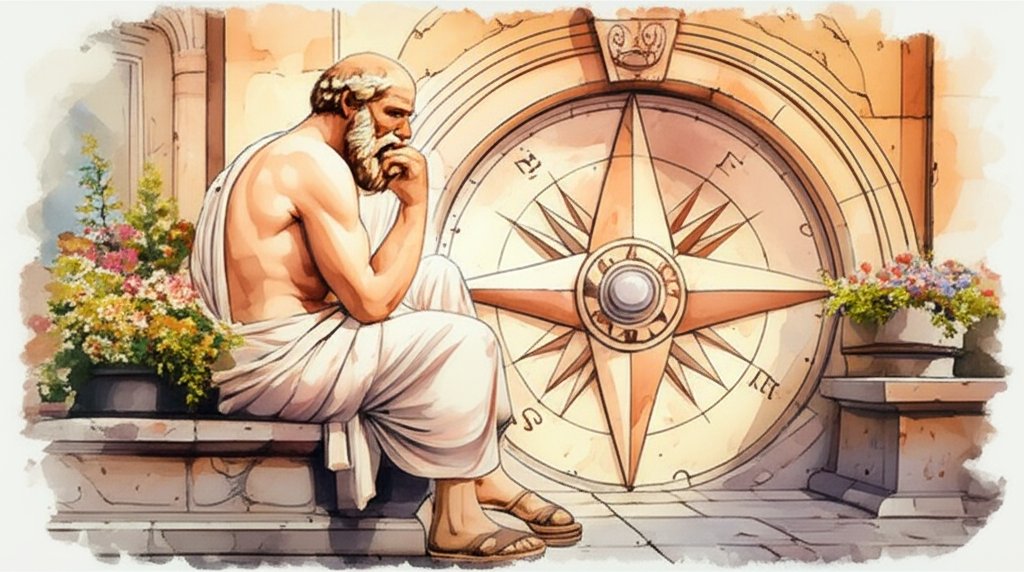
Socrates’ trial and execution are often painted as a conflict between reason and blind faith, but the real story of Socrates and religion is far more nuanced. It’s about a philosopher who outwardly respected tradition while inwardly wrestling with profound questions about morality, divinity, and the nature of goodness.
At a glance:
- Understand Socrates’ complex relationship with traditional Greek religion.
- Explore the meaning and impact of Socrates’ “divine sign” (daimonion).
- Learn how Socrates’ emphasis on self-knowledge influenced his religious views.
- Evaluate the charges of impiety brought against Socrates during his trial.
- Discover practical ways to apply Socratic questioning to your own beliefs.
Socrates’ Outward Piety: Respecting Tradition
Socrates wasn’t a firebrand openly denouncing the gods. He participated in public religious festivals and adhered to traditional practices. This outward conformity served as a shield, perhaps, but it also reflected a genuine respect for the customs of his city. However, his interpretation of these customs differed significantly from the norm.
Imagine a modern analogy: attending church services while simultaneously questioning the literal interpretation of scripture. Socrates’ actions were similar – participating in rituals while philosophically dissecting their meaning.
The Daimonion: Socrates’ Inner Voice and Moral Compass
Socrates’ most distinctive religious claim was his reliance on a “divine sign” (daimonion), a kind of inner voice or intuition that warned him against certain actions. This wasn’t a command to do something, but rather a prohibition.
What the Daimonion Was NOT:
- A positive guide: It never told him what to do, only what not to do.
- An Oracle: It wasn’t about predicting the future, but influencing his present actions.
How it Functioned:
The daimonion acted as an immediate, unwavering deterrent, preventing him from pursuing actions he believed were intrinsically immoral. Think of it as a personal ethical alarm.
Example: He might be heading down a particular street to meet someone and suddenly experience the daimonion, causing him to turn back even without knowing why the meeting would have been problematic. The moral significance was discerned retroactively.
Self-Knowledge: A More Profound Form of Worship
Socrates believed that true reverence for the gods lay not in empty rituals or sacrifices, but in the pursuit of self-knowledge. He thought that understanding oneself – one’s strengths, weaknesses, and virtues – was a higher form of worship. This is further explained in Socrates’ Beliefs and Divine Guidance.
He argued that if the gods were truly wise and good, they would value intellectual and moral progress over material offerings. In essence, striving to become a better person was the ultimate offering to the divine.
Practical Application: Apply this principle by dedicating time to self-reflection each week. Ask yourself:
- What are my core values?
- How am I living in accordance with those values?
- Where can I improve?
Socrates and the Nature of Goodness: A Divine Dilemma
Socrates grappled with a fundamental question: Is something good because the gods love it, or do the gods love it because it is inherently good? This is known as the Euthyphro dilemma, named after Socrates’ dialogue with the religious figure Euthyphro.
The Implications:
- If the gods define goodness: Morality becomes arbitrary, subject to the whims of the divine.
- If goodness exists independently: The gods are not the arbiters of morality but are themselves subject to a higher standard.
Socrates leaned towards the latter, suggesting that goodness is an objective reality, a standard to which even the gods adhere. This idea challenged the conventional view of the gods as all-powerful beings whose will alone dictated right and wrong.
The Trial: Impiety and the Corruption of Youth
Socrates’ trial was nominally about impiety and corrupting the youth, but it was also about challenging the established order. He was accused of not believing in the city’s gods and introducing new ones.
The Charges:
- Impiety: Disrespect for the traditional gods of Athens.
- Corruption of Youth: Leading young Athenians astray with his philosophical teachings.
The Reality:
His accusers likely felt threatened by his constant questioning of authority figures and his encouragement of critical thinking among the young. The daimonion was also perceived as a private, and therefore suspect, source of divine guidance.
Defense Strategy: Socrates did not beg for mercy or try to minimize his actions. He defended his philosophical mission as a service to the god Apollo, who had declared him the wisest man in Athens through the Oracle at Delphi. He argued that his questioning was intended to expose the ignorance of others and encourage them to seek true wisdom.
The Agnostic Stance: Exploring the Unknown After Death

While Socrates claimed to believe in gods during his trial, his statements about the afterlife suggest a degree of agnosticism. In Plato’s Apology, he describes death as either a state of nothingness or a journey to another world where he can continue his philosophical inquiries.
He does not fear death because he doesn’t know what awaits him. This openness to the unknown suggests a willingness to accept uncertainty, a key aspect of his philosophical approach.
Socrates’ Influence: A Legacy of Questioning
Socrates’ emphasis on reason, self-examination, and the pursuit of truth has had a profound impact on Western thought. His method of questioning, known as the Socratic method, remains a powerful tool for critical thinking and intellectual exploration.
How to Apply the Socratic Method:
- Begin with a question: Start with a simple, open-ended question about a belief or assumption.
- Seek clarifications: Ask for definitions and examples to ensure a shared understanding of terms.
- Challenge assumptions: Question the underlying assumptions that support the belief.
- Explore contradictions: Identify any inconsistencies or contradictions in the person’s reasoning.
- Reach a deeper understanding: Guide the person towards a more nuanced and informed perspective.
Example:
- Question: Is happiness the ultimate goal in life?
- Clarification: What do you mean by “happiness”?
- Assumption: Is it always good to pursue happiness, even if it harms others?
- Contradiction: Can someone be truly happy if they are causing suffering to others?
- Deeper Understanding: Perhaps happiness is not the ultimate goal, but rather a byproduct of living a virtuous and meaningful life.
Socrates and Religion: Quick Answers
Q: Was Socrates an atheist?
A: Not in the modern sense. He participated in religious rituals and spoke of gods, but his interpretations of these concepts were unconventional and often challenged traditional beliefs. He may have been more accurately described as agnostic, or at least unorthodox in his views on the divine.
Q: What was the purpose of Socrates’ daimonion?
A: It served as a personal moral compass, preventing him from taking actions he believed were wrong. It wasn’t about divination or predicting the future, but about guiding his present behavior.
Q: Did Socrates believe in the immortality of the soul?
A: He presented arguments for the immortality of the soul in Plato’s Phaedo, but it’s unclear whether he truly believed them or was simply exploring philosophical possibilities. His statements about the afterlife suggest a degree of uncertainty.
Q: How did Socrates’ views on religion contribute to his trial and execution?
A: His unconventional views on the gods, his questioning of authority, and his reliance on the daimonion were all perceived as threats to the established order. He was accused of impiety and corrupting the youth, charges that ultimately led to his death.
Actionable Close: Question, Reflect, and Live Ethically
Socrates’ legacy is not about providing definitive answers, but about encouraging us to ask questions, examine our beliefs, and live in accordance with our values. Embrace the Socratic method, cultivate self-knowledge, and strive to live a life of virtue and wisdom. The journey of questioning, not the destination of certainty, is the true essence of Socrates’ teachings. Let his example inspire you to engage in a lifelong pursuit of truth and meaning.










