
Imagine a planet with a magnetic field so immense, it’s the largest structure in our solar system. That’s Jupiter, and its magnetic field isn’t just big; it’s a complex and powerful force that shapes the environment around the gas giant. We’re talking about something approximately 19,000 times stronger than Earth’s!
At a glance:
- Jupiter’s magnetic field is incredibly strong, thousands of times stronger than Earth’s.
- It creates a giant “bubble” around Jupiter called a magnetosphere.
- This magnetosphere traps charged particles, forming radiation belts.
- Volcanic activity on Jupiter’s moon Io fuels the magnetosphere with particles.
- Jupiter’s auroras are far more powerful than Earth’s.
Why Should You Care About Jupiter’s Magnetic Field?
Understanding Jupiter’s magnetic field gives us insight into the planet’s interior, its interaction with the solar wind, and even the dynamics of entire planetary systems. It’s a natural laboratory for studying extreme physics and provides clues about how planets form and evolve. Plus, it’s just plain cool. Unveiling Jupiters Magnetic Secrets is a journey worth taking.
What Makes Jupiter’s Magnetic Field So Special?
Think of Earth’s magnetic field as a small bar magnet. Jupiter’s, however, is more like a lumpy, supercharged dynamo. Here’s what sets it apart:
- Immense Strength: As mentioned earlier, it’s roughly 19,000 times stronger than Earth’s. This immense strength is one of the most important characteristics of Jupiters Powerful Magnetic Field.
- Vast Magnetosphere: Jupiter’s magnetic field creates a huge magnetosphere, a region of space dominated by the planet’s magnetic field. It extends millions of kilometers into space – so large, it would appear bigger than the sun if you could see it from Earth!
- Radiation Belts: The magnetosphere traps high-energy charged particles, creating intense radiation belts that could damage spacecraft.
- Complex Structure: Unlike Earth’s relatively simple dipole field, Jupiter’s has significant quadrupole and octupole components, making it more complex and lopsided.
How Does Jupiter Generate Such a Powerful Magnetic Field?
The prevailing theory involves something called a metallic hydrogen dynamo. Deep inside Jupiter, immense pressure transforms hydrogen into a metallic, electrically conducting fluid. Jupiter’s rapid rotation then generates powerful electric currents within this metallic hydrogen, which in turn create the magnetic field. Jupiters Magnetic Field Explained and the process behind its magnetic strength is fascinating.
The Role of Metallic Hydrogen
Imagine squeezing hydrogen so hard that it becomes like a metal. That’s essentially what happens deep inside Jupiter. This metallic hydrogen is an excellent conductor of electricity, and Jupiter’s fast rotation (about 10 hours) sets up the perfect conditions for a dynamo effect.
Dynamo Effect Explained
The dynamo effect is similar to how a generator works on Earth. A conductor moving through a magnetic field generates an electric current, and that current then creates its own magnetic field. In Jupiter’s case, the metallic hydrogen acts as the conductor, and the planet’s rotation provides the motion.
Jupiter’s Magnetosphere: A Solar Wind Shield
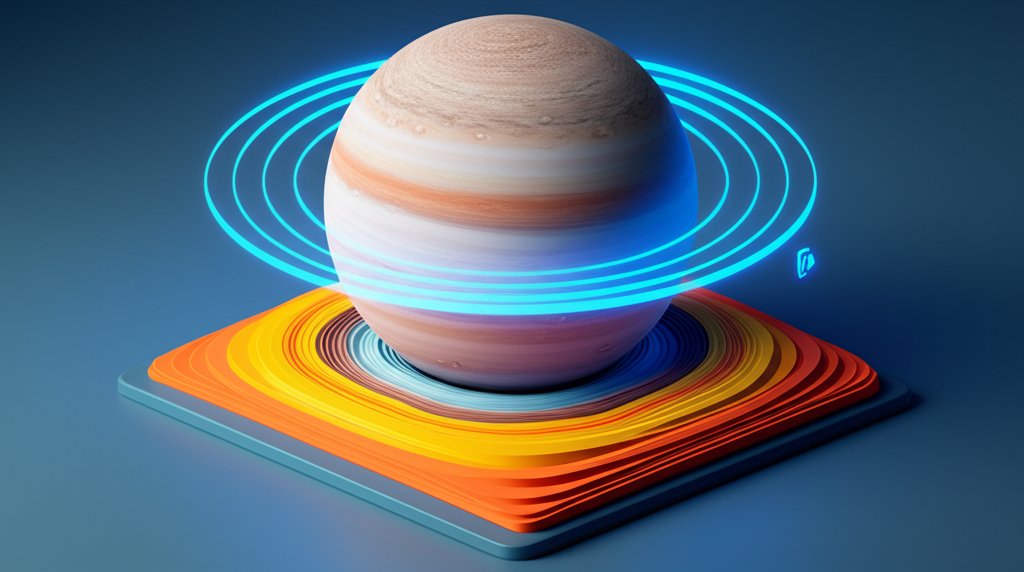
Jupiter’s magnetosphere acts as a giant shield, deflecting the solar wind – a constant stream of charged particles from the Sun. This interaction creates several interesting features:
- Bow Shock: The region where the solar wind first encounters the magnetosphere.
- Magnetotail: A long tail extending behind Jupiter, stretched out by the solar wind. It can reach as far as Saturn’s orbit!
- Magnetopause: The boundary between the magnetosphere and the solar wind.
The extent of Unveiling Jupiters Magnetic Shield is truly remarkable, and its immense size is a testament to the power of Jupiter’s core.
The Io Torus: A Volcanic Contribution
Jupiter’s moon Io is the most volcanically active object in the solar system. These volcanoes spew out tons of sulfur, oxygen, and sodium into space. These particles become ionized (electrically charged) and form a doughnut-shaped cloud called the Io torus, which orbits Jupiter along Io’s path.
Io’s Influence on the Magnetosphere
The Io torus is a major source of plasma (a mixture of ions and electrons) for Jupiter’s magnetosphere. This plasma contributes to the radiation belts and influences the overall dynamics of the magnetosphere.
Auroras: Jupiter’s Spectacular Light Shows
Just like Earth, Jupiter has auroras – spectacular displays of light in the polar regions. However, Jupiter’s auroras are much more powerful and complex.
What Causes Jupiter’s Auroras?
Jupiter’s auroras are caused by charged particles from the magnetosphere interacting with the planet’s atmosphere. These particles follow the magnetic field lines towards the poles, where they collide with atmospheric gases, causing them to glow. What are the reasons for Jupiters Polar Lights Explained? The answer lies in the planet’s powerful magnetic field and its interaction with the solar wind and particles from Io.
Permanent and Variable Auroras
Unlike Earth’s auroras, which are largely driven by solar activity, Jupiter’s auroras have both a permanent component and a variable component. The permanent component is caused by particles from Io, while the variable component is influenced by the solar wind.
The Influence of Jupiter’s Moons
Jupiter’s moons, especially Io, Europa, and Ganymede, significantly affect the magnetosphere.
Ganymede’s Unique Magnetosphere
Ganymede is the only moon in the solar system with its own internal magnetic field. This creates a mini-magnetosphere within Jupiter’s magnetosphere, a fascinating and complex interaction.
Europa and Io’s Impact
Europa and Io absorb charged particles from the magnetosphere, creating “footprints” in Jupiter’s auroras. Io’s volcanic activity, as previously mentioned, is a major source of plasma for the entire magnetosphere.
Spacecraft Exploration: Unveiling Jupiter’s Secrets

Our understanding of Jupiter’s magnetic field has been greatly enhanced by spacecraft missions. Pioneer, Voyager, Galileo, Cassini, and Juno have all contributed valuable data.
Pioneer and Voyager Missions
The Pioneer and Voyager missions provided the first detailed measurements of Jupiter’s magnetic field and magnetosphere. They revealed the immense strength and size of the magnetosphere and discovered the radiation belts. Pioneer data also helped determine the composition of the Jovian atmosphere.
Galileo and Juno Missions
The Galileo mission provided detailed observations of the Io torus and the interaction between Jupiter’s magnetosphere and its moons. The Juno mission, currently orbiting Jupiter, is providing unprecedented detail about the planet’s magnetic field, auroras, and interior structure. Juno’s findings are crucial to Unlocking Jupiters Magnetic Field.
Why Study Jupiter’s Magnetic Field?
Studying Jupiter’s magnetic field isn’t just an academic exercise. Understanding it offers immense benefits:
- Planetary Formation: Jupiter provides clues about how gas giants form and evolve.
- Space Weather: Understanding the interaction between Jupiter’s magnetosphere and the solar wind helps us to better understand space weather, which can affect satellites and even power grids on Earth.
- Plasma Physics: Jupiter’s magnetosphere is a natural laboratory for studying plasma physics under extreme conditions.
Common Misconceptions About Jupiter’s Magnetic Field
Let’s clear up some common misconceptions:
- Misconception: Jupiter’s magnetic field protects it from everything.
- Reality: While the magnetosphere deflects the solar wind, Jupiter is still bombarded by high-energy particles.
- Misconception: Jupiter’s magnetic field is perfectly symmetrical.
- Reality: It’s actually quite complex and lopsided due to the contributions from multiple sources.
- Misconception: Earth’s magnetic field is just a weaker version of Jupiter’s.
- Reality: While both fields are generated by dynamo effects, the underlying processes and resulting structures are quite different.
What’s Next in Jupiter Magnetic Field Exploration?
Future missions and continued analysis of Juno data will undoubtedly reveal even more about Jupiter’s magnetic field. Scientists are particularly interested in understanding the dynamo mechanism in more detail, the precise composition of the Io torus, and the dynamics of Jupiter’s auroras.
Take Action: Explore Jupiter’s Magnetic Field on Your Own
You don’t need to be a rocket scientist to explore Jupiter’s magnetic field. Here are a few things you can do:
- Follow space missions: Keep up with the latest news from the Juno mission and other space exploration efforts.
- Explore online resources: NASA and other space agencies provide a wealth of information about Jupiter and its magnetic field.
- Learn more about space weather: Understand how the solar wind interacts with planetary magnetospheres, including Jupiter’s and Earth’s.
Jupiter’s magnetic field is a vast and complex phenomenon that continues to fascinate and challenge scientists. By exploring this giant’s force field, we can learn more about our solar system and the fundamental processes that shape planets.










