
Imagine Earth’s aurora borealis, but amplified to a planetary scale and driven by forces far beyond just solar wind. Jupiter’s aurorae at the poles are not just pretty lights; they’re a window into the most powerful magnetic field in our solar system and the complex interactions happening within Jupiter’s magnetosphere.
At a glance:
- Uncover the driving forces behind Jupiter’s intense polar aurorae.
- Understand how Jupiter’s moon Io fuels auroral activity.
- Distinguish Jupiter’s aurorae from Earth’s and other planets.
- Explore new discoveries about Jupiter’s auroral hot spots.
- Learn about the tools scientists use to study these magnetic light shows.
What Makes Jupiter’s Aurorae So Spectacular?
Jupiter’s aurorae dwarf Earth’s in both size and intensity. While solar wind plays a role, a major difference comes from Jupiter’s rapid rotation and its moon Io. The immense strength of Jupiter’s magnetic field, about 19,000 times that of Earth, channels charged particles towards the poles, creating these mesmerizing displays. Explore Jupiter’s magnetic field to understand the foundation upon which these aurorae are built.
Io: The Volcanic Powerhouse Behind the Light
Io, Jupiter’s volcanically active moon, constantly spews sulfur dioxide and other gases into space. These gases become ionized and trapped within Jupiter’s magnetosphere, forming the Io plasma torus, a doughnut-shaped ring of charged particles. As these particles interact with Jupiter’s magnetic field, they are accelerated towards the poles, contributing significantly to the auroral displays.
- Io Plasma Torus: A ring of ionized gas surrounding Jupiter, fed by Io’s volcanic activity.
- Auroral Hot Spots: Regions of intense auroral emission, often linked to Io’s position.
Without Io, Jupiter’s aurorae would be significantly weaker. Io acts like a constant fuel source, keeping the auroral engine running.
Earth vs. Jupiter: A Tale of Two Aurorae
While both planets experience aurorae, the differences are striking:
| Feature | Earth’s Aurorae | Jupiter’s Aurorae |
|---|---|---|
| Primary Driver | Solar Wind | Internal Magnetospheric Processes (Io), Solar Wind |
| Intensity | Relatively Weaker | Extremely Intense |
| Variability | More Variable with Solar Activity | More Persistent and Complex |
| Spectral Emission | Dominated by Oxygen and Nitrogen Emission | Dominated by Hydrogen Emission, with some Oxygen and Sulfur |
| Location | Primarily at High Latitudes (Auroral Oval) | Primarily at the Poles, but also features auroral spots linked to Io and other moons. |
| Earth’s aurorae are largely driven by fluctuations in the solar wind, making them more sporadic. Jupiter’s aurorae, while still influenced by the sun, are more persistent due to the constant supply of particles from Io and internal magnetospheric dynamics. |
Deciphering Jupiter’s Auroral Hot Spots
Jupiter’s aurorae aren’t uniform; they exhibit bright spots and complex structures. These “auroral hot spots” are linked to specific magnetic flux tubes connecting Jupiter to its moons, particularly Io.
- Io Footprint: An auroral spot linked directly to the magnetic connection between Jupiter and Io.
- Heel and Tail: Features within the Io footprint, caused by the complex interaction of Io’s plasma with Jupiter’s magnetosphere.
Analyzing the location and behavior of these hot spots provides valuable information about the structure and dynamics of Jupiter’s magnetosphere and the interaction between Jupiter and its moons.
Peeking Inside: How We Study Jupiter’s Aurorae
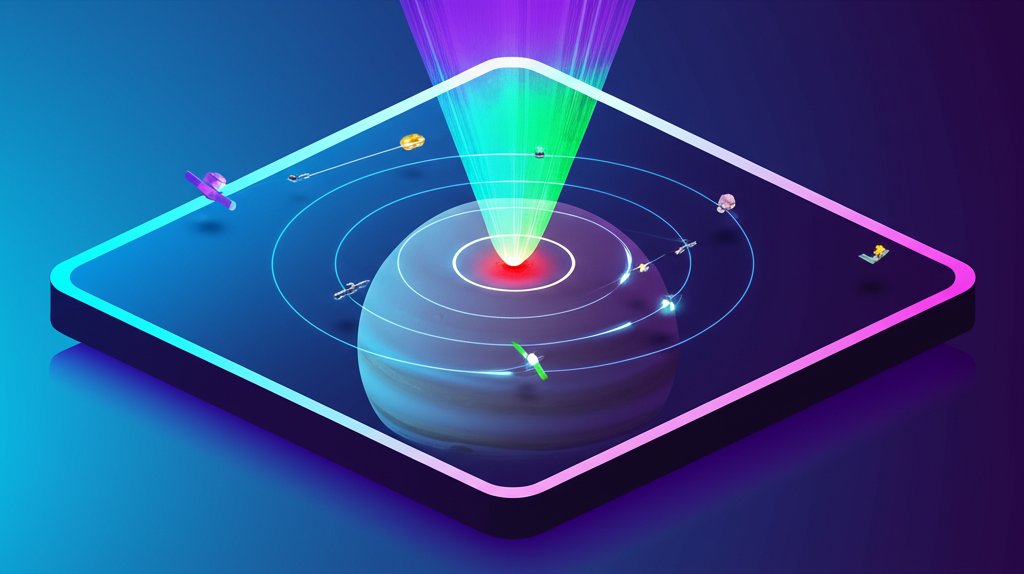
Scientists employ a variety of tools to study Jupiter’s aurorae:
- Space-Based Observatories: Missions like Hubble Space Telescope (HST) and Juno provide remote sensing observations across a wide range of wavelengths, from ultraviolet to infrared.
- Radio Telescopes: Ground-based radio telescopes detect radio emissions associated with auroral activity, providing information about the energy of the charged particles.
- In-Situ Measurements: Spacecraft orbiting Jupiter, such as Juno, directly measure the magnetic fields and charged particles in the planet’s magnetosphere, providing crucial context for interpreting auroral observations.
Example: Hubble’s UV images revealed the dynamic nature of Jupiter’s aurorae, showing how they respond to changes in the solar wind and the activity of Io. Juno’s close-up measurements confirmed the link between auroral emissions and the flow of charged particles along magnetic field lines.
A Practical Playbook: Understanding and Interpreting Auroral Data
Want to dig deeper into Jupiter’s aurorae? Here’s a simple guide:
- Start with the Basics: Familiarize yourself with the structure of Jupiter’s magnetosphere (dipolar field, plasma torus, magnetotail).
- Study Auroral Morphology: Learn to identify key features like the main auroral oval, Io footprint, and polar cap emissions.
- Consider Multi-Wavelength Data: Combine UV, infrared, and radio observations for a more complete picture.
- Explore Space Weather Effects: Investigate how solar wind events affect Jupiter’s aurorae.
- Follow Current Research: Stay up-to-date with the latest findings from missions like Juno and future planned missions.
Quick Answers: Your Jupiter Aurorae FAQs
Q: Can we see Jupiter’s aurorae with the naked eye from Earth?
A: No, Jupiter’s aurorae are primarily observed in ultraviolet and infrared light, which are not visible to the human eye. We need specialized telescopes in space to capture these emissions.
Q: Is solar wind the only cause of Jupiter’s aurorae?
A: While the solar wind does influence Jupiter’s aurorae, it’s not the primary driver. The internal processes within Jupiter’s magnetosphere, particularly the interaction with Io’s plasma, play a much larger role.
Q: Are Jupiter’s aurorae constant, or do they change?
A: Jupiter’s aurorae are dynamic and constantly changing. They respond to both internal magnetospheric processes and external influences from the solar wind. The intensity and morphology of the aurorae can vary significantly over time.
Q: How do scientists know that Io is connected to Jupiter’s aurorae?
A: Scientists have observed a direct relationship between Io’s position and the location of auroral hot spots, known as the Io footprint. This footprint traces the magnetic field lines that connect Jupiter to Io.
Actionable Close: Witnessing the Unseen
Jupiter’s aurorae at the poles are more than just a beautiful spectacle. They are a powerful tool for understanding Jupiter’s magnetic field, its internal dynamics, and its interactions with its moons. By studying these auroral displays, we gain valuable insights into the complex processes that shape the atmospheres and magnetospheres of giant planets throughout the universe. Keep exploring; there’s always more to discover.










