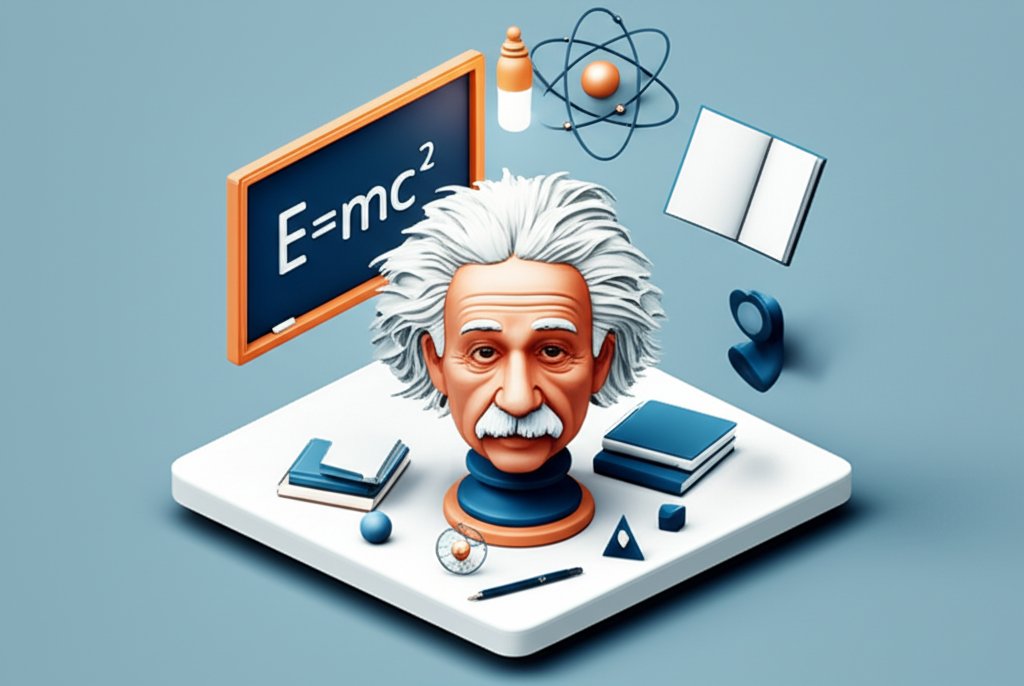
Close your eyes and picture a “genius.” Chances are, the image that flashes in your mind has a wild halo of white hair, a bushy mustache, and kind, knowing eyes. Maybe there’s even a playful tongue sticking out. That iconic image of scientist Albert Einstein has become more than a portrait; it’s the universal symbol for brilliance, a shorthand for a mind that reshaped our understanding of the universe.
But behind the caricature lies a series of powerful photographs that tell a much richer story—of a dapper young patent clerk, a world-famous academic, a refugee, a musician, and a reluctant celebrity who never lost his sense of wonder or his disdain for convention. This is the story of how the man became the icon, one snapshot at a time.
At a Glance: Understanding Einstein’s Image
Before we dive deep, here are the key takeaways about the man behind the famous photos:
- An Evolving Look: Einstein’s image transformed dramatically, from a sharp, formally dressed young professional in his early years to the famously disheveled “absent-minded professor” in his Princeton days.
- The Famous Tongue Photo: The most recognizable photo of Einstein was a spontaneous act of playful rebellion against paparazzi on his 72nd birthday. He loved the picture so much he used it for greeting cards.
- Calculated Simplicity: His signature unkempt look—especially the wild hair and his refusal to wear socks—was a conscious choice, reflecting his belief that trivial matters like appearance distracted from the pursuit of knowledge.
- More Than a Scientist: The photographs capture glimpses of a multifaceted individual: a passionate violinist, an avid sailor, and a dedicated humanitarian who used his fame to advocate for civil rights and pacifism.
- The Man vs. The Myth: While his image is now synonymous with genius, it sometimes overshadows the complex, deeply human person who grappled with fame, family, and the moral implications of his own discoveries.
More Than a Caricature: Deconstructing a Global Persona
Today, Albert Einstein’s face is one of the most recognizable in the world, printed on everything from coffee mugs to dorm room posters. His likeness has become a brand, a visual cue for intelligence and non-conformity. Yet, this wasn’t an overnight transformation or a carefully crafted PR campaign. It was an organic evolution, shaped by his personality and the turbulent times he lived in.
Early photographs show a different man entirely. As a young clerk in the Swiss patent office in Bern, where he developed his groundbreaking 1905 papers, Einstein was clean-shaven and wore smart, fitted suits. He looked the part of a serious, ambitious European intellectual. It was in this period, his annus mirabilis or ‘miracle year,’ that he published four articles that changed physics forever, outlining the photoelectric effect, Brownian motion, special relativity, and the mass-energy equivalence expressed in his legendary equation, E = mc².
As his fame grew, especially after his theory of general relativity was confirmed in 1919, his public profile exploded. The photographs from this era capture a man ascending to global stardom, often seen in the company of other scientific titans like Marie Curie and Hendrik Lorentz at the Solvay Conferences. His hair became less tamed, his clothing more comfortable, hinting at the icon to come.
The Story Behind the World’s Most Famous Tongue
Of all the images, one stands apart. It’s the cheeky, irreverent, and profoundly human photograph of Einstein sticking his tongue out at the camera. This single frame has done more to define his public persona than any other, but its origin was a simple moment of fatigue and frustration.
On March 14, 1951, Einstein was leaving a celebration for his 72nd birthday at Princeton’s Institute for Advanced Study. He was exhausted and had been hounded by reporters and photographers all evening. As he got into a car, photographer Arthur Sasse of the UPI rushed forward and urged, “Hey, Professor, smile for a birthday picture, eh?”
Having already forced countless smiles that day, Einstein did something else. In a flash of playful defiance, he stuck his tongue out. Sasse was quick enough to capture it. While his editors were hesitant to publish the undignified photo, it quickly became a sensation. Einstein himself adored it. He felt it perfectly captured his opinion of the media circus and his general contempt for authority and convention. He famously ordered nine copies for himself to send to friends, making that single rebellious einstein picture a personal statement to the world.
From Patent Clerk to Global Icon: A Visual Timeline
Einstein’s life can be traced through the distinct phases of his photographic record, each revealing a new chapter in his journey.
The Bern Years (Early 1900s): The Sharp-Dressed Thinker
In his twenties and early thirties, Einstein was a family man and a government employee. Photos with his first wife, Mileva Marić, and their children show a focused, conventional young man. There is little hint of the eccentric genius he would later become. Yet, it was behind this conventional facade that he was quietly dismantling and rebuilding classical physics. His work at the patent office, evaluating electromagnetic inventions, gave him ample time to conduct the thought experiments that would lead to relativity.
The Berlin Period (1914-1933): Ascending to Fame
Lured to Berlin in 1914, Einstein became a leading figure at the prestigious Prussian Academy of Sciences. He was now a world-renowned physicist. The photographs of this era show him at the height of his intellectual powers, lecturing, attending conferences, and solidifying his theory of general relativity. His hair began its famous rebellion against the comb, and his fame made him an unwilling public figure. It was during this period that he won the 1921 Nobel Prize in Physics, not for relativity as many assume, but for his explanation of the photoelectric effect.
The Princeton Sage (1933-1955): The American Icon
Being of Jewish heritage, Einstein was a vocal opponent of the rising Nazi party in Germany. When Hitler came to power in 1933, Einstein was visiting the United States and never returned to his home country. He accepted a position at the Institute for Advanced Study in Princeton, New Jersey, becoming an American citizen in 1940.
It was here, at his home on 112 Mercer Street, that the definitive image of Einstein was forged. He abandoned all pretense of formal dress, favoring worn-out sweaters and, famously, no socks. When asked why, he explained that his big toe always ended up making a hole in them, so they were simply illogical. This wasn’t laziness; it was a deliberate stripping away of the non-essential to free his mind for what truly mattered: his quest for a unified field theory to unite the forces of the universe.
What Einstein’s Photos Don’t Always Show
The popular image of a lone genius scribbling equations can obscure the richer, more complex reality of the man himself. A deeper look at his photographic history reveals other facets of his life.
The Musician and Sailor
Einstein was a passionate and accomplished violinist, an interest he cultivated from a young age. He often found solace and inspiration in music, particularly Mozart and Bach. He once said, “Life without playing music is inconceivable to me.” Photos of him with his violin, “Lina,” reveal a softer, more contemplative side.
He was also an enthusiastic sailor, though by many accounts, not a particularly skilled one. He loved the feeling of being on the water, letting his mind drift with the wind. This hobby underscores his connection to the natural world and his desire for simple, tangible experiences outside the abstract realm of theoretical physics.
The Committed Humanitarian and Activist
Far from being locked in an ivory tower, Einstein was a deeply engaged political and social activist. Having fled persecution himself, he became a vocal advocate for civil rights in the United States, calling racism “a disease of white people.” He understood the power of his platform and used it to champion causes he believed in, from pacifism to world government.
His most famous political act was co-signing a letter with physicist Leo Szilard to President Franklin D. Roosevelt in 1939. The letter warned that Nazi Germany might be developing nuclear weapons and urged the U.S. to begin its own research. Though this letter contributed to the initiation of the Manhattan Project, Einstein later expressed profound regret, stating he would have done nothing of the sort had he known the Germans would fail in their efforts. Throughout his life, he remained a staunch opponent of nuclear weapons.
Frequently Asked Questions About Einstein’s Image

The enduring mythos around Einstein has led to many common questions about his life and famous photographs.
Why did Albert Einstein have messy hair?
His wild hair was a combination of factors. In his later years, he simply didn’t bother with grooming, viewing it as a distraction from his work and a concession to the bourgeois standards he disdained. It became an accidental part of his “brand” as the eccentric genius who was too busy pondering the cosmos to worry about a comb.
Is the photo of Einstein riding a bike real?
Yes, it’s very real. The joyful photo was taken in 1933 while Einstein was visiting Santa Barbara, California. It beautifully captures his childlike sense of wonder and his simple pleasures, becoming another enduring symbol of a genius who never lost his connection to the world around him.
Did Albert Einstein really not wear socks?
He really didn’t. He found socks to be a nuisance and stopped wearing them as a young man. This small, quirky detail is a perfect example of his practical, logic-driven approach to life. If something didn’t serve a useful purpose, he discarded it, whether it was a social convention or a pair of socks.
What is the story of E=mc²?
This equation, the “world’s most famous,” states that energy (E) is equal to mass (m) times the speed of light (c) squared. It’s a conclusion from his 1905 theory of special relativity, revealing that mass and energy are two forms of the same thing. It’s the scientific principle that underpins nuclear power and weapons, though Einstein himself did no direct work on their development. If you’d like to View Albert Einsteins picture with his famous formula, several images show him writing it on a blackboard for students and reporters.
Curating Genius: How We Remember Einstein Today
The image of Albert Einstein has transcended photography to become a piece of cultural iconography. His face signifies not just intelligence, but a particular kind of intelligence: creative, rebellious, and deeply human. He represents the idea that true genius doesn’t have to conform to stuffy academic norms.
This powerful image, however, can be a double-edged sword. It often simplifies a profoundly complex individual. We remember the hair and the tongue more readily than his staunch advocacy for social justice or his lifelong struggle with the philosophical implications of quantum mechanics—a theory he helped found but could never fully accept, famously stating, “God does not play dice.”
Beyond the Snapshot: Engaging with Einstein’s True Legacy
The photographs of Albert Einstein offer a window into his extraordinary life, but they are only the beginning of the story. To truly appreciate his impact, we must look beyond the still frames.
Instead of just admiring the icon, consider exploring the man. Read his collection of essays, “The World as I See It,” to understand his worldview and his powerful, eloquent prose. Watch a documentary about his life to grasp the historical context he navigated. Or pick up a popular science book that explains his theories of relativity, which reveal a universe more strange and wonderful than we could have ever imagined.
Ultimately, the most powerful image of scientist Albert Einstein is not a physical photograph. It is the enduring idea he represents: that curiosity is our greatest tool, that questioning authority is a moral duty, and that the universe is full of mysteries waiting to be unraveled by anyone with the courage and imagination to look.










