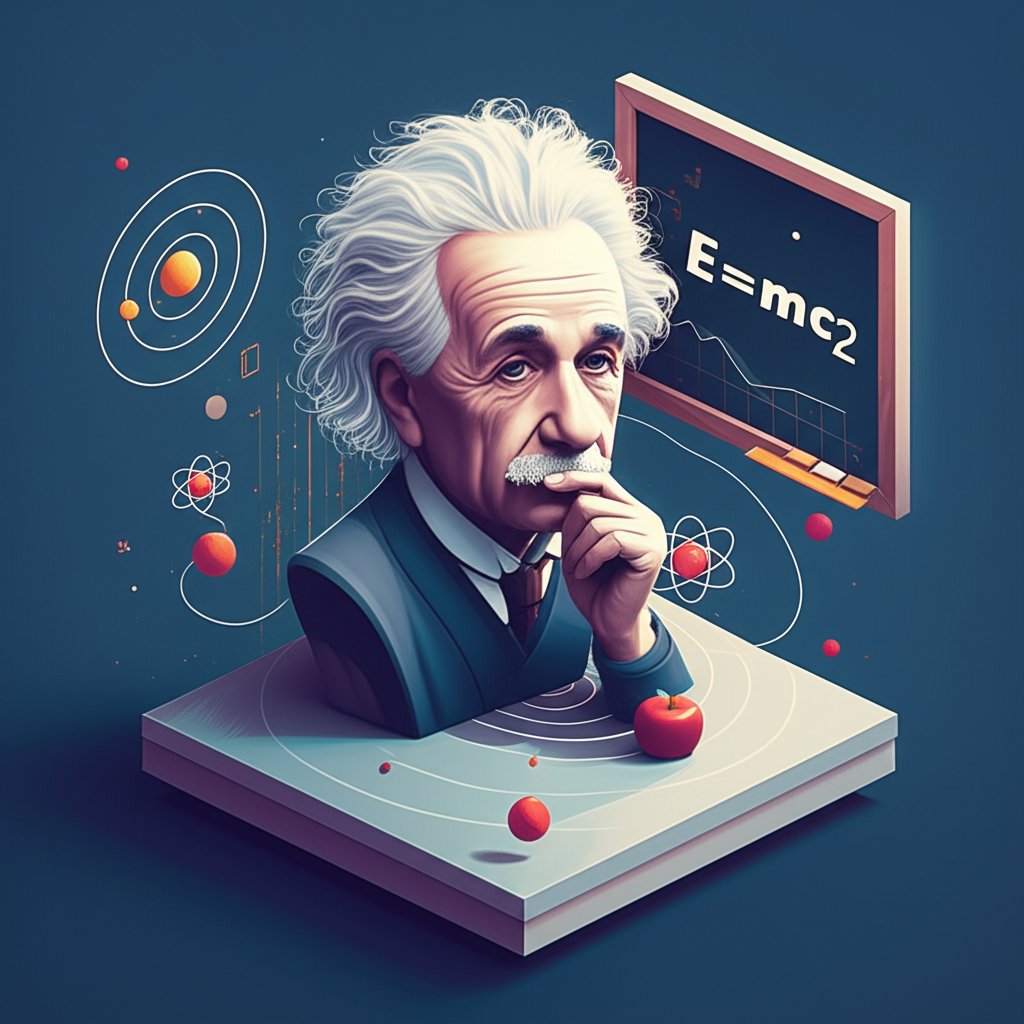
Almost every famous Albert Einstein picture tells a story, but not always the one you think. Beyond the playful man with the wild hair sticking his tongue out, there’s the intense young patent clerk who dismantled classical physics in his spare time and the world-renowned professor who reimagined gravity itself. These images are visual records of a mind engaged in one of history’s greatest intellectual pursuits: the development of the theory of relativity.
Understanding the context behind these photographs transforms them from simple portraits into windows. They reveal the focus required for Special Relativity in 1905, the intellectual weight of General Relativity a decade later, and the philosophical isolation of his later years. Each era, captured in a different kind of Einstein picture, reflects a distinct phase in his journey to redefine space, time, and the cosmos.
At a Glance: Decoding Einstein’s Image
This deep dive will equip you to see more than just a famous face. Here’s what you’ll uncover:
- The Young Rebel: How photos from his “miracle year” reveal the intense concentration that produced Special Relativity.
- The Established Master: The visual shift as Einstein became a global celebrity while formulating the cosmic-scale ideas of General Relativity.
- The Solitary Sage: How his later portraits in Princeton reflect his intellectual divergence from mainstream physics.
- Reading the Visual Cues: A practical guide to interpreting the details—from his blackboard to his expression—in any Einstein picture.
- Beyond the Formula: Connecting the iconic E = mc² to the man captured in photos at the moment of its conception.
The Focused Clerk: Picturing Special Relativity
In the early 1900s, the world didn’t know Albert Einstein. The photographs from this era show a sharp, well-dressed young man with a penetrating gaze, working as an examiner at the Swiss Patent Office in Bern. There’s no trace of the eccentric, white-haired sage he would become. This clean-cut image is the face of pure, undistracted intellectual firepower.
This was the Einstein of the “annus mirabilis,” or ‘miracle year’ of 1905. During this single year, while holding down a full-time job, he published four groundbreaking papers. One of them introduced the special theory of relativity, a revolutionary concept that proposed the laws of physics are the same for all non-accelerating observers and that the speed of light in a vacuum is constant, regardless of the observer’s motion.
Visual Clues from the ‘Miracle Year’
When you look at an Einstein picture from this period, you’re seeing the mind that created a new physical reality.
- The Setting: The backdrop is often a simple office or a stark room. This reflects the reality of his work—these world-changing ideas weren’t born in a grand university laboratory but in the mind of a patent clerk during his off-hours.
- The Expression: His look is one of intense, almost severe, focus. This isn’t the relaxed, grandfatherly figure of later fame. It’s the expression of a man wrestling with fundamental paradoxes, like what happens if you could ride alongside a beam of light.
- The Simplicity: The lack of a messy blackboard or cluttered desk in these early photos is telling. Special relativity emerged from pure thought experiments—”gedankenexperiments”—that required only a pen, paper, and a formidable imagination.
This early Einstein picture is the visual representation of raw intellectual horsepower. It captures the essence of a thinker on the verge of proving that time and space are not absolute but relative. To see how this focused young man transformed into the global icon we know today, you can Explore Einstein’s iconic photos and trace his visual journey.
The Global Celebrity: Capturing General Relativity

By the 1910s and 1920s, Einstein’s world had changed, and so had his image. After publishing his paper on general relativity in 1916, he was no longer an anonymous clerk but a celebrated professor at the Prussian Academy of Sciences in Berlin. The photographs from this time show a man grappling not just with physics, but with fame.
General relativity was a far more ambitious undertaking than special relativity. It was Einstein’s theory of gravitation, proposing that massive objects cause a distortion in space-time, which is felt as gravity. It took him over a decade of grueling mathematical work to formulate. The Einstein picture from this era reflects that intellectual and personal evolution.
From Sharp Focus to Cosmic Vision
The visual hallmarks of this period signal a shift from the concentrated energy of his youth to the expansive, almost weary, wisdom of a man who had seen the universe’s hidden architecture.
| Visual Element | The Young Clerk (Special Relativity) | The Berlin Professor (General Relativity) |
|---|---|---|
| Hair | Neat, short, and conventional. | The famous unruly mane begins to appear, a sign of his growing fame. |
| Expression | Intense, sharp, and focused inward. | Often contemplative, sometimes tired, with a gaze that seems to look past the camera. |
| Environment | A simple office or room. | A lecture hall, a study filled with books, or in front of a complex blackboard. |
| Key Achievement | E = mc², reconciling mechanics with electromagnetism. | A geometric theory of gravitation, explaining the universe’s large-scale structure. |
| A classic Einstein picture from this period shows him standing before a blackboard covered in tensors and complex equations. This is the visual shorthand for the immense intellectual labor behind general relativity. Unlike the pure thought experiments of 1905, general relativity required a deep and sustained engagement with advanced mathematics. The chaotic blackboard symbolizes the magnificent complexity of a universe where space and time are not a fixed stage but active participants in the cosmic drama. |
The Princeton Sage: The Face of Intellectual Isolation
After fleeing Nazi Germany in 1933, Einstein settled at the Institute for Advanced Study in Princeton, New Jersey. The photographs from the last two decades of his life created the most enduring public image: the wise, gentle old man with twinkling eyes, often clad in a simple sweater.
This Einstein picture, however, masks a deep intellectual struggle. While the world saw a living legend, the physics community saw a figure increasingly detached from the mainstream. He dedicated his final years to two primary, and ultimately unsuccessful, quests:
- Devising a Unified Field Theory: An attempt to unite electromagnetism and gravitation into a single, elegant theory.
- Challenging Quantum Mechanics: He was deeply unsettled by the probabilistic nature of quantum theory, famously stating, “God does not play dice with the universe.”
The portraits from Princeton capture this duality. His expression is often serene and thoughtful, but it’s the serenity of a man who has chosen his own path, even if it leads him away from his peers. The photos lack the raw intensity of the patent clerk or the celebrated confidence of the Berlin professor. Instead, they show a quiet determination, the look of a man still searching for a final, unifying truth that he believed must exist.
A Practical Guide to Reading an Einstein Picture

When you encounter a photo of Einstein, you can decode the story behind it by looking for a few key details. Think of it as a visual playbook for understanding the man behind the science.
Step 1: Analyze the Era (And the Hair)
The easiest first step is to place the photo in time.
- Young and Neat (1900-1910): This is the Einstein of special relativity. The focus is on the sheer intellectual power that led to E = mc².
- The Famous Mane Emerges (1915-1930): This is the Einstein of general relativity and global fame. The untamed hair mirrors his unconventional, universe-bending ideas.
- The White-Haired Sage (1935-1955): This is the Princeton Einstein, reflecting his philosophical stance and his quest for a unified theory.
Step 2: Look at the Background
The environment provides crucial context for his work.
- A Sparse Office: Suggests the pure, theoretical nature of his early thought experiments.
- A Blackboard Full of Equations: The classic image of genius at work, directly linked to the mathematical heavy lifting of general relativity.
- A Cozy Study or a Sailboat: Shows the Princeton sage, a man whose work had become a more personal, philosophical quest.
Step 3: Interpret the Expression
His face tells the story of his mindset.
- Intense and Piercing: The young revolutionary challenging the foundations of physics.
- Confident and Expansive: The celebrated master, comfortable on the world stage.
- Playful or Wistful: The elder statesman, secure in his legacy but perhaps aware of the intellectual roads not taken.
Quick Answers to Common Questions
A few frequent questions pop up when connecting the Einstein picture to his scientific work.
Q: Does the famous picture of Einstein with his tongue out have any connection to his theories?
A: Not directly. The photo was taken on his 72nd birthday in 1951. When pestered by photographers to smile, he playfully stuck his tongue out instead. While it reveals his irreverent and humane personality, it’s more a reflection of his weariness with public life than a comment on relativity. It represents the public persona, not the private physicist deep in thought.
Q: What about the pictures of him with a violin?
A: Einstein was an accomplished amateur violinist, and music was a profound source of inspiration and relaxation for him. He once said that if he hadn’t been a physicist, he would have been a musician. These photos offer a glimpse into the creative, intuitive side of his mind—the part that he believed helped him “feel” his way toward the elegant truths of the universe, including the beautiful symmetries of relativity.
Q: Is the iconic E = mc² blackboard photo real?
A: Many photos show Einstein in front of a blackboard with equations, but one of the most famous, featuring a clear “E = mc²”, is often a composite or a recreation. However, photos of him lecturing on relativity with chalkboards filled with the complex tensor calculus of general relativity are very much authentic. These images powerfully capture the real, messy work of theoretical physics.
From Image to Insight
Every Einstein picture is a portal. Look past the iconic hair and the famous formula, and you’ll find a visual narrative of one of the most extraordinary scientific journeys ever undertaken. The sharp-eyed patent clerk gave us a new understanding of time and energy. The confident Berlin professor revealed a universe where space itself could bend and warp. And the solitary Princeton sage left us with an image of a mind still chasing the ultimate cosmic questions until the very end.
By learning to read these visual cues, you transform a simple portrait into a deeper appreciation for the genius who not only conceived of the theory of relativity but lived through its stunning implications. You see not just a scientist, but the human story of focus, struggle, and unending curiosity that reshaped our world.










