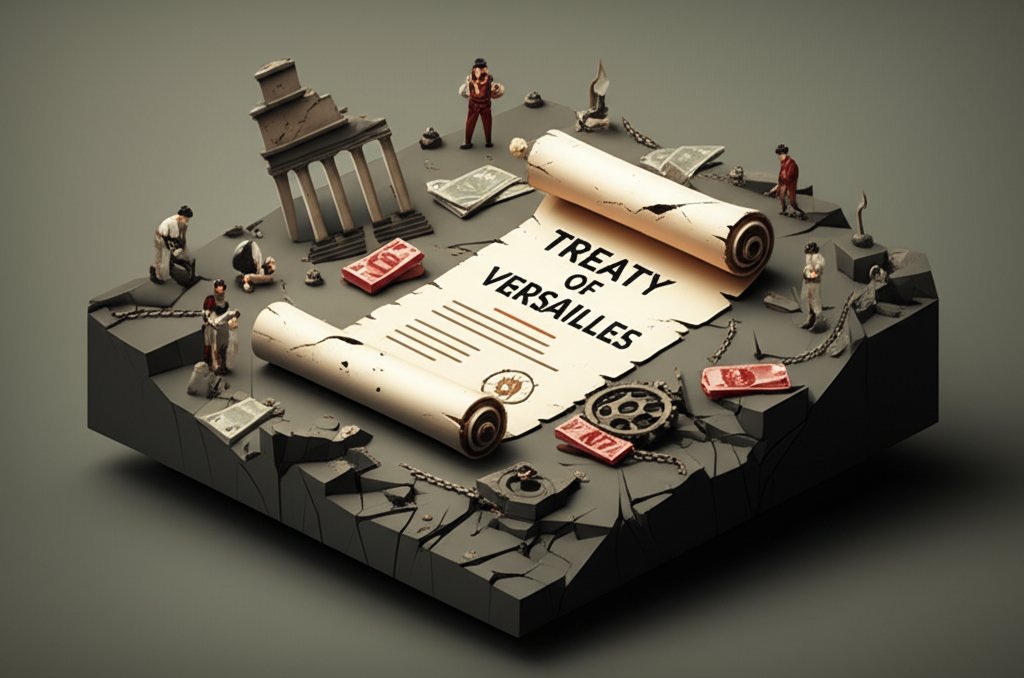
Discussions about how did Treaty of Versailles caused ww2 often get lost in complex economics and diplomacy, but the real story is simpler and far more human. It begins with a signature on a document in the grand Hall of Mirrors—a signature that wasn’t a negotiation, but a forced confession. The treaty didn’t just end a war; it branded an entire nation with guilt, crippled its economy, and created a burning sense of injustice that would smolder for two decades before erupting into an even greater conflict.
The peace treaty signed on June 28, 1919, was designed to prevent another war, but its terms did the opposite. It created a perfect storm of national shame, economic desperation, and political chaos within Germany, laying the groundwork for an extremist like Adolf Hitler to rise to power on a simple, powerful promise: to tear the treaty to shreds and restore German greatness.
At a Glance: Key Ways Versailles Paved the Road to War
- The “War Guilt Clause”: Understand why Article 231 was more than just words—it was a moral condemnation that poisoned German politics.
- Crippling Reparations: See how the impossible debt of 132 billion gold marks triggered hyperinflation, destroyed the middle class, and delegitimized the democratic government.
- Military Emasculation: Learn how severe restrictions on Germany’s army, navy, and air force created a profound sense of vulnerability and a thirst for rearmament.
- Territorial Losses: Discover how carving up German land and displacing its people fueled a powerful narrative of revenge and reunification.
- The Rise of Extremism: Connect the dots between the treaty’s harsh terms and the rise of the Nazi Party, which masterfully exploited German grievances.
The “War Guilt Clause”: A National Humiliation Beyond Repair
At the heart of Germany’s rage was Article 231, the infamous “War Guilt Clause.” This clause forced Germany and its allies to accept full and sole responsibility for causing World War I. For the Allied powers, particularly France, this was a legal necessity to justify the massive reparations they demanded. For the German people, it was an unbearable humiliation.
Imagine a nation that had just sacrificed millions of its sons, endured a devastating blockade, and was on the brink of starvation. Now, the victors were telling them that their entire struggle was illegitimate and their suffering was a punishment they deserved. This wasn’t a peace treaty; it felt like a criminal verdict delivered by a kangaroo court.
This clause immediately fed into the toxic “stab-in-the-back” myth (Dolchstoßlegende). This conspiracy theory claimed that the German army had not been defeated on the battlefield but was betrayed by politicians, socialists, and Jews on the home front. Article 231 became “Exhibit A” for extremists, who could point to the German leaders who signed the treaty—the “November Criminals”—as proof of this betrayal. The democratic Weimar Republic, born at the end of the war, was forever tainted by its association with this national disgrace.
Economic Strangulation: How Reparations Broke the German State
The economic terms of the treaty were designed to keep Germany weak for a generation. The final reparations bill was set at a staggering 132 billion gold marks, a sum so vast that many economists at the time, including John Maynard Keynes, warned it was impossible to pay and would ruin the European economy.
The German government tried to pay by printing more money, which led to one of the most catastrophic cases of hyperinflation in modern history.
- In early 1922: One U.S. dollar was worth about 320 German marks.
- By late 1923: One U.S. dollar was worth 4.2 trillion German marks.
The consequences were devastating. Life savings were wiped out overnight. A wheelbarrow full of cash was needed to buy a loaf of bread. The middle class, the bedrock of any stable democracy, was utterly destroyed. This economic chaos created a breeding ground for political extremism. When people see their lives fall apart, they lose faith in mainstream parties and become desperate for radical solutions. The broader economic and political fallout created a perfect storm, a topic explored in our main guide on How Versailles led to WWII.
When Germany inevitably defaulted on its payments in 1923, French and Belgian troops occupied the Ruhr, Germany’s industrial heartland. This act of foreign occupation on German soil poured fuel on the fire of national resentment, further convincing many Germans that the treaty was nothing more than a tool for their continued oppression.
A Nation Disarmed: The Psychological Impact of Military Restrictions
For a country with a powerful martial tradition like Germany, the military restrictions of Versailles were a profound psychological blow. The treaty effectively neutered the German military machine.
Key Military Limitations:
- Army: Reduced to just 100,000 men (a small domestic police force).
- Navy: Limited to a handful of small ships, with no submarines allowed.
- Air Force: Completely forbidden.
- Weapons: Prohibited from having tanks, heavy artillery, and poison gas.
- The Rhineland: This strategic region bordering France was to be permanently demilitarized.
These terms created a deep-seated sense of powerlessness and vulnerability. Germans felt defenseless against their neighbors, especially France and the newly-formed nations of Poland and Czechoslovakia, which now had larger armies.
This humiliation was a central theme in Hitler’s speeches. His promises to defy the treaty and rearm Germany were not just about rebuilding military strength; they were about restoring national pride. When Hitler marched troops back into the Rhineland in 1936, in direct violation of the treaty, he was met with euphoric crowds. It was a symbolic act of defiance that showed the German people he was the leader who would finally break the shackles of Versailles.
Carving Up the Homeland: Territorial Losses and the Cry for ‘Lebensraum’
The Treaty of Versailles redrew the map of Europe at Germany’s expense. The territorial losses were both economically costly and emotionally galling.
- Alsace-Lorraine: This resource-rich region, a symbol of Franco-German rivalry for decades, was returned to France.
- The “Polish Corridor”: A strip of land was given to the newly created Poland to provide it with sea access. This act split Germany in two, cutting off East Prussia from the rest of the country.
- Colonies: Germany was stripped of all its overseas colonies in Africa and Asia.
- Other Areas: Portions of Germany were ceded to Belgium, Denmark, and Lithuania. The Saarland, a key industrial area, was placed under League of Nations control for 15 years.
These losses meant millions of ethnic Germans were now living as minorities in foreign countries. This created a powerful and emotional political issue: the plight of the “lost Germans.” Hitler masterfully exploited this sentiment, promising to unite all German-speaking peoples under one flag.
His demand for Lebensraum (living space) in Eastern Europe was a direct consequence of these territorial losses. His early aggressions—the annexation of Austria (Anschluss), the seizure of the Sudetenland from Czechoslovakia, and ultimately the invasion of Poland—were all justified to the German public as necessary steps to reclaim lost lands and bring separated Germans back into the Reich. The treaty didn’t just punish Germany; it laid out a clear roadmap for its future aggressions.
From Grievance to Goose-Step: How Hitler Turned Treaty Terms into a Weapon
The true genius of Nazi propaganda was its ability to connect every problem in Germany back to the Treaty of Versailles. The treaty became a simple, all-encompassing explanation for every hardship. This table shows the direct line between the treaty’s provisions and the Nazis’ popular promises.
| Treaty of Versailles Provision | The German Grievance | Hitler’s Exploitative Promise |
|---|---|---|
| Article 231 (War Guilt) | National humiliation; the “stab-in-the-back” myth. | Reject the “Versailles Diktat” and restore German honor. |
| Reparations | Economic ruin, hyperinflation, and mass poverty. | End all reparation payments, create jobs through rearmament, and achieve economic self-sufficiency. |
| Military Limits | Powerlessness, vulnerability, and loss of pride. | Rebuild the Wehrmacht, Luftwaffe, and Kriegsmarine in open defiance of the treaty. |
| Territorial Losses | Lost land and separated German peoples. | Reclaim lost territories and unite all ethnic Germans under one Reich (Lebensraum). |
Quick Answers to Common Questions
Q: Was the Treaty of Versailles the only cause of WWII?
No, it wasn’t the sole cause, but it was arguably the most critical one. It created the necessary preconditions—economic desperation, political instability, and national resentment—that allowed other factors, like the Great Depression and the rise of fascist ideology, to ignite a global conflict. As historian Michael Neiberg argues, the treaty created “unstable conditions” that made a second great war not just possible, but likely.
Q: Could Germany have actually paid the reparations?
This is still debated by economists and historians. The initial sum of 132 billion gold marks was almost certainly impossible without wrecking the German economy. Later agreements, like the Dawes Plan (1924) and the Young Plan (1929), restructured the debt and made it more manageable. However, by then, the political and psychological damage was done. For a decade, the reparations had been a constant source of bitterness and a powerful tool for nationalist agitators.
Q: Why was the treaty so harsh on Germany?
The driving force behind the treaty’s harshness was French Prime Minister Georges Clemenceau. France had been invaded by Germany twice in the preceding 50 years (1870 and 1914) and had suffered catastrophic casualties in World War I. Clemenceau’s primary goal was ensuring French security by crippling Germany economically and militarily so it could never again threaten his country. While understandable from a French perspective, this punitive approach ultimately backfired by creating a deeply resentful and vengeful Germany.
A Peace Built on Quicksand
The legacy of Versailles is a stark lesson in the difference between winning a war and building a lasting peace. The treaty that was supposed to secure “the war to end all wars” instead became the first chapter of the next one. By prioritizing punishment over reconciliation, the Allied powers created a defeated nation, but not a pacified one. They created a Germany that was broken, humiliated, and desperate for a savior who would promise to restore its honor and tear up the “Diktat” of Versailles. In Adolf Hitler, they got exactly that, with catastrophic consequences for the entire world.










