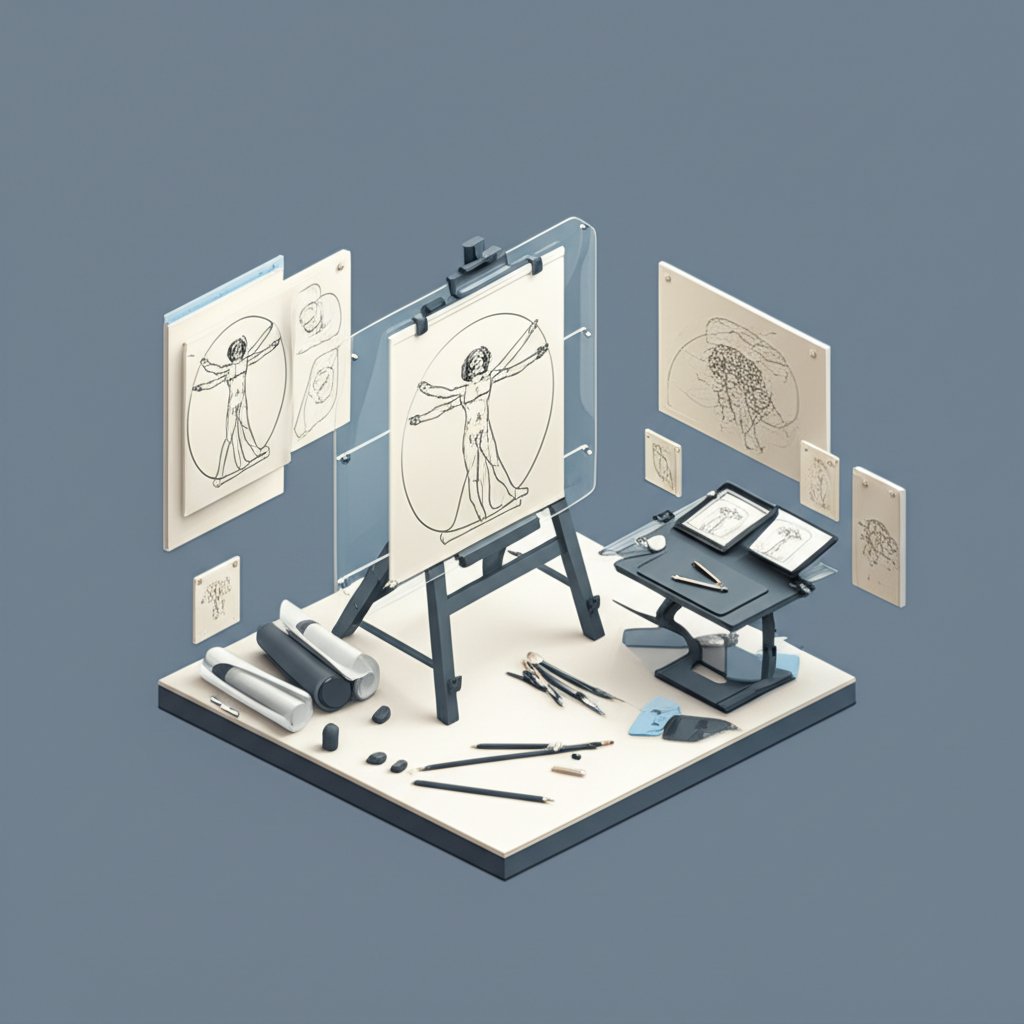
Behind many of the world’s most revered paintings lies a more private, elemental truth: a drawing. These famous drawings are not just preliminary steps; they are the artist’s thoughts made visible, a direct line from mind to hand, capturing a raw energy that a finished oil painting sometimes polishes away. From Leonardo da Vinci’s scientific inquiries to Picasso’s minimalist gestures, these works on paper offer an intimate glimpse into the creative process, revealing the very foundation of art history.
At a Glance: What You’ll Discover
- Why drawings are more than just sketches: Understand their crucial role as standalone masterpieces and intellectual blueprints.
- The stories behind the icons: Explore the context and technique of five seminal drawings from the Renaissance to the Modern era.
- How to “read” a drawing: Learn to spot an artist’s corrections, understand the medium’s impact, and identify the work’s original purpose.
- The unfiltered creative process: See how famous drawings provide a rare, intimate look at an artist’s problem-solving and genius at work.
More Than a Sketch: The Hidden Power of Drawing
We tend to think of drawings as the warm-up act for the main event—the painting. In reality, they are the architectural plans, the scientific experiments, and the emotional diaries of the art world. A drawing is where an artist battles with composition, perfects the turn of a wrist, or captures a fleeting expression. It’s a field of trial and error, where we can often see pentimenti—ghostly traces of earlier lines that have been erased or drawn over, revealing the artist’s changing mind.
This raw authenticity is precisely what makes famous drawings so compelling. While a commissioned painting like The Arnolfini Portrait was a public statement of wealth and status, a preparatory drawing by Michelangelo for the Sistine Chapel was a private struggle with anatomy and divine form. It’s in these works that we feel the closest connection to the artist.
The relationship between drawing and painting is foundational. The meticulous planning in a Raphael sketch is what gives his final fresco its harmonious balance. While we rightly celebrate the finished canvases, understanding the drawings that preceded them offers a much richer appreciation for the artist’s journey. To see how these foundational ideas blossom into legendary works, you can Explore famous paintings’ power and trace the full path from sketch to cultural icon.
The Anatomy of a Masterpiece: Five Famous Drawings Deconstructed
Certain drawings have transcended their original purpose to become masterpieces in their own right. Each tells a unique story about the artist’s obsessions, techniques, and the era in which they worked.
Leonardo da Vinci’s Vitruvian Man (c. 1490): The Intersection of Art and Science
Long before he painted the Mona Lisa‘s enigmatic smile, Leonardo was consumed with understanding the universe. His Vitruvian Man is far more than a life drawing; it’s a philosophical and scientific thesis on paper. Based on the writings of the Roman architect Vitruvius, the drawing illustrates the idea that the ideal human body can fit perfectly within a circle and a square—symbols of the divine and the terrestrial.
- What to Look For: Notice the precision of the pen-and-ink lines and the accompanying mirror-script notes. The dual poses—one with arms outstretched to touch the square’s sides, the other with limbs splayed to meet the circle’s circumference—are a brilliant solution to a complex geometrical problem.
- Why It Matters: This single drawing perfectly encapsulates the Renaissance spirit of humanism, where art, science, and philosophy were seen as interconnected pursuits to unlock the mysteries of nature.
Albrecht Dürer’s Praying Hands (1508): Emotion in Every Line
Perhaps the most universally recognized symbol of devotion, Dürer’s Praying Hands was never intended to be a standalone work. It was a meticulous study for an apostle’s hands in a large altarpiece that was later destroyed by fire, making this preparatory drawing even more precious.
- What to Look For: Executed in ink with white highlights on blue-toned paper, the drawing achieves a stunning level of realism. Dürer renders every vein, knuckle, and fold of the sleeve with an engraver’s precision, yet the image radiates a profound sense of humility and spiritual feeling.
- Why It Matters: Praying Hands has become an icon, often reproduced and separated from its original art-historical context. It demonstrates how a fragment—a simple study—can become more famous than the finished work it was meant to serve.
Michelangelo’s Figure Studies: Building Gods from Chalk and Paper
To understand the breathtaking power of the Sistine Chapel ceiling, you must first look at Michelangelo’s drawings. He was a master draftsman who used red and black chalk to explore the human form with an intensity that bordered on obsession. His studies of the male nude (ignudi) weren’t just about anatomy; they were about capturing terribilità—a sense of awesome, divine power.
- What to Look For: In his sketches, you can see how Michelangelo uses powerful contour lines and cross-hatching to create a sense of three-dimensional, muscular form. He twisted and turned the body, solving complex problems of foreshortening for figures that would be viewed from nearly 60 feet below.
- Why It Matters: These drawings are the building blocks of his greatest achievements. They prove that behind the monumental frescoes was a deep, intellectual practice of drawing, where every figure was rigorously planned before a single drop of paint was applied.
Raphael’s Cartoons: The Grand Scale of a Simple Drawing
In the Renaissance, a “cartoon” wasn’t a comic strip. It was a full-scale preparatory drawing used to transfer a design onto a surface for a fresco or tapestry. Raphael’s studies for the Sistine Chapel tapestries, such as his sketches for St. Paul Preaching in Athens, are masterclasses in composition and narrative clarity.
- What to Look For: Even in a preliminary chalk sketch, Raphael masterfully arranges groups of figures. He uses gesture and posture to direct the viewer’s eye and convey the complex emotions of the scene. Each figure has a distinct role in the unfolding drama.
- Why It Matters: Raphael’s drawings show that great composition is about more than just aesthetics; it’s about storytelling. They reveal the intellectual rigor required to orchestrate a large, multi-figure scene and ensure it remains coherent and emotionally resonant.
Picasso’s Minimalist Lines: The Essence of Form
Jumping forward four centuries, Pablo Picasso completely redefined the purpose of drawing. Known for radical works like Les Demoiselles d’Avignon, he also produced a series of stunningly simple one-line drawings (dessins au trait). With a single, unbroken stroke, he could capture the essence of a horse, a dove, or a human face.
- What to Look For: The genius is in its economy. Observe how a simple curve can suggest the powerful haunch of a horse or the gentle slope of a shoulder. Picasso isn’t describing the animal; he’s capturing its spirit and movement.
- Why It Matters: These works show the evolution of drawing from a primarily preparatory tool to a conceptual art form. For Picasso, the line itself was the subject, demonstrating that complex ideas could be conveyed with the utmost simplicity.
A Practical Guide to “Reading” a Famous Drawing
When you encounter a drawing in a museum, you’re looking at an intimate piece of history. Here’s how to unlock its secrets:
| Feature to Notice | What It Tells You | Example |
|---|---|---|
| The “Pentimenti” | Visible traces of erased or altered lines show the artist’s thought process and corrections. It’s like watching them think. | In Leonardo’s studies, you can often see him adjusting the angle of a limb or the tilt of a head. |
| The Medium | The material choice dictates the drawing’s character. Pen and ink are precise, charcoal is soft and atmospheric, and silverpoint is delicate and uncorrectable. | Dürer’s use of white chalk on colored paper creates dramatic highlights that make the form “pop.” |
| The Purpose | Was it a quick first idea (schizzo), a detailed analysis of a subject (studio), or a finished presentation piece (disegno)? | A rapid sketch of a battle scene by Leonardo feels energetic, while a detailed anatomical study is coolly scientific. |
| The Pressure of the Hand | A light, feathery line suggests exploration, while a dark, incisive line conveys confidence and decision. | Michelangelo’s powerful chalk lines feel as if they are carving the form from the paper. |
Quick Answers to Common Questions
Q: Why are so many famous drawings just studies for other works?
A: In the Renaissance and Baroque periods, paper was valuable, but pigments, canvas, and marble were far more expensive. Drawing was the most efficient and cost-effective way for artists to solve compositional problems, study anatomy, and present ideas to patrons before committing to the final, costly masterpiece. These surviving studies give us a priceless, behind-the-scenes look at their creative process.
Q: Are drawings less valuable than paintings?
A: While the highest prices at auction are typically for paintings, the market for master drawings is incredibly strong. A rare and historically significant drawing by Leonardo, Michelangelo, or Rembrandt can be considered priceless and fetch tens of millions of dollars. Their value is determined by the artist, rarity, condition, and its importance in art history.
Q: What’s the difference between a drawing and a print?
A: A drawing is a unique, one-of-a-kind artwork created directly by the artist’s hand on a surface like paper. A print, such as an etching or woodcut, is an image made from a matrix (like a metal plate or wood block) that is inked and pressed onto paper. This process allows for the creation of multiple, nearly identical impressions. Hokusai’s The Great Wave off Kanagawa, for instance, is a famous woodblock print, not a drawing.
Q: Can I see these famous drawings in person?
A: Yes, but often under controlled conditions. Materials like paper, chalk, and ink are highly sensitive to light, which can cause them to fade and deteriorate. To preserve them, museums typically house them in climate-controlled drawing cabinets and display them in low-light galleries for limited periods.
Your Next Steps in a World of Lines
The next time you visit a museum, don’t walk past the drawing galleries. These quieter spaces offer some of the most profound encounters you can have with an artist.
- Look for the process, not just the product. Celebrate the smudges, the corrections, and the exploratory lines. You’re witnessing the moment of creation.
- Connect the drawing to the final work. If you see a study for a famous painting you know, like The Last Supper, take a moment to appreciate how a few lines of chalk or ink grew into a monumental masterpiece.
- Appreciate the skill. Recognize the confidence it takes to render a perfect form with a few strokes of a pen or the patience required for a highly detailed silverpoint study. Famous drawings are not just accessories to art history—they are its very heartbeat.










