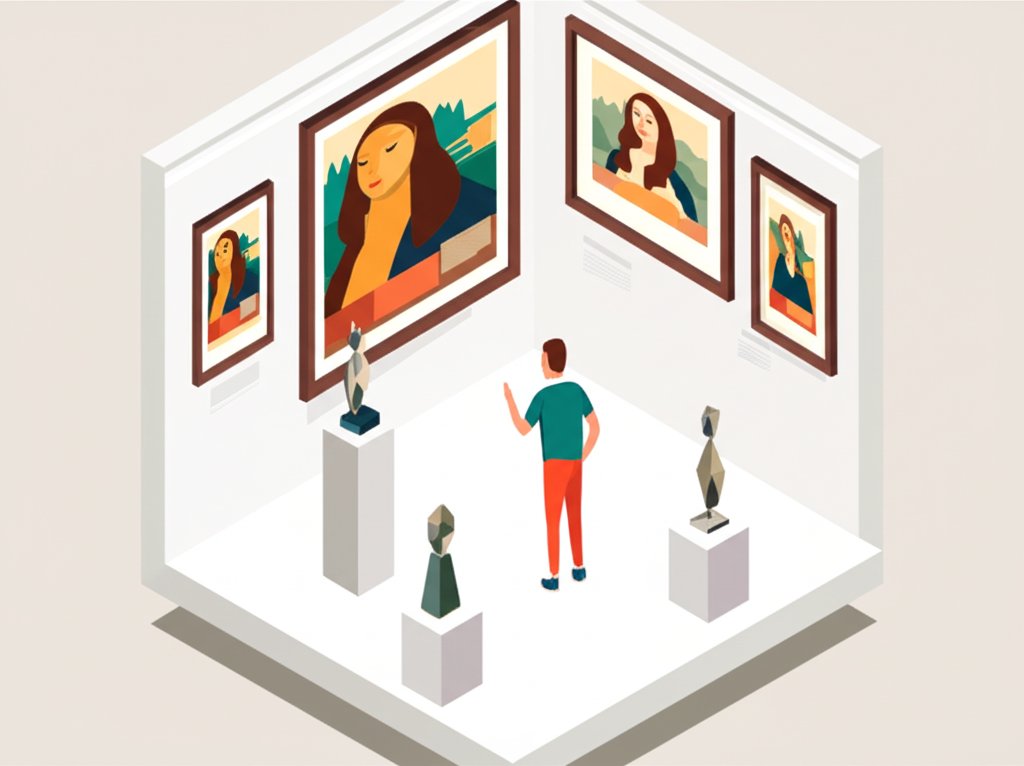
What elevates a painting from mere decoration to a global icon? The quest to define the “best art” isn’t about finding a single right answer; it’s about understanding the powerful cocktail of innovation, raw human emotion, and historical significance that allows certain works to transcend their time. These masterpieces aren’t just famous—they are conversations across centuries, reflecting our deepest fears, highest aspirations, and shared experiences.
They are the visual anchors of our collective memory, from the enigmatic smile of the Mona Lisa to the swirling, desperate energy of The Starry Night. Understanding them is to understand a piece of ourselves.
At a Glance: What You’ll Discover
- The Anatomy of an Icon: Unpack the key ingredients—technical genius, emotional resonance, and historical impact—that define timeless art.
- Stories in Every Stroke: See how masterpieces like Guernica and The Last Supper are not just images but powerful narratives.
- From Renaissance Perfection to Modern Disruption: Journey through pivotal art movements and the works that defined them.
- A Practical Framework: Learn a simple three-step method to analyze and appreciate any famous painting you encounter.
- Answers to Common Curiosities: Get clear, concise answers to questions about the world’s most famous art.
What Forges a Painting into a Masterpiece?
Not all paintings are created equal. While millions have been painted, only a select few achieve a level of fame that makes them instantly recognizable worldwide. Their status is built on a foundation of several key elements, often working in perfect harmony.
Technical Mastery and Radical Innovation
The best art often comes from artists who didn’t just follow the rules—they rewrote them. Their work showcases a level of skill that was groundbreaking for its time and continues to awe viewers today.
- Leonardo da Vinci’s The Last Supper (1498) is a masterclass in perspective and human psychology. By arranging the apostles into dynamic groups of three and capturing the unique, dramatic reaction of each to Christ’s announcement of betrayal, Leonardo turned a static biblical scene into a moment of intense, relatable drama.
- Jan van Eyck’s The Arnolfini Portrait (1434) is a landmark of the Northern Renaissance, believed to be one of the first major works executed in oil paint. The level of detail—from the reflection in the convex mirror to the texture of the fur-lined robes—created a sense of realism that was simply unprecedented.
- Georges Seurat’s A Sunday Afternoon on the Island of La Grande Jatte (1886) introduced Pointillism, a painstaking technique using tiny dots of color. This scientific approach to light and optics was a stark departure from the spontaneous brushwork of the Impressionists, creating a scene that feels both modern and classically timeless.
A Connection to Universal Human Experience
Iconic paintings tap into emotions and ideas that are universally understood, regardless of culture or time period. They speak to our shared sense of awe, anxiety, love, or loneliness.
- Edvard Munch’s The Scream (1893) is the definitive visual of existential dread. The tormented figure against a blood-red sky captures a raw, internal anguish that feels deeply personal yet universally recognizable.
- Caspar David Friedrich’s Wanderer above the Sea of Fog (1818) perfectly embodies the Romantic ideal of the sublime—the feeling of awe and terror when faced with the overwhelming power of nature. We see the world through the subject’s eyes, invited to contemplate our own place in the vastness of the universe.
- Edward Hopper’s Nighthawks (1942) is a profound statement on urban isolation. The four figures in the brightly lit diner are physically close but emotionally distant, creating a palpable sense of loneliness that resonates strongly in our modern, hyper-connected world.
A Mirror to a Pivotal Moment in History
Some paintings become immortal because they capture the spirit of their age or document a historic event with such power that they become the event’s primary visual record.
- Pablo Picasso’s Guernica (1937) is perhaps the most powerful anti-war statement ever painted. Created in response to the horrific bombing of a Basque town during the Spanish Civil War, its stark, monochromatic palette and fragmented figures convey the brutal chaos and suffering of conflict.
- Eugène Delacroix’s Liberty Leading the People (1830) commemorates the July Revolution in France. By combining an allegorical figure of Liberty with realistic portrayals of revolutionaries from different social classes, Delacroix created an enduring symbol of the fight for freedom that would later inspire the Statue of Liberty.
How to “Read” a Masterpiece: A Practical Framework
Appreciating the best art isn’t just about passive viewing. It’s an active process of inquiry. By asking the right questions, you can unlock a deeper level of understanding and connection with any great work. Use this simple, three-step framework the next time you’re in a gallery or browsing online.
1. Analyze the Form (The “How”)
Start with the fundamentals—the visual choices the artist made. Don’t worry about the meaning yet; just observe the technical elements.
- Composition: Where does your eye go first? Is the composition balanced and serene, like in a Renaissance painting, or is it dynamic and chaotic?
- Light & Color: How does the artist use light and shadow (chiaroscuro)? Rembrandt was a master of this in The Night Watch (1642), using dramatic light to spotlight key figures in what was actually a daytime scene. Is the color palette vibrant and emotional, like in Van Gogh’s work, or is it radically simplified, as in Piet Mondrian’s Composition with Red Blue and Yellow (1930)?
- Brushwork: Are the brushstrokes invisible, creating a smooth, photo-realistic surface? Or are they thick and expressive, like in Claude Monet’s Impression, Sunrise (1872), the painting that gave Impressionism its name?
2. Understand the Context (The “Why”)
No artwork exists in a vacuum. To fully grasp its significance, you need to understand the world from which it emerged. This is often where a good painting becomes a great one.
- The Artist: What was happening in the artist’s life? Vincent van Gogh painted The Starry Night (1889) from the window of his room in a mental asylum, a fact that infuses the turbulent sky with profound personal meaning.
- The Period: What was the prevailing cultural or artistic movement? Gustav Klimt’s The Kiss (1908), with its lavish use of gold leaf, is the pinnacle of his “Golden Phase” and a jewel of the Art Nouveau style. To see how these artistic shifts connect over time, you can Explore famous paintings’ enduring power and the broader movements they belong to.
- The Purpose: Was it a commission? A religious work? A personal expression? Michelangelo’s The Creation of Adam (c. 1512) was painted on the ceiling of the Sistine Chapel for the Pope, designed to convey the divine power of God in a way that all could understand.
3. Connect with the Subject (The “What”)
Finally, consider the story, symbolism, and emotion at the heart of the painting.
- Narrative: What story is being told? Théodore Géricault’s The Raft of the Medusa (1819) is a harrowing piece of journalism, depicting the desperate moment when survivors of a real-life shipwreck spot a rescue vessel. Géricault interviewed survivors to capture the scene with gut-wrenching accuracy.
- Symbolism: Are there hidden meanings? The complex, surreal triptych The Garden of Earthly Delights (c. 1515) by Hieronymus Bosch is packed with bizarre symbolism that art historians still debate today.
- Emotional Core: How does the painting make you feel? The enigmatic gaze of the subject in Johannes Vermeer’s Girl with a Pearl Earring (c. 1665) is a masterclass in ambiguity. Is she curious? Sad? Seductive? The mystery is a huge part of its appeal.
Quick Answers to Common Questions
Even the most famous artworks can be intimidating. Here are some straightforward answers to common curiosities.
Is the Mona Lisa really the “best” painting ever?
While “best” is subjective, the Mona Lisa (c. 1503-1517) is arguably the most famous. Its fame is a product of Leonardo da Vinci’s technical innovations (like his sfumato technique for soft, hazy outlines), the enduring mystery of the sitter’s identity and smile, and a major historical event: its theft from the Louvre in 1911, which made international headlines and cemented its legendary status.
Why are so many famous older paintings religious?
For centuries, the Catholic Church was the wealthiest and most influential institution in Europe, making it the primary patron of the arts. Art was commissioned to decorate churches and illustrate biblical stories for a largely illiterate population. Works like The Creation of Adam and The Last Supper were essentially powerful, visual sermons.
What’s the difference between a portrait and a ‘tronie’?
A portrait is intended to be a likeness of a specific, identifiable person, like Whistler’s formal study of his mother in Arrangement in Grey and Black No. 1. A tronie, a popular genre in the Dutch Golden Age, is a study of a character type, an interesting expression, or an exotic costume. Vermeer’s Girl with a Pearl Earring is considered a tronie because its focus is on the girl’s captivating expression and the glistening pearl, not on her specific identity.
How can a painting of simple shapes and colors be considered great art?
Works like Piet Mondrian’s Composition with Red Blue and Yellow represent a radical shift in the purpose of art. Artists in the De Stijl movement, and later the Minimalists, moved away from representing the natural world. Instead, they focused on distilling art to its essential elements: line, form, and primary color. These works are considered masterpieces for their purity, influence, and bold redefinition of what a painting could be.
The enduring power of the world’s best art lies in its ability to speak to us across time. These paintings are not static relics; they are dynamic reservoirs of history, emotion, and human genius. The next time you encounter one, look beyond the surface. Ask what it’s saying about its time, and more importantly, what it’s saying to you now. That dialogue is where art truly comes alive.










