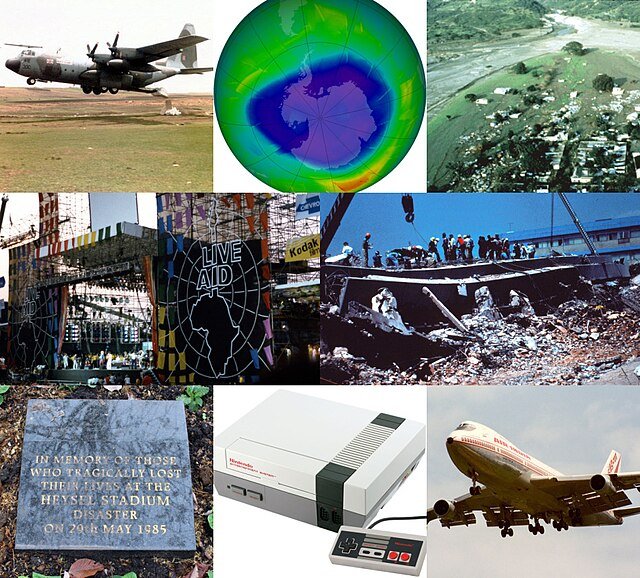
In 1985, the world felt a profound duality: on one hand, images of devastating famine and heartbreaking tragedies spurred unprecedented global unity; on the other, quiet technological shifts were laying the groundwork for a future we now inhabit. The sheer breadth of major events in 1985, from seismic geopolitical shifts to cultural touchstones, created a year of extraordinary contrasts that continue to resonate.
At a Glance: How 1985 Shaped Our World
- Humanitarian Power: Witness the unprecedented global response to famine in Africa, epitomized by “We Are the World” and Operation Moses.
- Geopolitical Crossroads: Understand the rise of Mikhail Gorbachev and early signals of Cold War thawing, juxtaposed with enduring conflicts and anti-apartheid struggles.
- Foundational Tech Leaps: Discover the origins of the modern internet with the Domain Name System (DNS) and the first registered domain, symbolics.com.
- Social & Cultural Milestones: Explore the birth of new pop culture icons, breakthrough medical diagnostics (like the HIV test), and significant social controversies.
- Profound Tragedies: Grapple with devastating natural disasters, industrial accidents, and acts of political violence that marked the year.
The World Rises: Unprecedented Humanitarian Response and Stark Realities
The early months of 1985 were dominated by a global spotlight on the devastating famine in Ethiopia. The crisis spurred an outpouring of international aid and cooperation that had rarely been seen on such a scale. This era of solidarity was perhaps best embodied by the creation of “We Are the World.” Recorded on January 28th, this anthem brought together 45 of the era’s biggest music stars, raising millions for African famine relief. It was a powerful demonstration of how pop culture could mobilize vast resources and public sentiment for humanitarian causes.
Concurrently, a covert operation in January, known as Operation Moses, saw Israel rescue thousands of Ethiopian Jews (Falashas) from Sudanese refugee camps, saving them from the very famine that gripped the region. This mission, initially shrouded in secrecy, highlighted the complex interplay of humanitarianism and geopolitical sensitivity.
Yet, amidst this wave of compassion, the year also brought stark reminders of human vulnerability and the fragility of life. A catastrophic train derailment in Ethiopia on January 13th killed at least 428 people, underscoring the severe infrastructural challenges in the developing world. Later in May, two separate incidents—the Bradford City stadium fire in England, which claimed 56 lives, and the controversial MOVE bombing in Philadelphia, leading to 11 deaths and the destruction of an entire city block—revealed devastating consequences of poor safety standards and urban conflict, respectively. These tragedies served as sobering counterpoints to the year’s more hopeful humanitarian narratives.
Shifting Geopolitical Sands: A New Soviet Era and Enduring Conflicts
March 1985 marked a pivotal moment on the global stage with the ascension of Mikhail Gorbachev as General Secretary of the Communist Party of the Soviet Union. His appointment signaled the beginning of a new era, characterized by his later policies of glasnost (openness) and perestroika (restructuring). Early indicators of a potential thaw in Cold War tensions emerged swiftly; in April, Gorbachev announced a unilateral freeze on the deployment of intermediate-range SS-20 nuclear missiles in Europe, a significant diplomatic gesture.
Despite these hopeful signs, the world remained deeply entrenched in various conflicts and political struggles. In South Africa, the fight against apartheid intensified. On January 31st, President P.W. Botha offered Nelson Mandela conditional release from prison, demanding he renounce violence. Mandela famously refused, solidifying his status as a symbol of resistance. The regime continued its repressive measures, banning publications and resisting international pressure, even as it made minor concessions like repealing mixed marriage acts in April.
Elsewhere, regional tensions simmered or erupted into violence. The murder of DEA agent Enrique ‘Kiki’ Camarena in Mexico in February, orchestrated by drug cartels, underscored the brutal realities of the global drug trade and its far-reaching consequences. The Irish Republican Army (IRA) continued its campaign with a deadly mortar attack on a police base in Northern Ireland in February, and the militant Shiite group Hezbollah formally established itself in Lebanon in February, signaling a new force in the volatile Middle East. Even acts of environmental activism could turn deadly, as seen with the sinking of the Greenpeace ship Rainbow Warrior by French agents in April, resulting in the death of photographer Fernando Pereira.
The Quiet Tech Revolution: Laying the Digital Foundation
While global headlines focused on famine and political shifts, 1985 was also a foundational year for the digital age, with several major events in 1985 quietly reshaping our technological landscape. On January 1st, the Domain Name System (DNS) was created, a seemingly technical detail that now underpins every website you visit. This innovation provided a human-readable way to access internet resources, moving beyond arcane numerical IP addresses. Just two months later, on March 15th, the very first commercial internet domain, symbolics.com, was registered. These early steps were crucial for the internet’s eventual mainstream adoption.
Mobile communication also took its tentative first steps into public consciousness. On January 4th, the UK saw its first-ever mobile phone call, made by Vodafone chairman Sir Ernest Harrison using a chunky Motorola DynaTAC 8000X. This moment marked the beginning of a revolution in personal connectivity. The concept of unsolicited commercial email, or “spam,” also made its debut in May, sent by Gary Thuerk to ARPANET users, foreshadowing a future challenge of the digital world.
Beyond networking, personal computing continued its evolution. In February, Steve Wozniak, co-founder of Apple, announced his departure, a significant shift for the pioneering tech company. In May, Microsoft Excel was launched for Macintosh, quickly becoming a standard for spreadsheets, and IBM released PC DOS 3.1, adding crucial support for local area networks. For broader context on how these advancements fit into the wider picture of technology and pop culture, delve into How 1985 reshaped the world. These developments in connectivity and software were quietly but fundamentally altering how people worked and communicated, setting the stage for the interconnected world we know today.
Social & Cultural Quakes: Pop Power, Medical Breakthroughs, and Public Debates
Beyond politics and tech, 1985 throbbed with cultural energy and significant social shifts. The recording of “We Are the World” in January (and its subsequent international release in March) wasn’t just a humanitarian effort; it was a cultural phenomenon that united music stars like never before, demonstrating the sheer power of pop music to effect change. VH-1 also made its debut on January 1st, offering a new music video outlet targeting an older demographic than MTV. Music festivals expanded their global reach, with the inaugural Rock in Rio in Brazil attracting a staggering 1.38 million attendees over ten days in January.
Cinema offered enduring cultural touchstones, too, with the release of the iconic teen film “The Breakfast Club” in February, which resonated with a generation about identity and social cliques. Meanwhile, new stars were emerging: Whitney Houston released her debut album in February, destined for superstardom, and an 18-year-old Mike Tyson made his professional boxing debut in March with a first-round technical knockout, signaling the arrival of a future champion. In sports, Wayne Gretzky continued his dominance, and the San Francisco 49ers defeated the Miami Dolphins in Super Bowl XIX, highlighting the era’s athletic prowess.
1985 also saw crucial advancements in public health. In March, the US Food and Drug Administration (FDA) approved the first commercial HIV antibody test, a critical step forward in understanding and combating the emerging AIDS epidemic. This breakthrough allowed for blood screening and early diagnosis, fundamentally changing public health strategy. In another medical first, William J. Schroeder became the first permanent artificial heart recipient to leave the hospital in February, showcasing the advancements in medical technology, though his journey would be challenging.
However, the year wasn’t without its controversies and missteps. Coca-Cola’s decision in April to introduce “New Coke,” a reformulated version of its classic beverage, triggered an unexpected and significant consumer backlash. This corporate miscalculation became a legendary case study in brand loyalty and the power of consumer sentiment. Politically, President Ronald Reagan’s visit to the Bitburg military cemetery in Germany in May, where members of the Waffen-SS were buried, ignited widespread criticism and controversy, highlighting lingering sensitivities from World War II.
Practical Playbook: Deciphering the Echoes of 1985
To truly grasp the significance of 1985, it helps to identify the enduring themes that ran through its many major events. This isn’t about specific “actions” to take, but rather a framework for understanding historical impact and applying that insight to contemporary challenges.
- Recognize the Power of Mass Mobilization: “We Are the World” taught us that collective action, amplified by media, can generate immense goodwill and resources for global crises. Consider: How are today’s digital platforms creating new avenues for global solidarity or, conversely, division?
- Track the Seeds of Digital Transformation: Events like the creation of DNS and the first domain registration might have seemed niche, but they were the bedrock of the internet economy. Lesson: Pay attention to seemingly minor technical innovations; they often carry the biggest long-term impact.
- Understand Geopolitical Inflection Points: Gorbachev’s rise and early policy shifts were critical indicators of the end of the Cold War, though it wasn’t immediately apparent. Insight: Look for new leadership and subtle policy changes as potential harbingers of large-scale geopolitical shifts.
- Acknowledge Social Progress and Persistent Struggles: The approval of the HIV test was a beacon of progress, while the anti-apartheid movement showcased the persistence of systemic injustice. Application: Evaluate current events by identifying both areas of advancement and where deeply entrenched social inequalities continue to manifest.
- Learn from Corporate and Political Missteps: New Coke demonstrated the perils of underestimating consumer loyalty, and the Bitburg visit highlighted the complexities of historical memory. Guidance: Consider how public sentiment and historical context can amplify or diminish the impact of corporate decisions or political gestures.
Quick Answers: Unpacking 1985’s Legacy
Q: What was arguably the biggest global event in 1985?
A: While highly subjective, the global humanitarian response to the Ethiopian famine, particularly through initiatives like “We Are the World,” marked an unprecedented moment of global solidarity and cultural impact. Mikhail Gorbachev’s rise to power in the Soviet Union also set the stage for monumental geopolitical changes.
Q: How did 1985 impact technology as we know it today?
A: 1985 was foundational for the internet, with the creation of the Domain Name System (DNS) and the registration of the first commercial internet domain, symbolics.com. It also saw the first UK mobile phone call and early commercial email (spam), foreshadowing the mobile and digital communication era.
Q: Were there significant social movements or changes in 1985?
A: Absolutely. The anti-apartheid movement continued to gain global momentum, symbolized by Nelson Mandela’s refusal of conditional release. The US Sanctuary Movement highlighted immigration issues, and farmers protested Reagan administration policies. The approval of the first commercial HIV test marked a critical moment in public health and the fight against AIDS.
Q: What were some of the major tragedies or conflicts that year?
A: 1985 was marked by several profound tragedies: a devastating train derailment in Ethiopia, the Bradford City stadium fire, the controversial MOVE bombing in Philadelphia, and the murder of DEA agent Kiki Camarena. Geopolitically, the sinking of the Greenpeace Rainbow Warrior and continued violence in Northern Ireland and Lebanon demonstrated ongoing conflicts.
The Enduring Echoes of 1985
The year 1985 stands as a testament to humanity’s capacity for both profound compassion and devastating conflict, all against a backdrop of accelerating technological change. From the collective embrace of “We Are the World” to the silent birth of the internet’s infrastructure, the major events in 1985 laid down complex layers of legacy. It was a year that redefined global responsibility, signaled shifts in superpower dynamics, and quietly built the digital scaffolding for the world to come. Understanding 1985 isn’t just about recalling facts; it’s about appreciating the interwoven forces that continue to shape our present and future.










