The year 1889 doesn’t always command the spotlight in textbooks, but if you look closely, you’ll see the DNA of modern America being written. To truly understand what happened in 1889 in American history, you have to picture a nation in motion—a country of surging ambition, stark contrasts, and profound change. It was a year when the map was literally redrawn, new technologies promised a future of dazzling efficiency, and the raw, often brutal, realities of the Gilded Age played out in catastrophic disasters and bold social experiments.
From a presidential inauguration that marked a shift in power to a land rush that created cities in a single day, 1889 was a pivot point. It was a year of endings, like the final bare-knuckle boxing championship, and beginnings, like the first issue of The Wall Street Journal. Let’s pull back the curtain on this transformative year.
At a Glance: Key Events of 1889
Pressed for time? Here are the major headlines that shaped America in 1889:
- Four New States: North Dakota, South Dakota, Montana, and Washington were admitted to the Union, the largest single-year expansion since the nation’s founding.
- New President: Benjamin Harrison was inaugurated as the 23rd U.S. President, having won the Electoral College despite losing the popular vote to Grover Cleveland.
- Oklahoma Land Rush: Nearly two million acres of “Unassigned Lands” were opened, leading to a frenzied race for territory and the instant creation of cities like Guthrie and Oklahoma City.
- The Johnstown Flood: One of the deadliest disasters in American history unfolded in Pennsylvania when a dam collapse killed over 2,200 people.
- Technological Leaps: The Coca-Cola Company was incorporated, the first jukebox debuted, and Herman Hollerith patented his electric tabulating machine, a precursor to modern computing.
- Social Milestones: The influential Hull House settlement opened in Chicago, and journalist Nellie Bly began her record-breaking trip around the world.
A Nation Redrawn: The Great State Rush of ’89
The most dramatic and lasting change of 1889 was the physical expansion of the United States. In a flurry of activity, the nation’s flag gained four new stars, fundamentally altering the political landscape of the West.
The Omnibus Bill and a New Political Map
The stage was set on February 22, when outgoing President Grover Cleveland signed the Enabling Act of 1889. This landmark legislation, often called the “Omnibus Bill,” authorized the territories of North Dakota, South Dakota, Montana, and Washington to form constitutional conventions and officially apply for statehood.
The move was a masterstroke of political calculation. For years, Democrats had blocked the admission of these largely Republican-leaning territories. With Republican Benjamin Harrison set to take office, the parties struck a deal, setting off a race to statehood.
Under President Harrison, the admissions came swiftly in November:
- November 2: North Dakota (39th state) and South Dakota (40th state)
- November 8: Montana (41st state)
- November 11: Washington (42nd state)
To avoid any political squabbling over which Dakota came first, Harrison famously shuffled the papers and signed one blindly. To this day, their official admission order is determined alphabetically. This expansion was a key part of the Gilded Age’s political saga, securing Republican influence in the Senate for years to come.
The Thunder of Hooves: The Oklahoma Land Rush
While politicians redrew maps with ink, thousands of settlers did it with wagons and horses. On April 22, 1889, the federal government opened 1.9 million acres of former Indian Territory in what is now Oklahoma. At the stroke of noon, a cannon blast signaled the start of the Land Rush of 1889.
An estimated 50,000 people, known as “Boomers,” lined the border, waiting to stake their claim on a 160-acre plot. The scene was one of controlled chaos, with riders on horseback, families in rickety wagons, and even some on foot surging forward to find their piece of the “promised land.”
By nightfall, entire cities had sprung from the prairie. Oklahoma City and Guthrie each boasted populations of over 10,000, complete with provisional governments, tent saloons, and land claim offices. Of course, not everyone played by the rules. “Sooners,” who had slipped past authorities to claim prime land before the official start, became a legendary part of the story.
The Unseen Cost of Expansion
This explosive growth came at a great cost. The land had been carved from territory historically assigned to the Creek and Seminole nations. The rush was another chapter in the painful displacement of Native American tribes, a process central to westward expansion.
That same year, the government formalized its assault on Native culture. The U.S. created the Indian Religious Code, a set of regulations enforced on reservations that banned traditional spiritual practices and ceremonies. This policy aimed to force assimilation by suppressing cultural identity, a stark reminder of the darker side of the era’s “progress.” The expansionist spirit was one of the defining Key events of the 1880s, and 1889 saw its consequences in sharp relief.
A New Hand at the Helm: Politics and Government
The year began with a political transition. Though the presidential election was held in 1888, its consequences solidified in 1889. Republican Benjamin Harrison, grandson of the ninth president, William Henry Harrison, was inaugurated on March 4.
Harrison’s victory over incumbent Democrat Grover Cleveland was one of the rare instances where the winner of the Electoral College lost the popular vote. With a high voter turnout of nearly 80%, the election highlighted the deep partisan divides of the era.
Beyond the White House, the federal government itself was evolving. On February 9, the Department of Agriculture was elevated to a Cabinet-level agency. This move signaled the growing importance of farming to the national economy and the government’s increasing role in regulating and supporting the industry.
Trial by Fire and Flood: A Year of Unprecedented Disaster
Nature and human error conspired to make 1889 a year of staggering tragedy. Three major events, in particular, captured national attention and exposed the vulnerabilities of a rapidly industrializing society.
The Johnstown Flood: A Man-Made Catastrophe
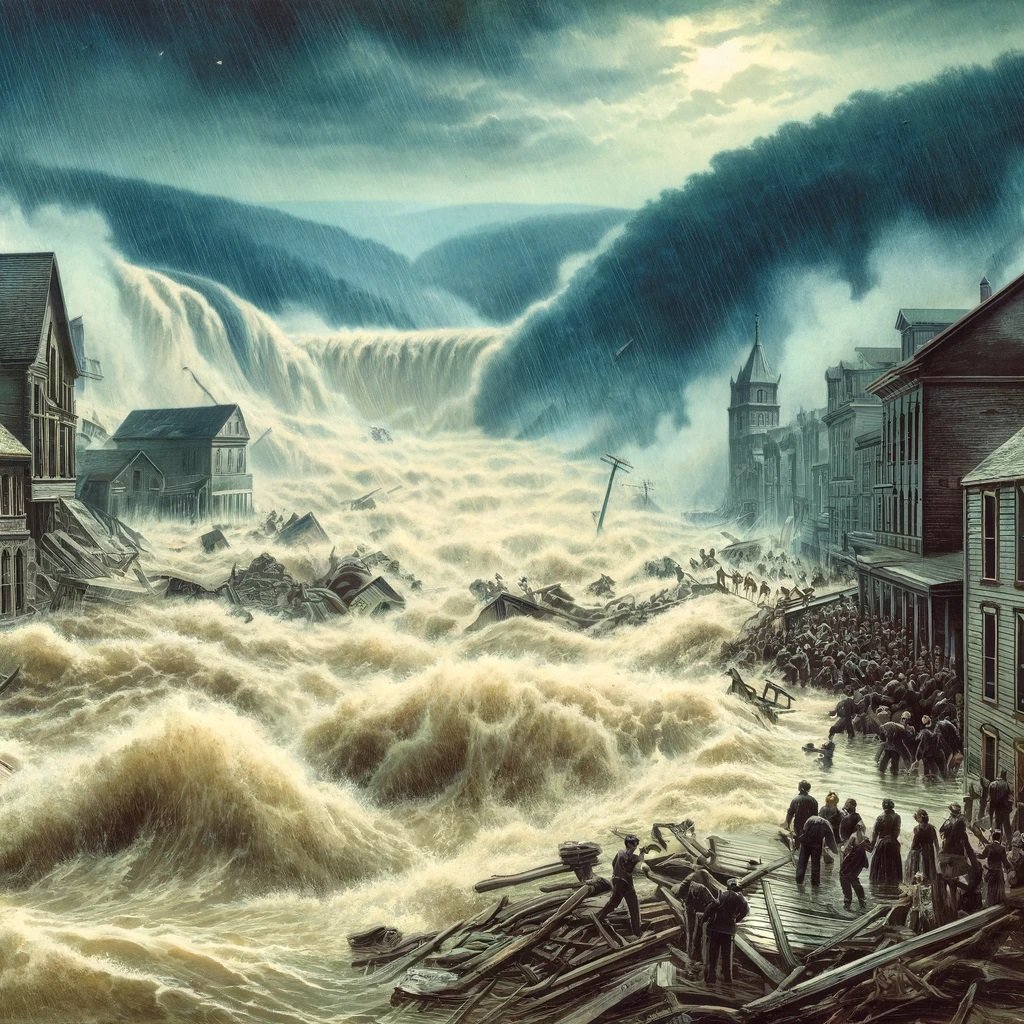
On May 31, after days of torrential rain, the South Fork Dam collapsed, unleashing 20 million tons of water from Lake Conemaugh into the valley below. The wall of water, said to be nearly 40 feet high and moving at 40 miles per hour, slammed into Johnstown, Pennsylvania, a bustling steel town.
The flood obliterated everything in its path. Homes, factories, and bridges were swept away in a tide of debris that caught fire, creating an apocalyptic scene. More than 2,200 people were killed, and thousands more were left homeless. The disaster was a direct result of negligence; the dam was poorly maintained by the wealthy South Fork Fishing and Hunting Club, whose members included Andrew Carnegie and Henry Clay Frick. The event became a national symbol of Gilded Age inequality, where the actions of a privileged few led to catastrophic consequences for working-class communities.
The Great Fires of the West
The devastation wasn’t limited to the East. On June 6, a glue pot in a cabinet shop started the Great Seattle Fire, which burned through 25 downtown blocks, destroying the city’s entire business district. Miraculously, no one was killed, and the city seized the opportunity to rebuild with brick and stone instead of wood, raising the street level and installing a modern water system.
Just a month later, on July 7, the Great Bakersfield Fire in California destroyed 196 buildings and left nearly 1,500 people without homes. Like Seattle, the city turned tragedy into an opportunity for modernization.
The Dawn of a Modern Age: Innovation in Commerce and Communication
While disaster struck, innovation surged. The year 1889 was a hotbed of inventions and new ventures that would shape the 20th century and beyond. A closer look reveals a vivid picture of Life in America, 1889, where new ideas were rapidly changing how people worked, consumed, and communicated.
The Machines That Changed Everything
- Electric Tabulating Machine: On January 8, Herman Hollerith received a patent for his groundbreaking invention. This device used punch cards to tabulate data and was a revolutionary leap in data processing. It was chosen to process the 1890 U.S. Census, completing the task in a fraction of the time it would have taken manually. Hollerith’s company would eventually become International Business Machines, or IBM.
- The First Jukebox: On November 23, the Palais Royale Saloon in San Francisco became home to the first coin-operated music player. Invented by Louis Glass, the “nickel-in-the-slot” phonograph allowed patrons to listen to music through one of four listening tubes.
Brands and Media Are Born
- Coca-Cola: While the drink was invented a few years earlier, the Coca-Cola Company was officially incorporated in Atlanta on January 15, setting the stage for it to become a global empire.
- The Wall Street Journal: On July 8, Charles Dow, Edward Jones, and Charles Bergstresser published the first issue of their financial newspaper. It quickly became the essential source for business and financial news in America.
- Columbia Phonograph: Formed on January 22, this company would become one of the “Big Three” in American record companies, bringing recorded music into homes across the country.
Culture, Society, and Human Endeavor
Beyond politics and technology, 1889 was a year of remarkable social and cultural moments that reflected the nation’s changing values and boundless spirit.
Champions of Change and Sport
On September 18, social reformers Jane Addams and Ellen Gates Starr opened Hull House in Chicago. It was a settlement house dedicated to providing social, educational, and artistic programs for the surrounding immigrant community. Hull House became a model for social work across the country, influencing policy on child labor, public health, and women’s rights.
In another victory for progress, Provident Hospital was established in Chicago on January 23. It was the first non-segregated, African-American-owned and operated hospital in the United States, a crucial institution in an era of deep racial discrimination.
On the sports front, the era of bare-knuckle boxing reached a brutal climax. On July 8, John L. Sullivan defeated Jake Kilrain in a grueling 75-round bout, the last heavyweight championship fought under London Prize Ring Rules. The fight’s sheer brutality helped usher in the era of gloved boxing under the Marquess of Queensberry Rules.
Around the World in 72 Days
Perhaps no one captured the ambitious, can-do spirit of 1889 better than journalist Nellie Bly. Inspired by Jules Verne’s novel Around the World in Eighty Days, she departed from New York on November 14 on a mission to circle the globe in record time. Her employer, the New York World, turned her journey into a media sensation. Bly completed the trip in an astonishing 72 days, 6 hours, and 11 minutes, returning a hero and cementing her status as a pioneer of investigative journalism.
Common Questions About 1889
Why were four states admitted in 1889 at once?
The admission was largely a political compromise. Democrats had long blocked the statehood of these Republican-leaning territories. The Enabling Act of 1889 was passed in the final days of a Democratic administration, clearing the way for the incoming Republican president to admit them, thereby strengthening the Republican party’s hold on the U.S. Senate.
Was the Homestead Act of 1862 still in effect in 1889?
Yes, the Homestead Act was still very much in effect and was the legal basis for events like the Oklahoma Land Rush. However, by 1889, its loopholes were being widely exploited by speculators, railroads, and corporations. The government was beginning to enforce land use and residency requirements more strictly to combat this fraud.
What was the biggest technological innovation of 1889?
While the jukebox and Coca-Cola’s incorporation were significant, Herman Hollerith’s electric tabulating machine had the most profound long-term impact. It laid the foundation for automated data processing and the entire computing industry, eventually leading to the creation of IBM.
The Enduring Echoes of a Transformative Year
Looking back, 1889 wasn’t just a collection of disparate events; it was a year that captured the essence of the Gilded Age. It was a time of explosive growth and devastating loss, of brilliant innovation and systemic injustice, of individual ambition and collective struggle.
The decisions made and the events that unfolded—from the drawing of state lines to the patenting of a new machine—created ripples that continue to shape the United States today. The new states of the West remain vital parts of the nation’s political and economic fabric. The social reforms pioneered at Hull House became the bedrock of modern social work. And the technological seeds planted in 1889 blossomed into the industries that define our world. It was, in every sense, a year that built the future.










