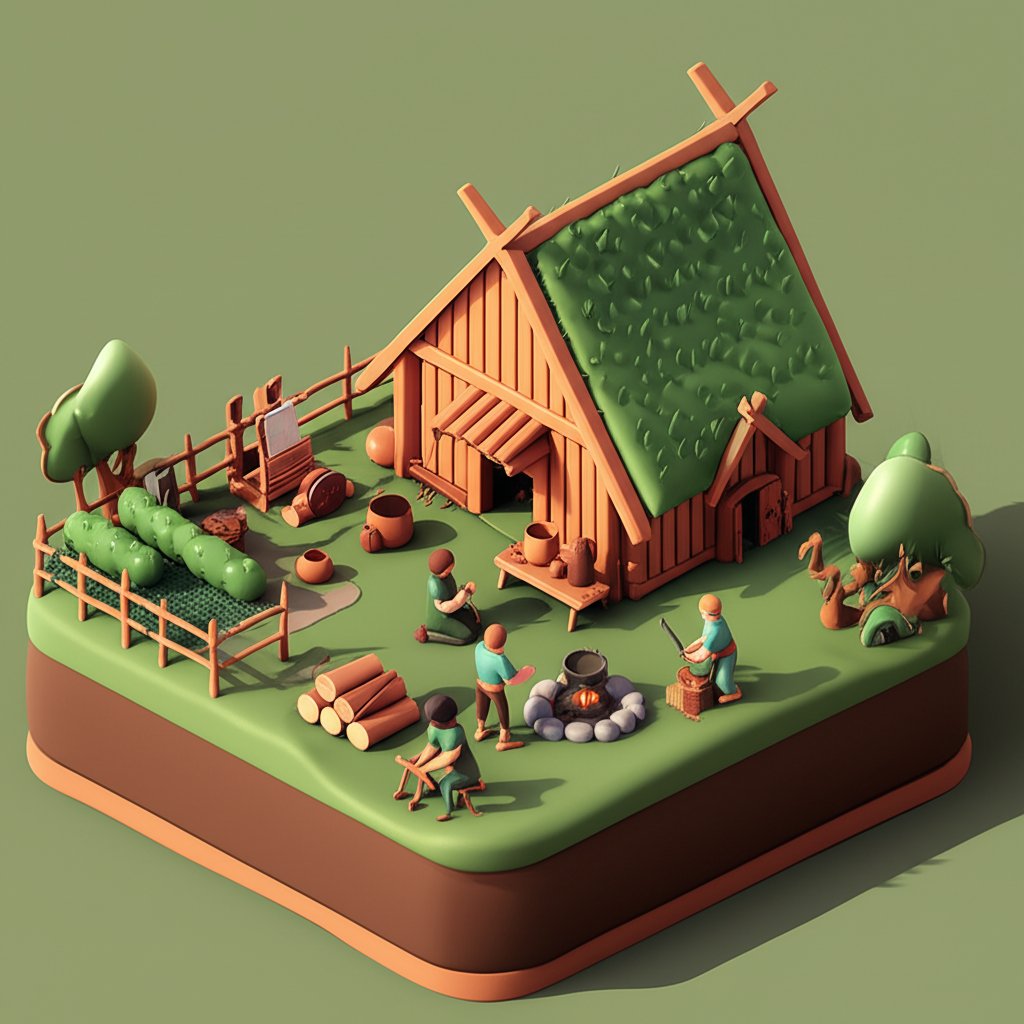
We’ve all seen the image: a hulking brute in a horned helmet, draped in drab furs, leaping from a longship with a battle-axe. But this caricature misses the fascinating truth of the realistic viking, a person far more complex, colorful, and clean than pop culture would have us believe. Understanding them means swapping fantasy for fact, from their hairstyles to their height.
At a Glance: What You’ll Uncover
- The Real Build: How Viking men and women were physically built—stronger, more compact, and with different facial structures than modern Scandinavians.
- Grooming and Style: The surprising truth about their hair, beards, hygiene, and even their use of makeup.
- A Colorful Wardrobe: Why the idea of drab, fur-clad raiders is wrong, and what they actually wore.
- Status in Silver and Bronze: How jewelry was more than decoration; it was a Viking’s bank account, resume, and statement of faith.
- Myth-Busting Common Tropes: A direct takedown of the most persistent fictions, from horned helmets to universal savagery.
Deconstructing the Viking Physique: Strength Over Stature
Forget the towering giants of Hollywood. Archaeological evidence from skeletal remains across Scandinavia paints a more grounded picture. A realistic viking was formidable, but their power came from dense muscle, not modern-day height.
Based on analysis from burial sites in Denmark, the average Viking man stood around 172 cm (5′ 7.5″), with women averaging 158 cm (5′ 2″). While some regional variations show men reaching up to 176 cm (5′ 9″)—taller than many of their European contemporaries—they were still a good 8-10 cm shorter than the average person today.
What they lacked in height, they made up for in brawn. Life was a cycle of hard physical labor: farming, sailing, smithing, and building. This lifestyle forged robust, muscular bodies in both men and women. Skeletons show thick bone density and well-developed muscle attachment points, indicating a life of constant physical exertion.
Faces of the Past: A Different Kind of Look
Interestingly, facial structures between the sexes were less distinct than they are today. Female skulls often exhibit a more prominent brow ridge, a feature we now associate more with male faces. Conversely, male skulls from the era show slightly softer jawlines and brow ridges than their modern counterparts. This created a more rugged, androgynous look across the population compared to modern standards. While we’re diving deep into the specifics of their build and grooming, you can get a complete overview of How Vikings truly looked in our main guide.
More Than Just Blondes: The Truth About Viking Style
The stereotype of a uniformly blonde-haired people is one of the most persistent myths. The reality was far more diverse, a direct reflection of their genetics and extensive travel.
- Regional Hair Color: DNA studies and historical accounts show a fascinating regional split. Blond hair was indeed common in northern areas like Sweden. However, red hair was more dominant in western regions like Denmark. And thanks to trade and settlement, darker hair colors like brown and black were present throughout the Viking world.
- Hair as a Statement: Hair was a source of immense pride. Men often wore their hair long, at least to the shoulder, and styled it in braids or ponytails to keep it out of their eyes during work or combat. One particularly famous—and historically verified—style was the “reverse mullet” or “Norman cut”: long in the front with the back and sides of the head shaved short.
- The Mighty Beard: For men, a full beard was a sign of virility and honor. They were meticulously cared for, often trimmed, combed, and sometimes even braided or woven with beads. To be called beardless was a grave insult.
- Women’s Crowning Glory: Women typically wore their hair very long. It was almost always styled in intricate braids or tied up in a knot or bun at the back of the head, a practical choice for a life of hard work. Married women often covered their hair with a scarf or cap as a sign of their status.
The Cleanest “Barbarians” in Europe
Contrary to the image of the grimy marauder, Vikings were remarkably well-groomed. Archaeological digs consistently unearth personal grooming kits from gravesites, containing items you might recognize today.
| Tool Found in Graves | Common Use |
|---|---|
| Combs | Made of bone, antler, or wood; used daily to style hair and beards. |
| Tweezers | For plucking stray hairs and personal hygiene. |
| Ear Spoons | Small, delicate tools for cleaning earwax. |
| Razors | Simple iron razors for shaving parts of the head or face. |
| Their commitment to cleanliness was so notable that it was recorded by outsiders. The Old Norse word for Saturday, laugardagur, literally translates to “washing day,” pointing to a weekly bathing ritual. The 13th-century English chronicler John of Wallingford even complained that the Viking men’s habit of combing their hair daily, bathing weekly, and changing their clothes frequently made them irresistibly attractive to English noblewomen. | |
| Furthermore, both men and women used a form of makeup. The Arab diplomat Ibn Fadlan, who met a group of Swedish Rus Vikings in the 10th century, noted that they outlined their eyes with kohl. This wasn’t just for women; it was a universal practice to enhance their eyes and create a more intimidating, striking appearance. |
A Wardrobe of Color and Function
The idea of Vikings wearing nothing but drab brown and grey animal hides is a cinematic invention. In reality, their world was full of color. Using dyes made from plants and minerals, they colored their wool and linen textiles in vibrant shades.
- Popular Colors: Madder root for red, woad for blue, and various lichens and plants for yellows and greens. Wealthier individuals could afford more exotic or concentrated dyes, making bright clothing a status symbol.
- Men’s Attire: The standard outfit was a long-sleeved tunic made of wool or linen, which reached the mid-thigh or knee. This was worn over trousers, which could be either loose-fitting or snug, sometimes with fabric wraps around the lower legs for warmth and protection. A leather belt held the tunic in place and was used to carry a knife, pouch, and other daily essentials. A rectangular wool cloak, fastened at the shoulder with a large pin or brooch, completed the ensemble.
- Women’s Attire: The iconic female garment was the hangerok, or apron dress. This was a tubular dress, typically made of wool, worn over a linen underdress or smock. It was held up by two straps that went over the shoulders and were fastened at the front with a pair of large, ornate brooches, known as tortoise brooches. Strings of glass or amber beads were often strung between these brooches, along with keys and small tools, displaying the woman’s role as head of the household.
Jewelry: Wealth Worn on the Body
For a realistic viking, jewelry was far more than simple adornment. In a society without formal banks, it was their savings account, a public display of wealth, and a testament to their travels and successes.
- Arm Rings: Men, especially successful warriors and chieftains, wore heavy rings of twisted silver or gold on their arms. These weren’t just for show. They functioned as portable wealth, a system known as “hack silver.” When a Viking needed to buy something, they could literally chop a piece off their arm ring to pay for it.
- Brooches and Pins: These were essential, functional items used to fasten cloaks and dresses. But their design—from simple iron pins to elaborate gilded bronze masterpieces—communicated the owner’s social standing at a glance.
- Pendants and Amulets: The most famous amulet was the Mjölnir, or Thor’s Hammer. Wearing one was a powerful statement of faith in the Old Gods, especially during the period when Christianity was gaining influence.
Quick Answers to Common Viking Myths
Let’s clear up a few more misconceptions.
Did Vikings really have horned helmets?
Absolutely not. This is the single most pervasive myth, an invention of a 19th-century costume designer for a Wagner opera. Not a single helmet with horns has ever been found from the Viking Age. Real Viking helmets were simple, functional bowls or conical caps made of iron or leather, sometimes with a nose guard or “spectacle” guard around the eyes. Horns would be a massive liability in a fight, easily grabbed or knocked aside.
What about tattoos? Were they common?
This is a grey area. The only written account comes from Ibn Fadlan, who described the Rus people he met as being covered in dark green, tree-like patterns “from the tips of his fingers to his neck.” However, the Rus may have been a distinct group with unique customs, and there is no other mention of tattooing in Norse sagas or any direct archaeological evidence (like preserved skin). So, while some may have had tattoos, it was likely not a widespread practice among all Scandinavian peoples of the era.
Were there other body modifications?
Yes, and we have the skeletal proof. Archaeologists have found numerous male skulls, primarily from the island of Gotland, Sweden, with horizontal grooves filed into their front teeth. The precision of these filings suggests it was done by a skilled artisan. The grooves were sometimes filled with pigment, likely to make them even more noticeable. This was a deliberate, likely intimidating modification chosen by certain groups of warriors to mark themselves as part of an elite brotherhood.
Was “Viking” a people or a job description?
Technically, it was a job. The Old Norse verb víking means to go on an expedition, usually by sea. A “Vikingr” was a person who did this—a raider, explorer, or long-distance trader. Not everyone in Scandinavia was a Viking; most were farmers, merchants, and craftspeople who never went raiding. The term has since evolved to describe the people and culture of the entire period.
Adopting a Realistic Viking Mindset
To truly understand the realistic viking, move past the one-dimensional warrior trope. Think of them as pragmatic, resourceful, and status-conscious people living in a harsh world. Their choices in clothing, grooming, and even body modification were driven by a complex mix of function, tradition, and a desire to project strength and success.
When writing a character, designing a costume, or simply picturing this historical period, focus on the details that ground them in reality:
- The Practicality: Every item had a purpose. A brooch held a cloak, an arm ring was money, and a hairstyle kept hair out of the way.
- The Pride: Their appearance was a reflection of their honor and accomplishments. A well-groomed beard or a brightly colored tunic was a sign that they were succeeding in life.
- The Diversity: There was no single “Viking look.” A Danish trader, a Swedish farmer, and a Norwegian raider would have looked and dressed differently, reflecting their unique regional cultures and personal fortunes.
By embracing this nuanced and fact-based view, we can appreciate the Viking Age not as a dark time of brutal caricature, but as a vibrant and complex era populated by real, fascinating human beings.










