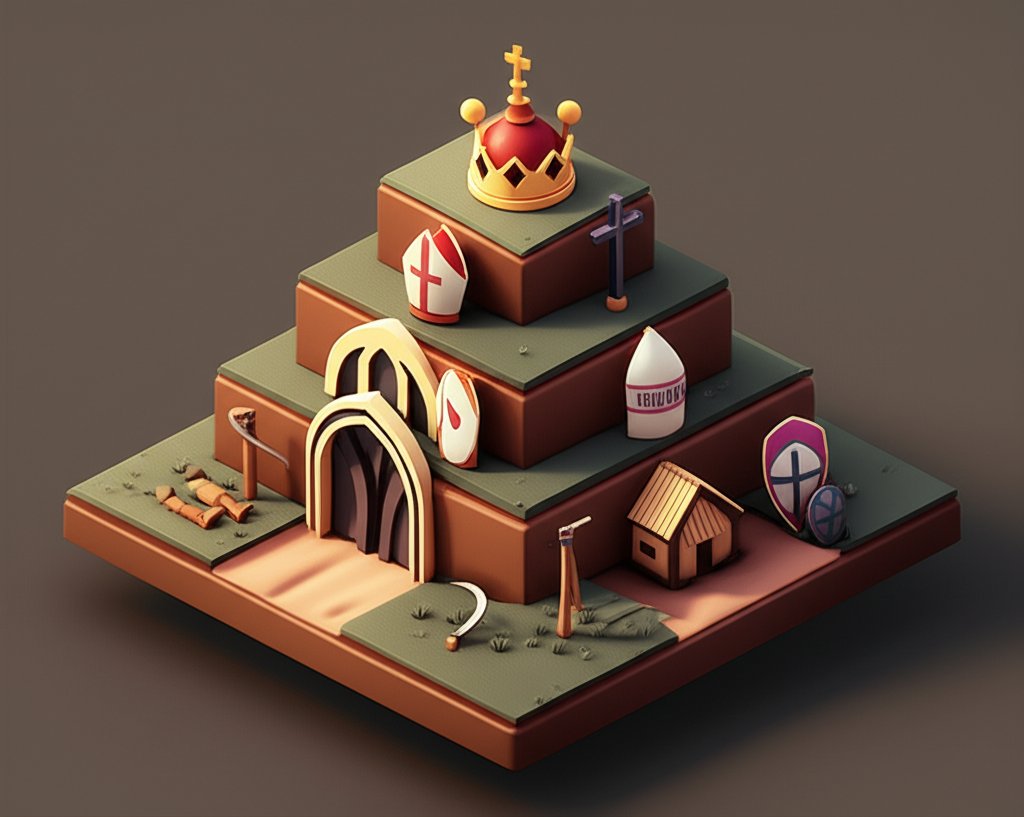
The world you were born into determined the world you would die in. For a farmer’s son in 12th-century Europe, this wasn’t a pessimistic outlook; it was a simple fact of life, governed by the rigid medieval hierarchy. This intricate social structure was more than a simple pyramid of power—it was the operating system for society, dictating everything from who you could marry and what you could eat to your obligations to your lord and your chances of seeing the world beyond your village. Understanding this system isn’t just about history; it’s about seeing the blueprint that shaped modern Western concepts of class, law, and power.
At a Glance: What You’ll Discover
- The “Three Orders” Model: Unpack the official ideology of “those who pray, those who fight, and those who work” and see how it played out in reality.
- A Web of Obligations: Learn how duties and responsibilities flowed both up and down the social ladder, creating a system of mutual, if unequal, dependence.
- The Nuances Within Each Class: Discover that no class was a monolith—a powerful duke and a poor knight were both nobles, but their lives were worlds apart.
- The Cracks in the Pyramid: Pinpoint the few, difficult paths to social mobility, from the church to the battlefield to the marketplace.
- Forces of Change: Grasp how plague, burgeoning cities, and peasant unrest began to challenge and ultimately unravel this centuries-old structure.
The Divine Blueprint: Those Who Pray, Those Who Fight, Those Who Work
The medieval mind craved order, and the medieval hierarchy provided it. The prevailing ideology, heavily promoted by the Church, divided society into three distinct “orders” or estates, each with a divinely appointed function:
- Oratores (Those Who Pray): The Clergy. Tasked with the spiritual well-being of all, their role was to pray for the souls of society and act as intermediaries with God.
- Bellatores (Those Who Fight): The Nobility. The warrior class, from kings down to knights, was responsible for protecting the realm and its people, administering justice, and leading in battle.
- Laboratores (Those Who Work): The Commoners. This vast majority (over 90% of the population) was tasked with producing the food and goods that sustained the other two orders.
This tripartite system was presented not as a social construct, but as a reflection of God’s will—a “Great Chain of Being” where everyone had a fixed and necessary place. This simple framework provides a great starting point for understanding the era’s social dynamics, but the reality on the ground was far more complex. For a broader overview of these three groups, see How medieval classes shaped life.
Unpacking the Pyramid: Who Really Held the Power?
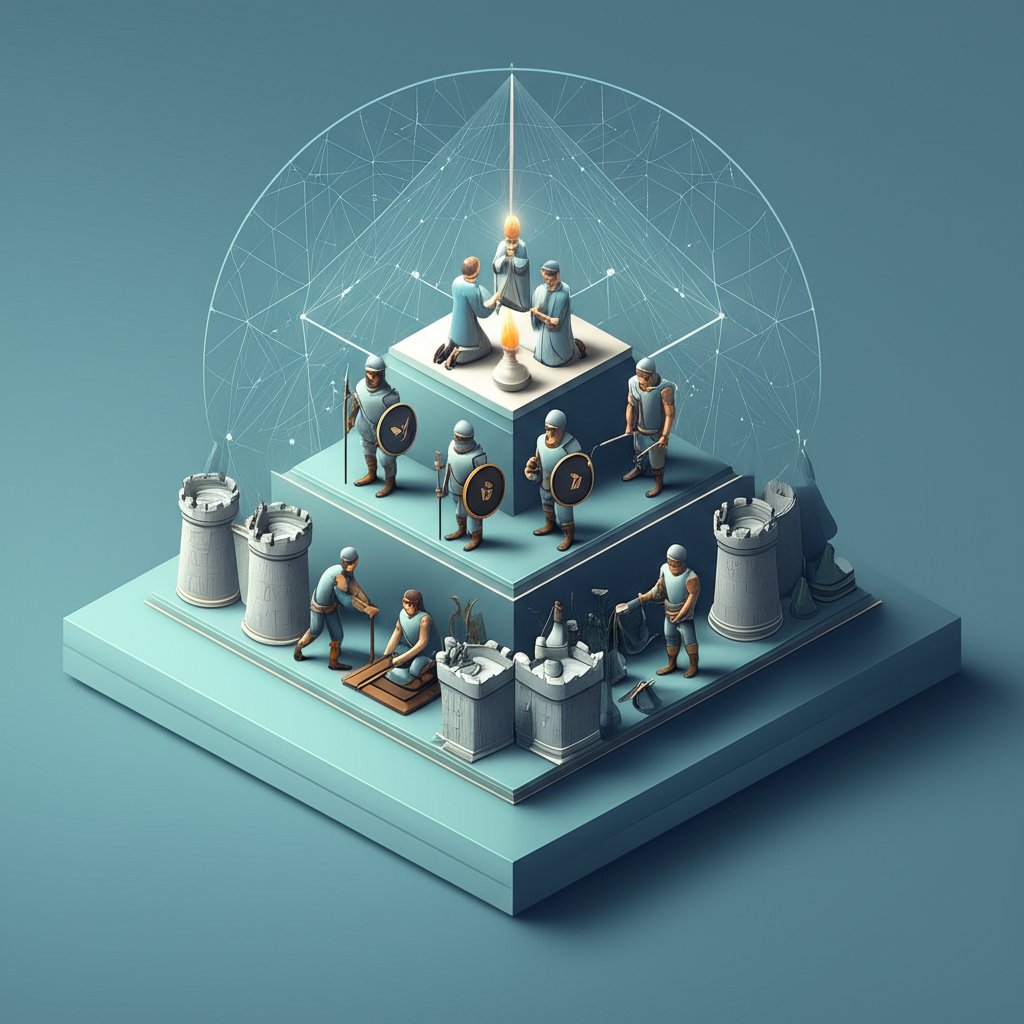
While the “Three Orders” model is a useful guide, it masks the deep divisions and sub-layers that existed within each group. Power wasn’t just about which order you belonged to; it was about your specific rank within that order’s own intricate hierarchy.
At the Apex: The King and High Nobility
At the very top sat the monarch, who in theory held ultimate authority. In practice, a king’s power often depended on the loyalty of his most powerful nobles—the dukes, earls, and counts. These high-ranking aristocrats controlled vast territories, sometimes rivaling the king’s own, and commanded their own armies of lesser nobles.
The core of this system was feudalism: a king or high lord would grant a parcel of land (a “fief”) to a lesser lord or knight. In return, the recipient swore an oath of fealty, promising military service, counsel, and financial aid. This created a pyramid of loyalty, but it was often fragile. A powerful duke might be a vassal to the king of France but simultaneously hold lands that made him a near-equal.
The Church: A Parallel Power Structure
The clergy was not just a spiritual class; it was a parallel government. The Church was the single largest landowner in Europe, and its hierarchy—from the Pope in Rome down to the village priest—wielded immense political and economic power.
A powerful archbishop or abbot could be as influential as a duke. They controlled vast estates, collected taxes (the tithe, a 10% levy on all agricultural produce), and ran their own court systems. Because clergy were often the only literate people, they served as essential administrators, record-keepers, and advisors to kings and nobles, further embedding their influence in the secular world.
The Growing Middle: Merchants, Guilds, and Urban Power
The simple category of “those who work” obscures one of the most dynamic forces in the later Middle Ages: the rise of a merchant and artisan class. As towns and cities grew, so did the power of those who controlled trade and craft.
These were not farmers. They were master weavers, skilled goldsmiths, and long-distance traders who organized themselves into powerful guilds. These guilds regulated prices, set standards of quality, and protected their members’ interests. A wealthy wool merchant in Flanders or a banker in Florence might be a “commoner” by birth, but their economic power could dwarf that of many land-poor knights. They represented a new form of power based on wealth, not land, and began to challenge the old feudal order.
The Broad Base: Critical Distinctions Among the Peasantry
Life for the vast majority was defined by agriculture, but not all peasants were equal. The distinction between a serf and a freeman was one of the most significant in the medieval world.
- Serfs were unfree peasants bound to the lord’s land (the manor). They could not leave, marry, or even have their grain milled without the lord’s permission. In exchange for a small plot to farm for their own families, they owed the lord labor service (known as corvée) on his personal lands.
- Freemen (or free peasants) were not tied to the land. They might rent land from a lord or even own a small plot outright. While they still owed taxes and tithes, they had legal rights and freedom of movement that serfs lacked.
This simple table illustrates the stark differences in their daily reality:
| Peasant Type | Freedom of Movement | Land Holding | Key Obligations |
| :— | :— | :— | :— |
| Serf | None (tied to the manor) | Could not own; worked a plot | Labor service (corvée), fees, tithes |
| Villein | Limited (permission needed) | Held land from the lord | Similar to serfs, but with more defined rights |
| Freeman | Yes | Could own or rent land | Rent, taxes, tithes; potential military service |
The Bonds of Fealty: What Each Class Owed the Others
The medieval hierarchy is often seen as purely exploitative, but it was built on a system of reciprocal, if heavily imbalanced, obligations. Each level of society owed something to the others, creating the social glue that held the feudal world together.
- A Peasant’s Perspective: You worked the lord’s land several days a week. You paid a fee to use his mill and oven. A portion of your harvest went to his storehouse. In return for this back-breaking labor, his knights and castle walls offered protection from bandits, invading armies, and the general chaos of the era. This protection was the fundamental promise of the feudal contract.
- A Knight’s Perspective: You held a manor granted by a baron. You were obligated to answer his call to arms for 40 days a year, fully equipped and ready for battle. You also had to attend his court and offer counsel. In return, the lands you held supported you, your family, and your warhorse, ensuring your status and livelihood.
- A Baron’s Perspective: You owed loyalty and a quota of knights to your duke or king. Neglecting this duty could mean forfeiting your lands and title. In return, the king’s authority legitimized your rule and offered a final court of appeal in disputes with other powerful lords.
When this system worked, it provided a degree of stability in a violent age. When it failed—due to a weak king, a greedy lord, or a crop-destroying famine—the consequences could be catastrophic for everyone.
Navigating the Hierarchy: The Rare Paths to Advancement

Social mobility was incredibly difficult, as the entire system was designed to be static. However, it wasn’t completely impossible. For the ambitious and the lucky, a few narrow paths offered a chance to climb the ladder.
- The Church: This was the most viable route. As the Church valued intellect and piety over bloodline, a bright peasant boy could theoretically rise to become a priest, a powerful abbot, or even a bishop who advised kings. Men like Abbot Suger, a key advisor to French kings in the 12th century, came from a minor family and achieved immense power through the Church.
- The Battlefield: In the early medieval period, exceptional courage or skill in battle could earn a common soldier a knighthood and a small grant of land. This path narrowed over time as knighthood became more exclusive and hereditary, but it remained a powerful ideal.
- The Marketplace: The rise of towns created a new avenue based on wealth. A shrewd merchant could accumulate a fortune that surpassed that of many nobles. This wealth could be used to purchase land, marry into a cash-strapped noble family, or lend money to a king in exchange for political favors and, eventually, a title. The de la Pole family in 14th-century England famously rose from wool merchants to become the Earls of Suffolk.
Of course, downward mobility was far more common. A noble family on the losing side of a war could lose everything. Famine or debt could force a free peasant to sell himself and his family into serfdom simply to survive.
Demystifying the Medieval Hierarchy
Common questions often arise about how this system truly functioned. Here are some quick, clear answers.
Q: Was everyone in a class treated the same?
Absolutely not. The nobility ranged from the king himself down to a landless hedge knight with little more than his horse and armor. The clergy included powerful prince-bishops who ruled vast territories and impoverished village priests who were barely better off than their parishioners. Within the “working” class, a master guildsman in a city had far more status, wealth, and freedom than a rural serf.
Q: Did people actually accept this system?
For the most part, yes. The system was powerfully reinforced by religious teaching, tradition, and the lack of visible alternatives. It was seen as the natural, God-given order of the world. However, simmering resentments over high taxes and harsh treatment frequently boiled over into violent uprisings, such as the English Peasants’ Revolt of 1381, proving that acceptance was not always willing.
Q: How did the Black Death change the hierarchy?
The Black Death (1347-1351) was a catastrophic event that killed a third or more of Europe’s population. It radically disrupted the social order by creating a massive labor shortage. Suddenly, surviving peasants were in a position to demand higher wages and greater freedoms. Many abandoned their manors for better opportunities in towns, severely weakening the old feudal bonds and accelerating the end of serfdom in much of Western Europe.
Q: Could you buy your way into the nobility?
Yes, but it was a slow and expensive process. A very wealthy merchant family might begin by buying a country estate. They would start living like nobles, arranging strategic marriages for their children with the lower, land-poor gentry. Over a generation or two, their “new money” would become “old money,” and they might eventually be accepted as part of the aristocracy, perhaps even purchasing a title directly from a king in need of cash.
The Enduring Structure of a Rigid World
The medieval hierarchy was far more than a simple org chart of kings, lords, and peasants. It was a complex web of interlocking duties, divine justifications, and economic realities that dictated the course of nearly every life in Europe for a thousand years. Its rigidity provided stability in a chaotic world, but it also stifled innovation and individual potential.
Understanding this structure is key to understanding the forces that eventually tore it down: the rise of a moneyed economy, the centralizing power of kings, the intellectual challenge of the Renaissance, and the spiritual upheaval of the Reformation. The echoes of this hierarchical world—in our legal systems, our concepts of land ownership, and the very existence of social classes—can still be felt today.










