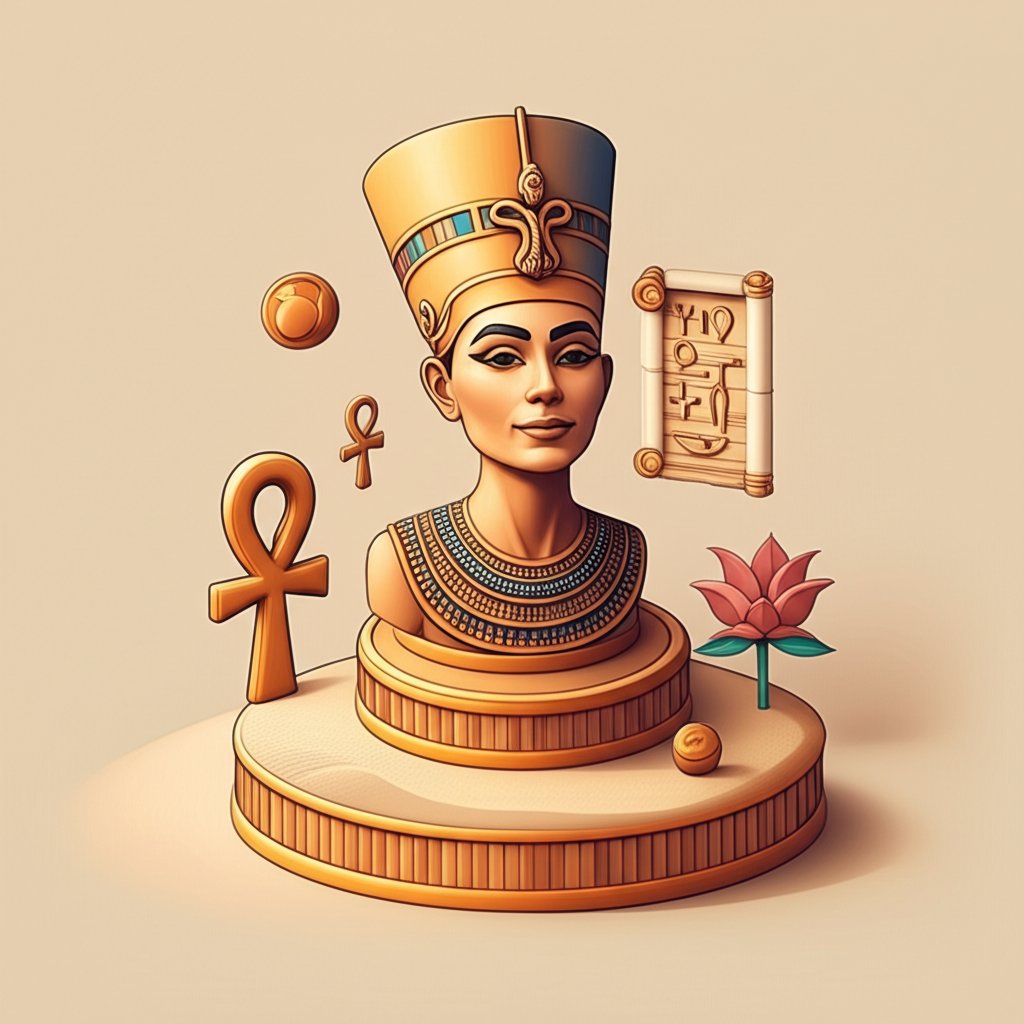
A quick search for a “cleopatra picture” unleashes a torrent of conflicting images. You’ll see a Roman-style bust, a pale Renaissance noblewoman, an Art Deco diva with a sharp black bob, and Elizabeth Taylor with her famous kohl-rimmed eyes. They can’t all be her. This visual chaos isn’t just a quirk of history; it’s a direct reflection of how every era has remade Cleopatra in its own image, using her as a canvas for its own ideals of power, beauty, and danger.
So, how do you sort the authentic from the fantasy? By learning to read the art itself. Each portrait tells a story—not just about the Egyptian queen, but about the world of the person who created it.
At a Glance: What You’ll Discover
- The Authentic Artifacts: We’ll look at the closest things we have to a real Cleopatra picture—ancient coins and temple carvings—and what they truly reveal.
- The Stories That Shaped Her Image: Uncover the dramatic anecdotes, largely from the writer Plutarch, that artists from the Renaissance onward couldn’t resist painting.
- Cleopatra Through Time: See how European artists molded her into a Venetian beauty or a tragic heroine, often ignoring historical reality.
- The Modern Queen: Explore how Hollywood and contemporary artists continue to challenge and redefine her identity, from cinematic siren to a symbol of Black heritage.
- Your Practical Toolkit: Get a simple, step-by-step framework for analyzing any depiction of Cleopatra you encounter.
Decoding the “Real” Cleopatra: Coins and Temple Walls
Before we dive into the fantasies, let’s ground ourselves in the few artifacts made during her lifetime. While we don’t have a painted portrait, we have official state-sponsored images that, while not photorealistic, are our most direct links to the historical queen. Understanding these is the first step in separating fact from centuries of artistic fiction.
These ancient sources provide a stark contrast to the Hollywood glamour we often associate with her. For a complete breakdown of what archeologists and historians have pieced together from these clues, you can explore What Cleopatra really looked like.
The Message on the Money: Cleopatra on Ptolemaic Coins
Think of ancient coins not as glamour shots but as political billboards. When Cleopatra put her face on a coin, she was sending a clear message about her legitimacy and power. These small metal discs are some of our most valuable sources.
- Key Features: The portraits are consistent. They show a woman with a prominent, slightly hooked nose, a strong jawline, a firm chin, and hair styled in a traditional “melon” coiffure, pulled back into a bun.
- The Intent: This wasn’t about conforming to a standard of beauty. The strong features, similar to those of her male Ptolemaic predecessors, were meant to project authority and dynastic continuity. She was signaling that she was a ruler to be taken as seriously as any king before her.
The Divine Pharaoh: The Dendera Temple Relief
On the southern wall of the Temple of Hathor at Dendera, a massive relief carving offers another official portrait. It depicts Cleopatra VII and her son by Julius Caesar, Ptolemy XV Caesarion, making offerings to the gods.
- Stylized, Not Realistic: This isn’t a life-like image. It’s rendered in the traditional, stylized manner of Egyptian art that had persisted for millennia. She is shown with a divine crown and the classic profile view characteristic of pharaonic depictions.
- The Purpose: The relief’s goal was to present Cleopatra and her son as the rightful, divine rulers of Egypt, connecting them to the long line of pharaohs and the gods themselves. It cemented her role not just as a queen of Greek heritage, but as a true Egyptian pharaoh.
From Ruler to Seductress: How Rome and Plutarch Crafted the Legend
After her death, Cleopatra’s story was written by her enemies: the Romans. Historians like Plutarch, writing over a century after she died, compiled dramatic accounts that emphasized her romantic entanglements and cunning over her political acumen. While he acknowledged her intelligence and charm, his vivid anecdotes provided the perfect raw material for artists for the next 2,000 years.
The Power of a Good Story: The Pearl and the Carpet
Two particular stories became artistic catnip, appearing again and again in paintings.
- The Lavish Bet (The Pearl): Plutarch tells of a banquet where Cleopatra bets Mark Antony she can host the most expensive meal in history. She wins by dissolving a priceless pearl earring in a goblet of vinegar and drinking it. This scene allowed artists like Benedetto Gennari to paint opulent, dramatic scenes of wealth and decadence.
- The Grand Entrance (The Carpet): To gain a secret audience with Julius Caesar, the young Cleopatra had herself smuggled into his chambers rolled up in a carpet (or bed-sack, depending on the translation). The moment she is unrolled at his feet is pure theater. The 19th-century French painter Jean-Léon Gérome’s Cleopatra and Caesar is perhaps the most famous depiction, cementing this scene in the public imagination.
These stories, whether entirely true or not, transformed her from a calculated politician into a character in a grand drama, making her an irresistible subject.
Reimagining a Queen: Cleopatra in Renaissance and Baroque Art
When European artists rediscovered classical stories during the Renaissance, Cleopatra became a star. But the Cleopatra picture they created had very little to do with the historical ruler from Alexandria. Instead, she became a mirror for their own time.
A Venetian Beauty: The Cleopatra of Tiepolo
Look at the works of 18th-century Venetian painter Giovanni Battista Tiepolo, such as The Banquet of Cleopatra. His queen is a pale-skinned woman with reddish-blonde hair, dressed in the extravagant silks and jewels of a European aristocrat. The setting isn’t Egypt; it’s a grand Venetian palace. Tiepolo wasn’t trying to be historically accurate. He used Cleopatra’s story to create a magnificent spectacle that celebrated the wealth and drama of his own culture.
The Tragic Heroine: The Focus on Her Death
A huge number of paintings focus on a single moment: her suicide. The image of her clutching an asp to her breast became an artistic trope. This fascination served several purposes:
- Moralizing Tale: It was a story about the downfall of a powerful woman, a cautionary tale about passion and ambition.
- Dramatic Potential: The scene is inherently tragic and emotional, allowing artists to explore themes of love, death, and beauty.
- The Female Nude: It also provided a classical justification for painting the female nude, often in a sensual, reclining pose that catered to the tastes of male patrons.
In these works, her political life, her intellect, and her rule over Egypt are erased, replaced by the story of a tragic lover.
The Modern Picture: Hollywood, Identity, and New Interpretations
The 20th and 21st centuries have produced some of the most enduring and challenging images of Cleopatra, moving beyond the European gaze to question her identity and reclaim her story.
The Hollywood Effect: Elizabeth Taylor’s Enduring Image
For many people, the definitive cleopatra picture is Elizabeth Taylor in the 1963 epic film Cleopatra. With her dramatic winged eyeliner, vibrant blue eyeshadow, and elaborate costumes, Taylor’s portrayal cemented the queen’s image as an exotic and powerful seductress. This look, a blend of ancient Egyptian motifs and mid-century Hollywood glamour, remains a pop culture touchstone, but it is a modern fantasy.
Reclaiming the Narrative: Artistic Counterpoints
Not all modern depictions follow the Hollywood script. Artists have begun using her image to explore complex themes of race, gender, and power, offering a vital corrective to the centuries-old tradition.
- Edmonia Lewis’s Empathy (1876): The African-American and Native American sculptor Edmonia Lewis created The Death of Cleopatra, a stunning marble work. Unlike her contemporaries who sexualized the queen’s death, Lewis presents a powerful, dignified, and empathetic vision. The queen is shown slumped on her throne after the venom has taken hold—not as a temptress, but as a defeated monarch and mother. It’s a deeply humanizing portrayal from an artist who understood what it meant to be an outsider.
- Chris Ofili’s Challenge (1992): Contemporary British artist Chris Ofili, of Nigerian descent, has painted Cleopatra as an unabashedly Black woman. His work directly confronts the long tradition of whitewashing her in European art. By doing so, he forces the viewer to grapple with questions of her Macedonian-Greek heritage, her African kingdom, and the historical erasure of Black figures from Western art.
Your Guide to “Reading” a Cleopatra Portrait
The next time you encounter a cleopatra picture, don’t just see it as a historical illustration. Use this simple framework to deconstruct it and understand the story it’s really telling.
| Step | Question to Ask | What It Reveals |
|---|---|---|
| 1. Check the Date | When was this made? Is it ancient, Renaissance, or modern? | This is the biggest clue. It tells you which era’s biases and aesthetics are at play. A 1700s painting is about the 1700s, not 30 BCE. |
| 2. Identify the Scene | What moment is being depicted? Her death? The banquet? The meeting with Caesar? | This shows what aspect of her legend the artist found most compelling: the tragedy, the opulence, the political cunning, or the romance. |
| 3. Analyze Her Appearance | Who does she look like? A Roman matron? A Hollywood star? An African queen? | This exposes the beauty standard being projected onto her. Note the skin tone, hair color, clothing, and features. |
| 4. Consider the Artist | Who created this work and what was their background? | An artist’s personal history and cultural context fundamentally shape their perspective. Edmonia Lewis’s background gives her work a different lens than Jean-Léon Gérome’s. |
Cleopatra in Art: Fact vs. Fiction
Let’s clear up some common questions and misconceptions that arise from these varied artistic interpretations.
Was Cleopatra really a great beauty?
Ancient sources are mixed. The writer Plutarch claimed her true charm wasn’t in her looks, which he called “not altogether incomparable,” but in her irresistible charisma, her intelligence, and the “sweetness in the tones of her voice.” The portraits on her coins suggest striking, strong features, not delicate beauty. The idea of her as an irresistible siren is largely a Roman and later European invention.
Why is she so often depicted as white in older paintings?
European artists from the Renaissance to the 19th century were not attempting historical ethnography. They painted historical and biblical figures—including Jesus and the Virgin Mary—as contemporary Europeans. They used local models and dressed their subjects in the fashions of their own time. Cleopatra was simply another character absorbed into their visual world.
Is the image of her with a short, black bob and bangs accurate?
This is a 20th-century invention. It became popular in the 1920s during the Art Deco period, following the discovery of Tutankhamun’s tomb, which sparked a craze for all things Egyptian. The sleek bob was a modern hairstyle that was given an “Egyptian” twist. The 1963 film with Elizabeth Taylor solidified this look in popular culture.
What is the most accurate Cleopatra picture?
The most authentic surviving images are the profiles on the coins minted during her reign and the stylized relief at the Dendera Temple. There are no surviving lifelike painted portraits from her time. Every other cleopatra picture is an interpretation, created long after she was gone.
Ultimately, every image of Cleopatra is a testament to her enduring power. For over two millennia, she has been a queen, a politician, a goddess, a seductress, a tragic heroine, and a cultural icon. The next time you see a cleopatra picture, you’ll know you’re looking at more than just the face of a queen. You’re seeing a mirror reflecting the world that imagined her, a rich, complex story of how we use the past to make sense of our present.










