
Of all the art forms, few capture the human experience with the depth, texture, and lasting power of oil painting. The world’s famous oil paintings aren’t just images on a canvas; they are time capsules, emotional outpourings, and technical marvels that have captivated audiences for centuries. They tell stories of love, war, devotion, and the simple, quiet moments of everyday life, all preserved in layers of luminous color.
But what makes a particular painting endure while thousands of others fade into obscurity? This guide will take you beyond the museum postcard, unveiling the stories, techniques, and sheer genius behind the masterpieces that have shaped art history. We’ll explore why these works matter and how you can appreciate them on a deeper level.
At a Glance: What You’ll Discover
- The Stories Behind the Icons: Journey through pivotal moments in art history, from the Renaissance to the modern era, and learn the context behind each masterpiece.
- Decoding the Techniques: Understand the artistic innovations—like sfumato, chiaroscuro, and impasto—that made these paintings revolutionary.
- Why They Became Famous: Uncover the factors beyond artistic skill, including cultural impact, historical events, and even theft, that elevated these works to global fame.
- Where to See Them Today: Find out which prestigious museums house these priceless treasures, so you can plan your own artistic pilgrimage.
What Elevates an Oil Painting to Masterpiece Status?
Before we dive into the gallery of greats, it’s worth asking: what’s the big deal with oil paint anyway? The technique, which involves mixing pigments with a drying oil like linseed, was not a sudden invention. Its earliest known use dates back to the 7th century CE, found in Buddhist cave murals in Afghanistan. However, it was perfected and popularized in 15th-century Europe by Northern Renaissance artists like Jan van Eyck.
Unlike the fast-drying tempera paint used before it, oil paint offered a world of new possibilities. Its slow drying time allowed for meticulous blending, subtle gradients, and rich, deep colors. This technical leap is the foundation for almost every famous work that follows.
But technique alone doesn’t guarantee fame. A painting becomes an icon through a combination of factors:
- Revolutionary Technique: Did the artist do something no one had ever done before? Think of Leonardo’s hazy, smoke-like sfumato or Monet’s capturing of fleeting light.
- Powerful Storytelling: Does the work convey a universal human emotion or a pivotal historical narrative? Picasso’s Guernica doesn’t just show a bombing; it screams the horror of war.
- Cultural Significance: Does the painting capture the spirit of its age or challenge its conventions? Grant Wood’s American Gothic became a symbol of American grit during the Great Depression.
- The Artist’s Legacy: Often, the artist’s life story—their struggles, passions, and unique vision—is inseparable from their work. We see Van Gogh’s turmoil in the swirling skies of The Starry Night.
Now, let’s explore the works that check all these boxes and more.
The Titans of the Renaissance and Baroque
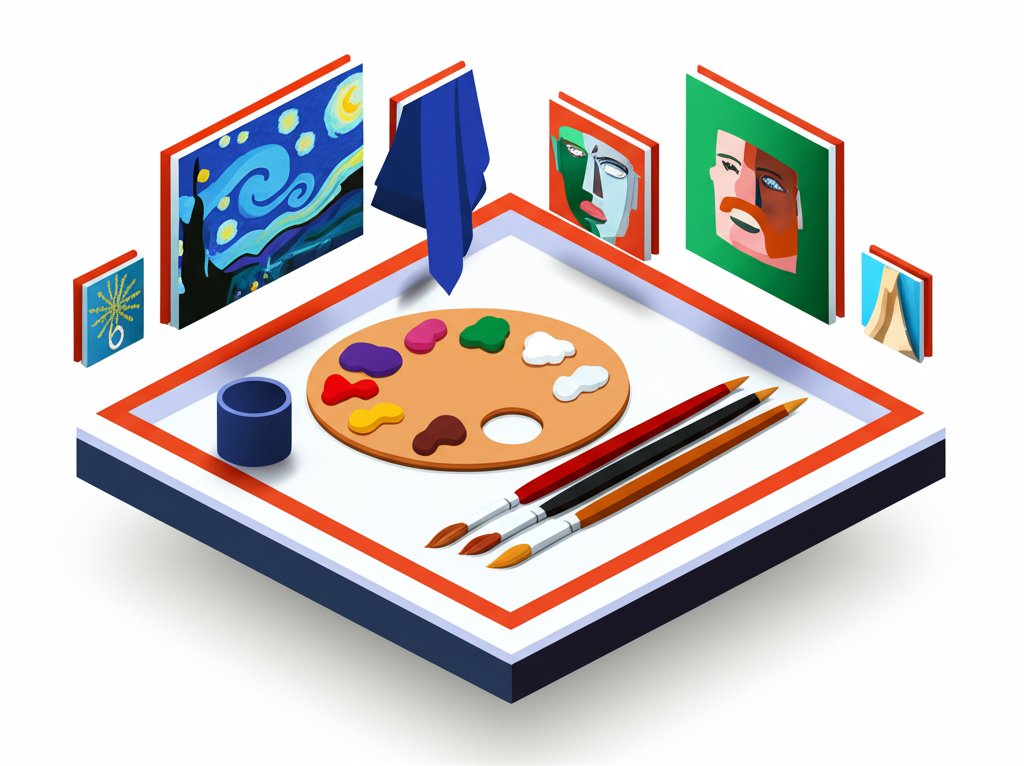
This era was a seismic shift in Western art, moving from flat, religious iconography to a world of humanism, realism, and dramatic depth. The genius of Famous oil painters like Leonardo and Vermeer laid the groundwork for centuries of art to come.
Mona Lisa – Leonardo da Vinci (c. 1503-1506)
Where to see it: The Louvre, Paris
Arguably the most famous portrait in the world, the Mona Lisa is a masterclass in subtlety. Leonardo da Vinci used his signature sfumato technique (Italian for “smoked”) to create soft, hazy transitions between colors, most notably around the corners of the model’s eyes and mouth. This gives her an ambiguous, enigmatic expression that seems to change before your eyes. The painting of Lisa Gherardini, an Italian noblewoman, gained global celebrity status after it was stolen from the Louvre in 1911, an event that cemented its place in the public imagination forever.
The Last Supper – Leonardo da Vinci (c. 1495-1498)
Where to see it: Santa Maria delle Grazie, Milan
Though technically a mural made with a mix of tempera and oil on plaster, The Last Supper is one of Leonardo’s most profound works. It captures the dramatic moment when Jesus announces that one of his apostles will betray him. Each figure reacts with a unique, psychologically charged emotion—shock, anger, denial, and sorrow. Leonardo’s composition brilliantly funnels all the focus toward the central, serene figure of Christ.
Girl with a Pearl Earring – Johannes Vermeer (c. 1665)
Where to see it: Mauritshuis, The Hague
Often called the “Mona Lisa of the North,” this captivating portrait from the Dutch Golden Age is all about a fleeting moment. Vermeer was a master of light. Notice how a soft, pearlescent glow illuminates the subject’s face against a dark, undefined background. Her gaze is direct and intimate, her lips slightly parted as if she is about to speak. The painting’s power lies in its mystery—we know nothing about her, which invites us to imagine our own story.
The Night Watch – Rembrandt van Rijn (1642)
Where to see it: Rijksmuseum, Amsterdam
This is not your typical, static group portrait. Rembrandt broke all the rules with The Night Watch, a massive canvas depicting a city militia company springing into action. He used dramatic contrasts of light and shadow (tenebrism) to create a sense of movement and chaos. The two central figures are bathed in light, while others emerge from the gloom, making the scene feel alive and theatrical. It’s a landmark of the Dutch Golden Age.
Las Meninas – Diego Velázquez (1656)
Where to see it: Museo del Prado, Madrid
Las Meninas (The Maids of Honour) is one of art history’s most complex and debated paintings. At first glance, it’s a portrait of the young Spanish princess, Infanta Margaret Theresa, with her entourage. But look closer. Velázquez painted himself into the scene, standing at his easel. In the mirror on the back wall, we see the reflections of the King and Queen—implying that they are standing where we, the viewers, are. It’s a brilliant puzzle about reality, illusion, and the very act of seeing.
The Dawn of Modern Art: Impressionism and Beyond
In the 19th century, a new generation of artists broke free from the rigid rules of academic painting. They moved out of the studio and into the world, determined to capture life as they actually saw it—full of light, color, and fleeting moments.
Impression, Sunrise – Claude Monet (1872)
Where to see it: Musée Marmottan Monet, Paris
This is the painting that gave Impressionism its name. When it was first exhibited, a critic mockingly used the title to dismiss the work as a mere “impression,” not a finished painting. The name stuck. Monet wasn’t interested in painting a detailed harbor scene; he wanted to capture the feeling of the sun burning through the morning mist over Le Havre. The quick, visible brushstrokes and emphasis on light over form were revolutionary.
The Starry Night – Vincent van Gogh (1889)
Where to see it: Museum of Modern Art (MoMA), New York City
Painted from his room in a French asylum, The Starry Night is a torrent of emotion rendered in oil. The sky explodes with celestial swirls, a blazing moon, and incandescent stars, rendered with thick, energetic brushstrokes—a technique called impasto. Below, a quiet village sleeps under the watch of a dark, flame-like cypress tree, a traditional symbol of death and eternity. It’s a direct look into the artist’s turbulent and beautiful inner world.
A Sunday Afternoon on the Island of La Grande Jatte – Georges Seurat (1884-1886)
Where to see it: Art Institute of Chicago
Seurat took the Impressionists’ ideas about color and light and turned them into a science. This monumental work is the masterpiece of Pointillism, a technique where the entire image is composed of tiny, distinct dots of pure color. Up close, it’s an abstract pattern. But step back, and the dots blend in the viewer’s eye to create a shimmering, luminous scene of Parisians enjoying a day by the river.
The Scream – Edvard Munch (1893)
Where to see it: National Gallery, Oslo
A raw, visceral expression of anxiety, The Scream is the quintessential Expressionist work. Munch used swirling lines and jarring, non-naturalistic colors to convey an internal feeling of terror. The figure is almost de-humanized, a conduit for a primal scream that reverberates through the blood-red sky. Munch described the inspiration as a moment when he “sensed a great, infinite scream passing through nature.”
20th-Century Icons: Redefining Reality
The 20th century saw art shatter into a dozen different movements, each challenging the very definition of what a painting could be. From Cubism’s fragmented perspectives to Surrealism’s dreamscapes, artists used oil paint to explore the complexities of a rapidly changing world.
Guernica – Pablo Picasso (1937)
Where to see it: Museo Reina Sofía, Madrid
One of the most powerful anti-war statements ever made, Guernica is Picasso’s response to the brutal bombing of a Basque town during the Spanish Civil War. Painted in a stark, monochromatic palette of black, white, and gray, the enormous canvas depicts the suffering of humans and animals in a chaotic jumble of fragmented forms. The screaming mother, the gored bull, and the dying horse have become universal symbols of the horrors of war.
The Persistence of Memory – Salvador Dalí (1931)
Where to see it: Museum of Modern Art (MoMA), New York City
Instantly recognizable, this Surrealist masterpiece features melting pocket watches draped over a dreamlike, desolate landscape. Dalí, a master of self-promotion and illusion, claimed the image was inspired by Camembert cheese melting in the sun. The “soft” watches challenge our perception of time as a rigid, reliable constant, suggesting it is instead fluid and subjective, especially in the realm of dreams and memory.
American Gothic – Grant Wood (1930)
Where to see it: Art Institute of Chicago
An icon of American Regionalism, American Gothic depicts a stoic farmer and his daughter standing before a Carpenter Gothic-style house. Wood intended the painting to be an affectionate portrayal of rural American values: hard work, perseverance, and piety. It has since become one of the most parodied images in the world, yet it remains a poignant symbol of the American spirit during the Great Depression.
The Two Fridas – Frida Kahlo (1939)
Where to see it: Museo de Arte Moderno, Mexico City
Frida Kahlo’s work is deeply personal, and this double self-portrait is one of her most revealing. Painted shortly after her divorce from Diego Rivera, it shows two identical Fridas sitting side-by-side. The Frida on the right, in traditional Mexican dress, represents the woman Rivera loved. The Frida on the left, in a European Victorian gown, is the woman he left. Their hearts are exposed and connected by a single artery, which the unloved Frida snips with a pair of scissors, a visceral depiction of her emotional pain and fractured identity.
Beyond the Canvas: How to Truly Appreciate These Works

Viewing these Popular oil painting classics is an experience that changes from person to person. But to deepen your appreciation, here are a few things to keep in mind, whether you’re seeing them online or in person.
Look Beyond the Subject
Try to see the painting as the artist did—as a series of choices.
- Composition: How are the elements arranged? Is there a clear focal point? Does the composition feel balanced and calm, or chaotic and energetic?
- Light and Shadow: Where is the light coming from? Is it soft and gentle (Vermeer) or harsh and dramatic (Rembrandt)? How does the artist use shadow to create mood and volume?
- Brushwork: Can you see the artist’s hand in the work? Are the brushstrokes invisible and smooth (Da Vinci) or thick, textured, and full of energy (Van Gogh)?
Understand the Context
A painting is a product of its time. Knowing a little about the artist’s life and the historical period can unlock layers of meaning. Why was Picasso so moved by the events in Guernica? What was happening in the Netherlands during Vermeer’s lifetime that allowed art to flourish? A quick search can transform your viewing experience.
Seeing Them in Person Is Different
No digital screen can replicate the true scale, texture, and presence of an original oil painting. If you ever have the chance to stand in front of The Night Watch or Guernica, you will be struck by their sheer size. You’ll be able to see the delicate cracks of age in the Mona Lisa and the thick, sculptural quality of the paint on The Starry Night. It’s a connection across centuries that is truly powerful.
Frequently Asked Questions About Famous Oil Paintings
What is the most famous oil painting in the world?
While it’s subjective, the Mona Lisa by Leonardo da Vinci is almost universally considered the most famous. Its fame is due to a combination of Leonardo’s mastery, the subject’s mysterious smile, its home in the world’s most visited museum (the Louvre), and its history, including the famous 1911 theft.
Why do so many old oil paintings look dark or yellow?
This is primarily due to the aging of the varnish. For centuries, artists applied a natural resin varnish to protect their paintings. Over time, this varnish yellows and darkens with exposure to light and air, obscuring the original colors. Many museums have painstakingly cleaned and restored masterpieces to reveal their true vibrancy.
What is the most expensive oil painting ever sold?
The record is currently held by Leonardo da Vinci’s Salvator Mundi, which sold for an astonishing $450.3 million at a Christie’s auction in 2017. However, many of the most famous paintings, like the Mona Lisa or The Starry Night, are considered priceless and will never be sold. The Mona Lisa holds the Guinness World Record for the highest insurance valuation in history—$100 million in 1962, which would be close to $1 billion today.
Start Your Own Artistic Journey
The famous oil paintings on this list are just the beginning. Each one is a gateway to a different time, a unique culture, and the mind of a creative genius. The next time you see one of these images, you’ll know the story behind the brushstrokes.
Let this be your starting point. Pick an artist who intrigues you and learn more about their life and other works. Plan a visit to a local museum to see what treasures it holds. Art is a conversation that spans generations, and by engaging with these masterpieces, you become a part of it. The canvas is waiting.










