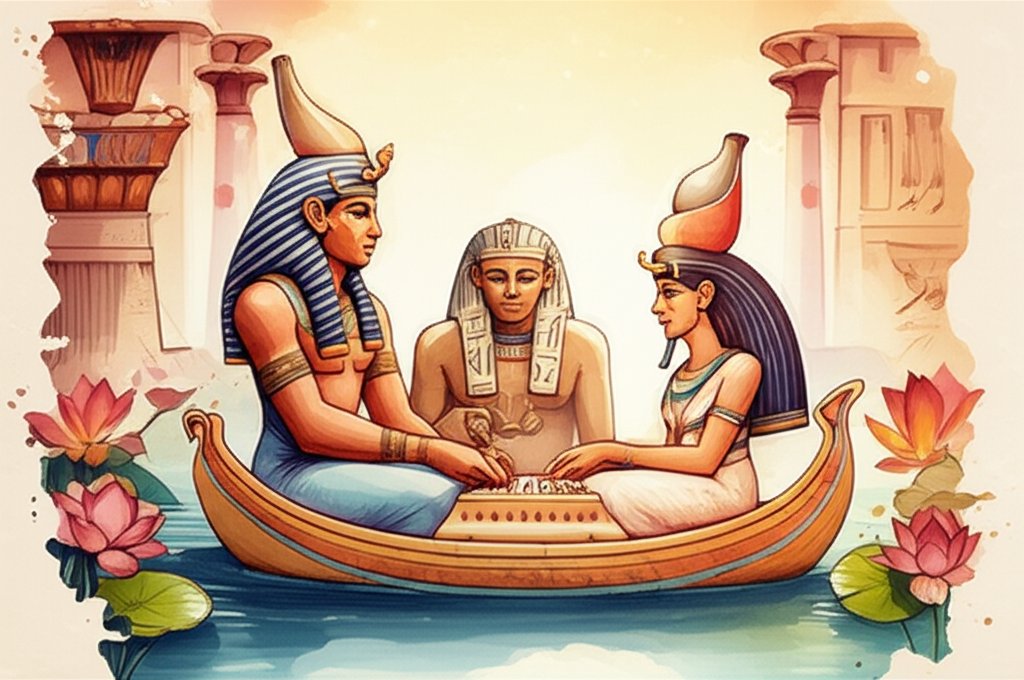
Ancient Egyptian life wasn’t all pyramids and pharaohs; egypt recreation played a vital role in their society, providing entertainment, fostering community, and even serving religious purposes. Games, in particular, were a popular pastime enjoyed by people of all social classes.
At a glance:
- Discover the most popular board games of ancient Egypt, like Senet and Mehen.
- Understand the rules and symbolism behind these games.
- Learn how games were integrated into religious and social life.
- Explore the role of gambling and divination in ancient Egyptian recreation.
- Get practical ideas for recreating these ancient games today.
Board Games: More Than Just Entertainment
Board games in ancient Egypt were much more than just a way to pass the time. They were deeply intertwined with their beliefs about the afterlife, their social structures, and even their understanding of the cosmos. These were not mere child’s play.
Senet: A Journey Through the Afterlife
Senet was arguably the most popular board game in ancient Egypt. Evidence of Senet boards has been found in tombs dating back to the Early Dynastic Period (c. 3100-2686 BC), showing its enduring appeal. The game board consists of 30 squares arranged in three rows of ten.
- Gameplay: Two players each have a set of pawns that they move around the board based on throws of casting sticks or bones.
- Objective: The goal is to be the first to move all of your pawns off the board.
- Symbolism: Senet was closely associated with the journey through the afterlife. Some squares on the board represented obstacles or trials that the deceased would face in the underworld. Winning the game symbolized successfully navigating these challenges and achieving eternal life. Tutankhamun even had multiple Senet sets buried with him, highlighting its importance. To learn more about the overall context of recreation in this era, Explore ancient Egyptian recreation.
How to Play Senet Today:
- Create a Senet board. You can find templates online or make your own.
- Use simple pawns (stones, beads, etc.) to represent your pieces.
- Substitute dice for the casting sticks (assign numbers to different stick combinations).
- Adapt the rules based on available information and personal preference. The original rules are not fully known, so feel free to experiment.
Mehen: The Coiled Serpent Game
Mehen, named after the serpent deity, was another popular board game, particularly during the Old Kingdom (2700-2181 BC). The game board was shaped like a coiled snake, with the head in the center and the tail at the outer edge.
- Gameplay: The rules of Mehen are still not fully understood, but it is believed that players moved pieces along the serpent’s body towards the center.
- Objective: The objective likely involved reaching the center of the board or capturing opponent’s pieces.
- Symbolism: Mehen, the serpent god, was believed to protect the sun god Ra during his nightly journey through the underworld. The game may have symbolized this journey and the themes of rebirth and protection.
Why Mehen is Still a Mystery: Unlike Senet, we have fewer surviving examples of Mehen boards and even less information about its rules. This makes it harder to reconstruct the game with certainty.
Hounds and Jackals: Strategy and Territory
Also known as “58 Holes,” this game (predating even Senet) involved strategy and territorial control. Boards have been found dating back to the third millennium BC, and show playing pieces shaped as dogs and jackals. Due to the games antiquity, rules have been lost but its believed to have involved capturing territory and strategic movement.
The Social and Religious Significance of Games
Games in ancient Egypt were not isolated activities. They were integrated into the fabric of society and played a role in religious rituals, festivals, and social gatherings.
Games as Rituals
Some games, like Senet, had a clear religious significance. As mentioned earlier, Senet symbolized the journey through the afterlife. Playing the game could be seen as a way to prepare for this journey or to invoke the blessings of the gods.
Gambling and Divination
Gambling was also associated with games in ancient Egypt. People would bet on the outcome of games, and the results were sometimes interpreted as omens or messages from the gods. This blurring of lines between recreation, gambling, and divination is a key aspect of egypt recreation during this time.
Games at Festivals
Festivals, such as the Heb Sed festival, often included games and sporting events. These events were a way to celebrate the pharaoh’s reign and to strengthen the community bonds.
Case Snippet: During the Heb Sed festival of Amenhotep III, chariot races and archery contests were held to showcase the pharaoh’s athletic prowess and to entertain the crowds.
Practical Playbook: Recreating Ancient Egyptian Games
Want to experience the thrill of ancient Egyptian games for yourself? Here’s a practical playbook to get you started:
- Choose Your Game: Start with Senet, as the rules are better understood than other games like Mehen.
- Gather Your Materials: You can find printable Senet boards online, or create your own using cardboard or wood. Use beads, stones, or other small objects as playing pieces.
- Learn the Basic Rules: Several websites and books provide reconstructions of the rules of Senet. Experiment and adapt the rules to your liking.
- Play with Friends and Family: Gather your friends and family for a fun and educational game night.
- Explore the Symbolism: As you play, discuss the symbolism behind the game and its connection to ancient Egyptian beliefs.
Tips for a Truly Immersive Experience:
- Play the game by candlelight to create an authentic atmosphere.
- Listen to ancient Egyptian music while you play.
- Serve traditional Egyptian snacks and drinks.
- Research ancient Egyptian clothing to play the game in costume.
Quick Answers: Common Questions About Egyptian Games
- Were women allowed to play games in ancient Egypt? Yes, both men and women played games in ancient Egypt. Images of women playing Senet and other games have been found in tombs and temples.
- Did children play games? Absolutely. Children played with toys, dolls, and simplified versions of adult games.
- Were there professional gamers in ancient Egypt? While there were no “professional gamers” in the modern sense, skilled players may have been highly respected and sought after for their abilities.
- Are the rules of Senet completely known? No, the exact rules of Senet are not fully known. Modern reconstructions are based on archaeological evidence and interpretations of ancient texts.
Embrace the Fun of Ancient Egyptian Recreation
Ancient Egyptian games provide a fascinating glimpse into the lives and beliefs of this ancient civilization. By recreating these games today, we can connect with the past and gain a deeper appreciation for the ingenuity and cultural richness of ancient Egypt. And it’s a lot more fun than just reading about it!










