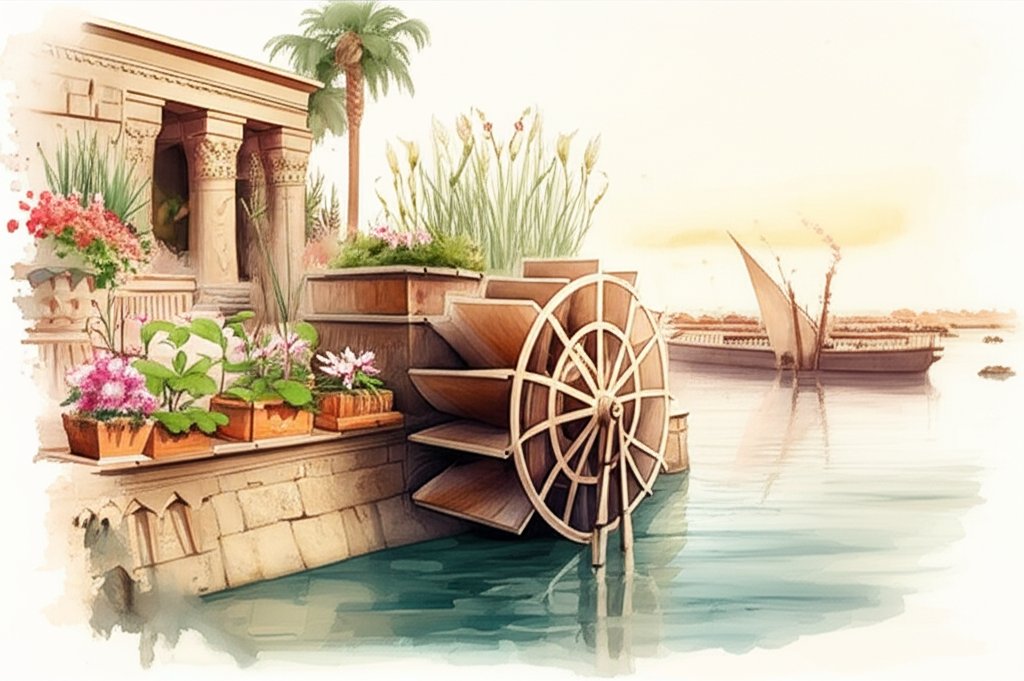
Ancient Egypt Agriculture: Nile’s Bounty Fueled Civilizations Rise
Imagine feeding an entire civilization with just one river. That’s exactly what ancient Egyptian farmers accomplished, transforming the arid landscape into a breadbasket that sustained their remarkable society. Their mastery of ancient egypt agriculture wasn’t accidental; it was a carefully honed system of observation, adaptation, and ingenious engineering.
At a glance:
- Understand how the Nile’s predictable floods shaped agricultural practices.
- Discover the key crops that formed the foundation of the Egyptian diet and economy.
- Explore the irrigation techniques that allowed for consistent harvests.
- Learn about the tools and labor that powered Egyptian agriculture.
- Uncover the religious significance interwoven with farming and the Nile.
- Identify some of the challenges faced by ancient Egyptian farmers.
The Nile’s Rhythmic Heartbeat: Predictable Floods, Plentiful Harvests
The defining characteristic of ancient egypt agriculture was its complete dependence on the Nile River. Unlike rain-fed agriculture, the Egyptians could rely on the annual inundation, the Akhet season, when the Nile overflowed its banks. This wasn’t just water; it was life-giving silt, rich in nutrients, deposited across the floodplain. This fertile soil was the bedrock of their agricultural success. But it was not a free for all; it required careful management.
The predictability of the Nile’s cycle allowed the Egyptians to plan their farming year with precision. The flooding season (Akhet) was followed by the emergence/sowing season (Peret) when the waters receded, and the land was ready for planting. Finally came the harvest season (Shemu).
Taming the Waters: Basin Irrigation and Flood Control
While the Nile’s flood was a blessing, it could also be a curse. Too much water could destroy crops and homes; too little led to famine. The Egyptians developed sophisticated irrigation systems, most notably basin irrigation, to manage the Nile’s flow.
Basin irrigation involved constructing earthen walls to create enclosed fields or “basins.” These basins trapped the floodwater, allowing the silt to settle and saturate the soil. After the water drained, farmers could plant their crops in the enriched earth. This simple but effective technique maximized the benefits of the flood while minimizing its destructive potential.
This required collective effort, from local communities to the pharaoh’s administration. Canals and dikes also played a important role in controlling the flow of the Nile and diverting water to fields further from the riverbank. For a broader view of the daily lives of those who orchestrated this process, explore this resource on Life as Nile River Farmers.
Staple Crops: Wheat, Barley, and the Foundation of Egyptian Diet
The ancient Egyptian diet was largely plant-based, with grains forming the cornerstone. Wheat and barley were the primary crops, used to make bread, beer, and other staples. Einkorn and emmer wheat were also common.
- Wheat and Barley: The workhorses of Egyptian agriculture. Used for bread (the staple food) and beer (a common drink).
- Flax: Not for food, but crucial for linen, the primary clothing material. Also used for rope and other textiles.
- Papyrus: Another non-food crop, used for everything from boats to paper. A valuable export commodity.
Beyond grains, Egyptians cultivated a variety of vegetables, including onions, garlic, radishes, lettuce, and parsley. Fruits such as dates, sorghum, grapes, watermelon, and sycamore figs were also grown. Later, fruits like carob, olive, apple, and pomegranate were introduced, adding to the dietary diversity.
From Plow to Plate: Tools, Techniques, and Labor
Ancient egypt agriculture relied on simple but effective tools. The ox-drawn plow was used to till the soil, while hoes were used for weeding and planting. Sickles were used to harvest the crops.
After the harvest, grain stalks were threshed, often by driving animals, such as donkeys, over them to separate the grain from the chaff. The grain was then winnowed to remove the remaining debris.
Labor was primarily provided by farmers and their families. During peak seasons, such as planting and harvesting, additional labor may have been required, potentially through a system of corvée labor, where individuals were required to work on public projects, including agricultural tasks.
More Than Just Food: Non-Food Uses of Plants

The bounty of ancient egypt agriculture extended beyond sustenance. Plants were used for a variety of purposes, including medicine, religious practices, and clothing.
- Papyrus: Used to create paper, boats, mats, sandals and more.
- Flax: Used to create linen, the primary fabric for clothing.
- Henna: Used as a dye for hair, skin, and textiles.
Many plants had medicinal properties and were used to treat a variety of ailments. Furthermore, certain plants were considered sacred and played a role in religious rituals.
Livestock: More Than Just Meat
While ancient egypt agriculture was centered on crops, livestock also played a crucial role. Cattle were raised for meat, milk, and labor. Different species included long-horned, short-horned, polled, and zebuine types. Evidence of cattle dates back to the fifth millennium BC in the Faiyum region.
Chickens were mass-produced using man-made incubators known today as Egyptian egg ovens. These incubators were built since the 4th century BC. Egyptians also raised geese, ducks, and other fowl.
Religious Observances: Gods of the Nile and the Harvest
Religion was deeply intertwined with ancient egypt agriculture. Hapi was the god of the Nile’s inundation, representing the life-giving flood. Osiris was associated with the Nile and fertility, symbolizing the cycle of death and rebirth. Religious festivals and ceremonies were held throughout the year to honor these deities and ensure a bountiful harvest. Offerings of crops and livestock were made to the gods to express gratitude and seek their favor.
Challenges and Resilience: Overcoming Adversity
Despite the predictability of the Nile, ancient egypt agriculture faced several challenges. Droughts and floods could devastate crops, leading to famine. Pests, such as locusts and rodents, could also destroy harvests. Heavy taxation, often in the form of grain and livestock, placed a burden on farmers. Diseases affecting crops and livestock could also impact agricultural productivity.
Despite these challenges, the Egyptians were remarkably resilient. They developed strategies to mitigate the risks, such as storing surplus grain in granaries to buffer against famine. They also developed techniques to control pests and diseases.
A Practical Playbook: Essential Steps to Egyptian Farming (Hypothetically!)
While we can’t recreate ancient egypt agriculture exactly, we can distill their key practices into actionable steps:
- Understand Your Environment: Know your local climate, soil, and water resources. (The Egyptians knew the Nile intimately.)
- Manage Water Wisely: Implement efficient irrigation techniques to conserve water and prevent both drought and flooding. (Basin irrigation is a great example of adapting to a specific environment.)
- Diversify Your Crops: Grow a variety of crops to reduce risk and create a balanced diet. (The Egyptians grew grains, vegetables, and fruits.)
- Maintain Soil Fertility: Use natural methods, such as crop rotation and composting, to enrich the soil. (The Nile silt was their natural fertilizer.)
- Protect Your Crops: Implement pest control strategies to minimize damage from insects, rodents, and other pests.
- Store Surplus: Maintain a reserve of food to buffer against potential shortages.
- Give Thanks: Acknowledge the forces of nature and the importance of agriculture in sustaining life. (The Egyptians had their gods, we can have our equivalent.)
Quick Start Decision Tree
- Is there a reliable, predictable water source?
- If yes: Design an irrigation system to maximize its benefits.
- If no: Explore alternative water sources or consider drought-resistant crops.
- Is the soil fertile?
- If yes: Start planting!
- If no: Amend the soil with organic matter or other fertilizers.
- Are there pests or diseases?
- If yes: Implement pest control and disease prevention strategies.
- If no: Monitor regularly and be prepared to act quickly if problems arise.
Quick Answers: Common Questions About Ancient Egyptian Agriculture
- Q: Was ancient egypt agriculture organic?
- A: In essence, yes. They didn’t have synthetic pesticides or fertilizers. They relied on natural methods like crop rotation and the Nile’s annual silt deposits.
- Q: How did they deal with droughts?
- A: Grain storage was crucial. They also likely had local variations in farming practices, some better suited to drier conditions. If needed, resources would be reallocated.
- Q: Was ancient egypt agriculture sustainable?
- A: For thousands of years, yes! However, over time, factors like soil salinization (salt buildup from irrigation) may have contributed to agricultural challenges in later periods of Egyptian history.
- Q: Did only farmers work in the fields?
- A: Primarily farmers and their families, but corvée labor (mandatory service to the state) was also used during peak seasons.
From River to Civilization: A Lasting Legacy
The success of ancient egypt agriculture was fundamental to the rise and longevity of ancient Egyptian civilization. The Nile’s bounty not only provided sustenance but also generated surplus resources that fueled trade, supported a complex social hierarchy, and enabled the construction of monumental architecture. The ingenuity and resilience of ancient Egyptian farmers serve as an inspiration for sustainable agriculture practices today. Their mastery of water management, crop diversification, and resource utilization offers valuable lessons for feeding a growing world population in a changing climate.










