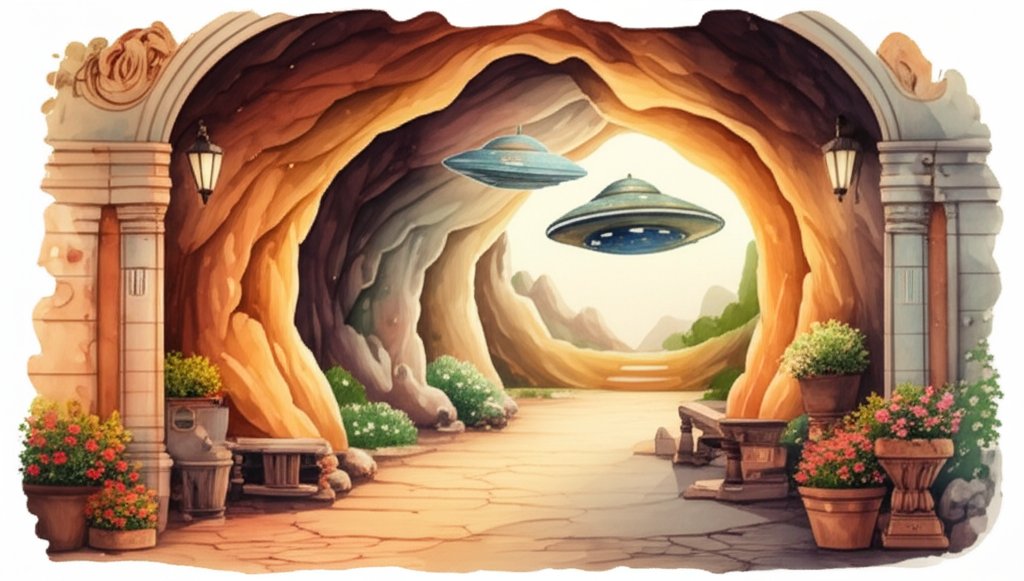
Ever paused in front of an old painting and wondered if that strange shape in the sky was more than just a cloud? The world of ufo painting offers a fascinating, if sometimes speculative, look at how societies throughout history have interpreted unexplained aerial phenomena.
At a glance:
- Discover how ancient and Renaissance artists depicted objects resembling modern UFOs.
- Understand the potential interpretations of these images, from religious symbols to literal sightings.
- Learn about specific examples of “ufo painting” and the debates they spark.
- Explore the challenges of interpreting historical art through a modern UFO lens.
- Gain insight into the role of art in humanity’s ongoing fascination with the unknown.
Deciphering the Skies: What Constitutes a “Ufo Painting”?
Defining a “ufo painting” can be tricky. It’s not about deliberate depictions of flying saucers, but rather imagery created before the modern UFO era that some interpret as representing unidentified flying objects. This often involves identifying anomalous aerial objects in paintings created for religious, historical, or symbolic purposes. The challenge lies in discerning artistic license, religious symbolism, and actual attempts to represent witnessed events.
Ancient Echoes: Prehistoric and Ancient Depictions
Far from being a modern phenomenon, the idea of strange objects in the sky has ancient roots. Cave paintings and petroglyphs found across the globe contain images that some believe resemble flying objects or beings from another world.
- Example: Some researchers interpret certain aboriginal rock art as depicting encounters with beings from the sky. These figures are often shown with large heads and disc-shaped objects.
- Interpretation Caveat: It’s crucial to consider the cultural context. What might look like a UFO could also be a representation of a deity, a natural phenomenon, or a symbolic element within the artist’s belief system.
Renaissance Mysteries: Anomalous Objects in Religious Art
The Renaissance period offers a wealth of examples that fuel the “ufo painting” debate. Religious paintings of the era often feature unusual objects in the sky, prompting speculation about their origins and meaning.
- The Madonna with Saint Giovannino (15th century): This painting, sometimes attributed to Domenico Ghirlandaio, features a small, disc-shaped object in the background sky. A man and a dog appear to be looking up at it. This has led some to believe it depicts a UFO sighting.
- The Baptism of Christ by Aert de Gelder (c. 1710). This painting depicts a disc-shaped object shining beams of light down upon John the Baptist and Jesus. While traditionally interpreted as the Holy Spirit, its unconventional representation has led to alternative interpretations involving extraterrestrial contact.
Interpreting the Symbols: Religion, Mythology, and the Unknown
Paintings are rarely straightforward representations of reality. Artists often imbue their work with symbolism, allegory, and references to religious or mythological narratives. When analyzing potential “ufo painting,” it’s vital to consider these layers of meaning. As you delve into the nuances take time to read Unraveling UFOs in Art.
- Religious Symbolism: Could a disc-shaped object represent a divine presence, a celestial being, or a miraculous event?
- Astrological Significance: Could the object be linked to astrological events, planetary alignments, or other celestial phenomena? Could it symbolize a comet or meteor shower?
- Personal Visions: Could the artist have been depicting a personal vision, dream, or altered state of consciousness?
Example: The gold sphere in Jacques Legrand’s Livre des Bonnes Meurs (c. 1430) could represent Fortune’s influence, a symbolic orb, or something else entirely.
The Pitfalls of Retroactive Interpretation
One of the biggest challenges in identifying a true “ufo painting” is the risk of imposing modern interpretations on historical artworks. It’s easy to see what we want to see, but it’s crucial to avoid anachronisms—attributing contemporary concepts to past eras.
- Confirmation Bias: Looking too hard for UFOs in art can lead to finding them even when they’re not there.
- Lack of Context: Without a deep understanding of the artist’s intentions, cultural context, and symbolic language, interpretations can be wildly inaccurate.
- Over-Simplification: Reducing complex artworks to mere depictions of UFOs ignores the richness and depth of their artistic and historical significance.
Practical Playbook: A Step-by-Step Guide to Analyzing a “Ufo Painting”
If you are hoping to examine ‘ufo painting’ here is a quick start guide.
- Identify the Anomalous Object: What specific feature of the painting suggests a potential UFO depiction? Note its shape, position, and relationship to other elements in the artwork.
- Research the Artist and Period: Learn about the artist’s life, artistic style, and the historical and cultural context in which they worked.
- Analyze the Symbolism: Identify any religious, mythological, astrological, or allegorical symbols present in the painting.
- Consider Alternative Explanations: Explore other possible interpretations of the anomalous object, taking into account artistic conventions, scientific knowledge of the time, and religious beliefs.
- Consult Expert Opinions: Seek out the views of art historians, UFO researchers, and other experts who have studied the painting or related topics.
- Formulate a Balanced Conclusion: Weigh the evidence and arrive at a reasoned conclusion, acknowledging the limitations of your interpretation and the possibility of alternative explanations.
Decision Tree: Is It a UFO, or Something Else?
Consider these questions when interpreting any ‘ufo painting’:
- Is the object clearly artificial, or could it be a natural phenomenon (e.g., cloud, comet)?
- Does the object fit within the known artistic conventions and symbolism of the period?
- Is there any historical evidence suggesting increased UFO activity during the time the painting was created?
- Are there any contemporary accounts or legends that might shed light on the object’s meaning?
- Have experts in art history and UFO studies reached a consensus on the object’s interpretation?
If the answer to most of these questions is “no,” it’s likely that the object is not a deliberate depiction of a UFO.
Quick Answers: Common Questions About Ufo Painting
- Are there any paintings that definitively prove the existence of UFOs in the past? No. While some paintings contain intriguing imagery, none provide irrefutable proof of UFO sightings. Interpretation is always subjective.
- Why are there so many UFO-like objects in Renaissance art? The Renaissance was a period of intense religious and philosophical inquiry, and artists often used symbolism and allegory to express complex ideas about the cosmos and the divine. Some of these symbols may resemble modern UFOs. Other explanations include optical phenomena, such as sun dogs or noctilucent clouds, that might have been mistaken for something else.
- Is it disrespectful to interpret religious art as depicting UFOs? It depends on your approach. Dismissing the religious significance of the artwork would be disrespectful, but exploring alternative interpretations in a thoughtful and informed way can be a worthwhile intellectual exercise.
- Where can I see examples of “ufo painting”? Many of the paintings discussed in this article are located in museums and galleries around the world. You can also find high-resolution images online.
- Could these images be time travelers? While a fun thought, there is no scientific basis to suggest time travel is depicted in these ‘ufo painting’ samples.
Actionable Close: Embracing the Mystery
The allure of ufo painting lies in its ability to spark curiosity and challenge our assumptions about history and the unknown. While definitive answers may remain elusive, the search for meaning in these enigmatic artworks encourages us to think critically, explore different perspectives, and appreciate the enduring power of art to capture the imagination. So, keep your eyes on the skies—and on the canvases of the past. You never know what you might discover.