
Have you ever looked at the pyramids of Egypt, the Nazca Lines in Peru, or the towering Moai statues of Easter Island and wondered, “Could aliens have been involved?” The ancient astronaut theory, also known as the “ancient aliens” or “paleocontact” theory, proposes that intelligent extraterrestrial beings visited Earth in the distant past and significantly influenced the development of human civilization. This includes influencing our technologies, cultures, religious beliefs, and even our very biology.
This super pillar hub dives deep into the fascinating, yet controversial, world of the “evidence of ancient aliens.” We’ll explore the key claims made by proponents of this theory, the supposed evidence they present, and the counterarguments offered by mainstream archaeology and science. Are there hidden messages for the stars? Or are these theories a misunderstanding of human ingenuity? Let’s find out.
The Core Claims: How Extraterrestrials Shaped Humanity
The ancient alien theory rests on several interconnected claims. The most prominent is that extraterrestrials directly assisted or inspired ancient civilizations in constructing monumental structures. Think of the pyramids, Stonehenge, or the precisely cut stones of Puma Punku. Could humans, on their own, have accomplished such feats?
Another key claim revolves around ancient texts and artwork. Proponents point to depictions of flying machines, alien-like figures, and advanced technologies in ancient art and religious writings. These are often interpreted as evidence of alien encounters. ufos in art may provide further insight into this topic. The existence of “out-of-place artifacts” – objects or accomplishments seemingly beyond the technical capabilities of the time – fuels the idea that a helping hand, or tentacle, was involved.
Examining the “Evidence”: From Pyramids to Ancient Texts
Let’s take a closer look at some of the most frequently cited pieces of evidence. The Egyptian pyramids, with their precise construction and astronomical alignment, are prime examples. Some suggest that the knowledge and technology required to build them must have come from an extraterrestrial source. Similarly, the massive stone blocks used in structures like Baalbek in Lebanon are often presented as evidence of technology beyond the grasp of ancient cultures.
Ancient texts are another area of intense debate. The Hindu vimanas, flying machines described in ancient Sanskrit texts, are often cited as examples of advanced technology witnessed by ancient humans. The Book of Ezekiel in the Bible, with its description of a “wheel within a wheel,” is also frequently interpreted as a depiction of a spacecraft. Some even suggest that aliens symbols embedded within these texts hold the key to unlocking these mysteries.
The Archaeological Perspective: Human Ingenuity Takes Center Stage
While the ancient alien theory presents compelling narratives, the archaeological community largely rejects it. One of the biggest criticisms is the lack of concrete evidence. No unequivocally alien tools, materials, or inscriptions have ever been found at any of these sites. Instead, archaeologists argue that ancient achievements can be attributed to human intelligence, labor, and social organization.
Researchers point to experimental archaeology, where they have successfully replicated ancient feats using only the tools and techniques available at the time. For instance, models have shown how the Moai statues of Easter Island could be “walked” upright using ropes and coordinated swaying. Similar studies have shed light on how the massive stones of Stonehenge were moved and erected.
Debunking the Theories: Why Experts Remain Skeptical
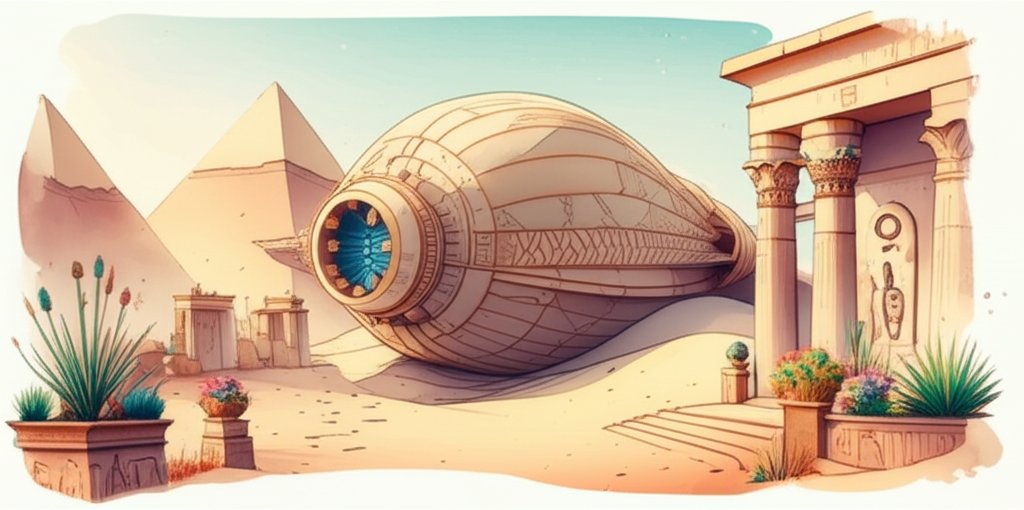
Beyond the lack of physical evidence, archaeologists also raise concerns about the cultural context and potential biases inherent in the ancient alien theory. Religious texts, they argue, are expressions of belief and cosmology, not scientific records of alien encounters. Ancient art and myth reflect human concerns and aspirations, not necessarily literal events. Moreover, the theory can be seen as culturally dismissive, implying that non-European civilizations were too “primitive” to achieve greatness without external help.
Critics also point out that proponents of the ancient alien theory often misrepresent primary sources and ignore crucial historical context. Ultimately, the vast majority of experts and academics remain skeptical. They believe that while the idea of ancient alien contact is fascinating, it lacks the rigorous scientific support necessary to be considered a valid explanation for ancient mysteries.
“Ultraterrestrials” and the Harvard Perspective
Adding another layer to the discussion is the “Ultraterrestrial” hypothesis, which suggests that UAP (Unidentified Aerial Phenomena) may reflect the activities of intelligent beings concealed on Earth or in its near environs. Coined by Harvard researchers, this hypothesis proposes four potential theories for UAP: Human Cryptoterrestrials, Non-human Civilization, Aliens/Future Humans, and Magical Cryptoterrestrials. While this framework challenges conventional thinking, it also highlights the need for continued investigation into the unknown.
Alternative Explanations for Ancient Wonders
Let’s revisit some of the examples mentioned earlier. The Great Pyramid of Giza was built during a time of centralized political power and incredible administrative coordination. The massive blocks, though impressive, were quarried locally. Ramps, levers, and sheer manpower allowed for their placement. The Nazca Lines, created by removing the reddish topsoil, likely served a ritualistic or astronomical purpose. And Stonehenge, built over centuries, functioned as a ceremonial site, burial ground, and possibly a solar calendar.
These examples show how human ingenuity, combined with social organization and available resources, can explain even the most seemingly impossible achievements of the ancient world. Deciphering Teka-teki glyph alien menanti pemecahan may provide additional clues to these achievements.
The Enduring Appeal: Why the Theory Persists
Despite the lack of scientific support, the ancient alien theory continues to captivate the public imagination. Its enduring appeal lies in its ability to offer simple, exciting explanations for complex mysteries. It allows us to imagine a universe teeming with life and the possibility of contact with civilizations far beyond our own.
Ultimately, the question of whether ancient aliens visited Earth remains unanswered. While the theory offers a tantalizing prospect, it requires extraordinary evidence to overcome the established explanations of archaeology and history. Perhaps future discoveries will shed new light on this debate but for now, the burden of proof remains with those who propose the existence of ancient alien contact.










