What Causes Jupiter’s Stripes? Shifting Gases and Chemicals.
Ever gazed at Jupiter and wondered what creates those distinctive bands of color? The answer isn’t as simple as just “clouds.” It’s a dynamic interplay of atmospheric gases, temperature differences, and Jupiter’s incredibly fast spin. This article dives deep into the processes behind Jupiter’s striking striped appearance.
At a glance:
- Understand how Jupiter’s zones and belts form due to atmospheric circulation.
- Learn how different chemical compounds contribute to the colors we see.
- Discover how Jupiter’s internal heat and rapid rotation influence its weather patterns.
- Explore the role of ammonia and water in creating distinct cloud layers.
Jupiter’s Zones and Belts: A Global Circulation System
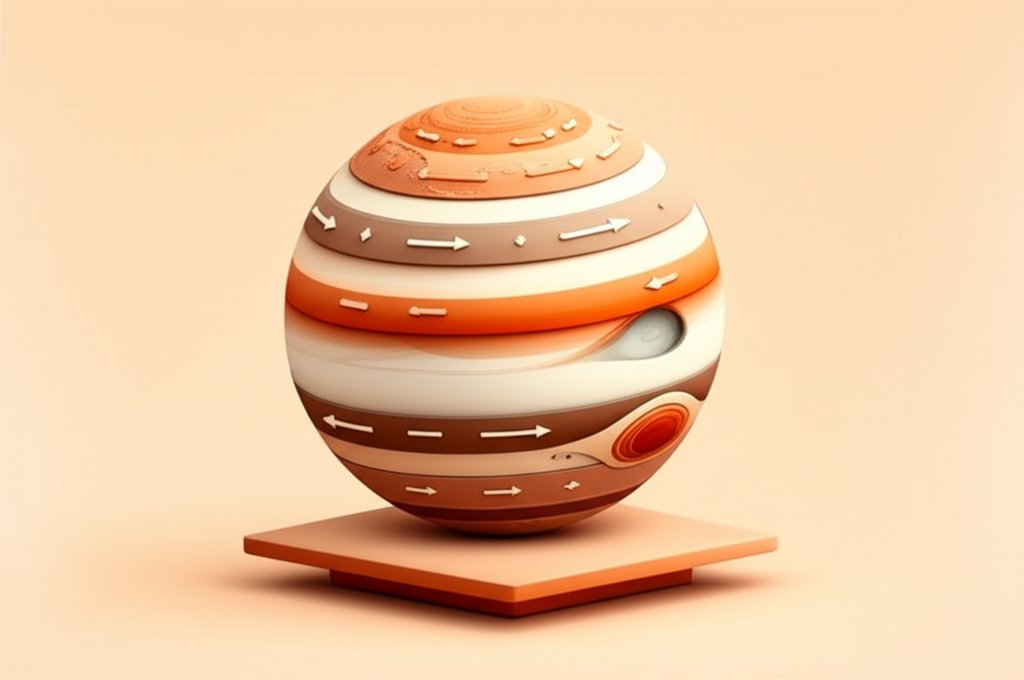
What causes Jupiter’s stripes? They’re not just random patterns. They are regions of rising and sinking gases, arranged in alternating bands that encircle the entire planet. These bands are categorized into two main types: zones and belts.
- Zones: These are the lighter-colored bands, and they represent areas where warmer gas is rising. This rising gas is rich in ammonia, which crystallizes in the upper atmosphere to form bright, reflective clouds.
- Belts: These are the darker-colored bands, and they represent areas where cooler gas is sinking. Because the gas is descending, there’s less ammonia cloud cover, allowing us to see deeper into Jupiter’s atmosphere where different chemicals create darker hues.
This alternating pattern of rising and sinking gas is driven by convection, much like the way heat rises and cool air sinks in Earth’s atmosphere. However, Jupiter’s rapid rotation dramatically influences this process, creating the distinct zonal flow we observe. To get a broader understanding of the atmospheric context of these phenomena, Explore Jupiter’s wild weather.
The Coriolis Effect: Twisting the Winds
Jupiter spins incredibly fast, completing one rotation in just under 10 Earth hours. This rapid rotation generates a strong Coriolis effect, which deflects moving air currents. On Jupiter, the Coriolis effect causes the rising and sinking gas flows to be deflected into powerful east-west winds. These winds, some reaching speeds of up to 400 mph (640 km/h), confine the rising and sinking gas into the distinct zones and belts that characterize Jupiter’s appearance.
Imagine throwing a ball on a spinning merry-go-round. The ball appears to curve because of the rotation. Similarly, on Jupiter, the Coriolis effect curves the paths of the rising and sinking gas, creating these jet streams that define the zones and belts.
Chemical Composition and Color
Why are the stripes different colors? The key lies in the chemical composition of Jupiter’s atmosphere at different altitudes.
- Ammonia (NH3): As mentioned earlier, ammonia plays a major role in the bright zones. It condenses into ice crystals in the upper atmosphere, forming reflective clouds.
- Ammonium Hydrosulfide (NH4SH): Deeper in the atmosphere, ammonium hydrosulfide clouds contribute to reddish-brown hues.
- Water (H2O): Even deeper, water ice clouds exist.
- Other Trace Compounds: Small amounts of other compounds like phosphorus, sulfur, and organic chemicals react with ultraviolet light from the sun, creating a range of colors from orange to brown.
These chemicals react differently to sunlight. For instance, the darker belts may contain sulfur compounds that absorb blue light, giving them a reddish-brown appearance. The exact composition and altitude of these clouds vary, leading to the subtle color variations within the zones and belts.
Juno’s Unveiling of Ammonia Distribution
NASA’s Juno mission has provided valuable insights into the distribution of ammonia in Jupiter’s atmosphere. Juno’s microwave radiometer revealed that ammonia isn’t uniformly distributed. Rather, it’s concentrated in certain regions, particularly in areas experiencing strong updrafts. This suggests that storms on Jupiter can lift ammonia ice particles high into the atmosphere, where they mix with water vapor and create slushy “mushballs” of ammonia and water. These mushballs then fall back into the atmosphere, redistributing ammonia and influencing the cloud formation.
Internal Heat and Weather Patterns
Jupiter’s internal heat is a major driver of its weather patterns. Although Jupiter receives sunlight, the planet emits almost twice as much heat as it receives from the sun. This internal heat originates from the planet’s formation, and it fuels convection currents within Jupiter’s atmosphere. This means Jupiter’s weather isn’t just driven by solar heating, which is different from our planet. Jupiter’s internal core temperatures reach approximately 43,000 degrees Fahrenheit.
This internal heat contributes to the strong updrafts and downdrafts that create the zones and belts. It also powers the intense storms and lightning that are characteristic of Jupiter’s atmosphere.
The Great Red Spot: A Long-Lived Storm
Perhaps the most famous feature of Jupiter’s weather is the Great Red Spot, a colossal storm larger than Earth that has been raging for centuries. While the exact mechanisms that sustain the Great Red Spot are still being studied, it’s believed to be fueled by energy from Jupiter’s internal heat and the planet’s rapid rotation. The Great Red Spot orbits the planet every 8 hours and rotates on its axis every nine hours in an anticlockwise direction
Practical Playbook: Understanding Jupiter’s Stripes
Here’s how you can visualize what causes Jupiter’s stripes:
- Imagine a pot of boiling water: The heat source from below causes water to rise in some areas and sink in others.
- Now, add a spinning motion: The spinning causes the rising and sinking currents to be deflected into swirling patterns.
- Finally, add different colored dyes: Each dye represents a different chemical compound in Jupiter’s atmosphere.
This simple analogy captures the essence of what causes Jupiter’s stripes: convection, rotation, and chemical composition.
Quick Answers: Common Questions About Jupiter’s Stripes
- Why are Jupiter’s stripes stable? Jupiter’s rapid rotation and strong Coriolis effect help maintain the zonal flow, keeping the zones and belts relatively constant over time.
- Do the stripes change? Yes, while the overall pattern remains, the colors and intensities of the zones and belts can change due to variations in atmospheric conditions and chemical reactions.
- Could we ever land on Jupiter and see the stripes up close? Landing is impossible due to the lack of a solid surface, toxic gases, quick rotation, and extreme wind speeds.
Actionable Close
Understanding what causes Jupiter’s stripes involves grasping the interplay of atmospheric circulation, chemical composition, and internal heat. By visualizing these factors, we gain a deeper appreciation for the complexity and dynamism of Jupiter’s atmosphere. So, the next time you look at Jupiter, remember that you’re witnessing a planet-wide weather system driven by fundamental physical processes, not just a static pattern.










