
Imagine a swirling canvas of vibrant colors, a tempestuous realm where storms rage for centuries and winds howl at unimaginable speeds. This is Jupiter, and understanding Jupiter’s Atmosphere and Weather reveals a world unlike any other in our solar system. It’s a place where the very definition of “atmosphere” stretches to its limit, blurring the line between gas and liquid.
At a glance:
- Jupiter doesn’t have a solid surface; you’d gradually transition from atmosphere to fluid interior.
- The atmosphere is primarily hydrogen and helium, with traces of other gases that create the vibrant colors.
- Giant storms, like the Great Red Spot, are a defining characteristic.
- Jupiter’s weather is driven by powerful jet streams and convection currents.
- The Juno mission is helping us understand Jupiter’s atmosphere in unprecedented detail.
The Anatomy of a Gas Giant’s Sky
Jupiter’s atmosphere is vast, the largest in our solar system. Unlike Earth, Jupiter doesn’t have a rocky surface. Instead, the atmosphere gradually becomes denser until it transitions into a fluid, metallic hydrogen interior. The primary components of the atmosphere are hydrogen (90%) and helium (around 10%), similar to the composition of the Sun. However, the small amounts of other gases have a significant impact, influencing both the atmosphere’s appearance and its overall chemistry.
Layered Complexity: Diving into the Depths
Jupiter’s atmosphere is structured into distinct layers, each with unique characteristics:
- Troposphere: This is the weather layer, analogous to Earth’s troposphere. Here, we find the iconic clouds of Jupiter, composed of ammonia crystals, ammonium hydrosulfide, and even water. This is also where the Great Red Spot resides. The base sits at a crushing 10 bars of pressure and a toasty 340 K (140°F).
- Stratosphere: Above the troposphere, the stratosphere contains hydrocarbons, which are formed as sunlight breaks down methane. Auroras also dance near the poles within this layer. The tropopause, marking the boundary with the troposphere, lies roughly 50 km above the visible clouds, with a chilly 0.1 bar pressure and 110 K (-261°F) temperature.
- Thermosphere: This is where things get surprisingly hot. Despite the distance from the sun, temperatures can reach a scorching 1,000 K (700°C or 1,300°F). This extreme heat is attributed to Jupiter’s powerful magnetic field and interactions with the solar wind. But as you rise, the temperature decreases to about 200 K.
- Exosphere: The outermost layer, the exosphere, gradually fades into space, merging with Jupiter’s vast magnetosphere. The density thins out until it becomes indistinguishable from the interplanetary medium.
Bands, Zones, and Colors: A Striking Visual Tapestry
One of the most striking features of Jupiter is its banded appearance. These bands and zones are a result of convection currents and differences in chemical composition. The lighter zones are rising columns of ammonia-rich gas, while the darker belts are sinking flows of cooler material. Understanding Jupiters Bands is essential for grasping how these regions interact. What gives these bands their colors? They’re thought to be derived from sulfur and phosphorus compounds reacting in the upper atmosphere.
Jupiter’s Wild Weather: Perpetual Storms and Furious Winds
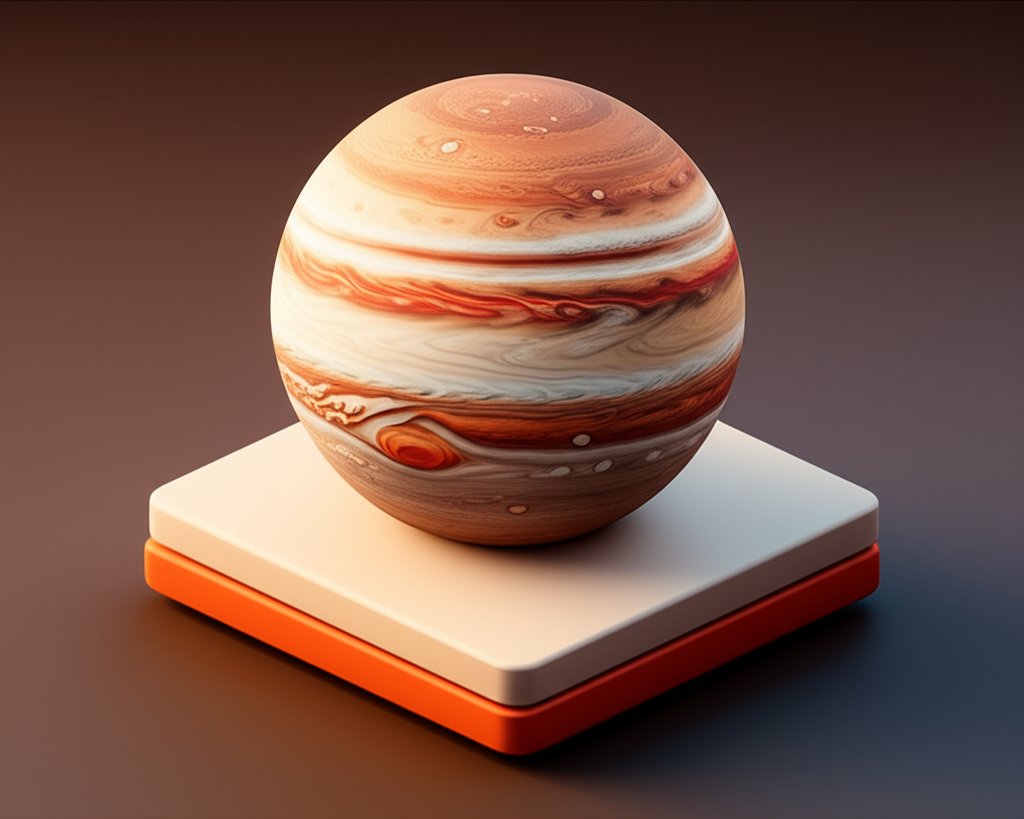
Jupiter’s weather isn’t like a typical rainy day; it’s extreme, continuous, and driven by powerful forces. Jet streams roar through the atmosphere, and storms can erupt and persist for years, even centuries. Jupiters wind speeds revealed – you’ll find they are far faster than the strongest hurricanes on Earth.
The Great Red Spot: A Timeless Storm
Perhaps the most famous feature of Jupiter is the Great Red Spot, a massive anticyclonic storm in the southern hemisphere. Larger than Earth, this weather phenomenon has been raging for at least 350 years. Winds inside the Great Red Spot can reach speeds of up to 432 km/h (268 mph). Although it has been shrinking in recent years, it’s still a dominant feature of Jupiter’s atmosphere. Learn more about the Spot and its enduring mysteries.
Lightning Strikes: Power and Origins
Jupiter experiences lightning, but it’s far more powerful than what we see on Earth. These lightning strikes are associated with water clouds and have been observed above these clouds. The detection of lightning helps scientists map the distribution of water in Jupiter’s atmosphere, crucial for understanding the planet’s formation history.
Unlocking the Secrets of Jupiter’s Composition
Beyond hydrogen and helium, Jupiter’s atmosphere contains trace amounts of other elements and compounds that provide clues to the planet’s origin and evolution. Scientists have found that elements like nitrogen, sulfur, and noble gases exceed solar values by a factor of about three. Delve into Jupiters atmosphere to learn more about the chemistry at play.
What Other Compounds Are Present?
Besides the major components, various other compounds exist in Jupiter’s atmosphere:
- Water
- Methane
- Hydrogen sulfide
- Ammonia
- Phosphine
Jupiter is enriched in carbon, nitrogen, sulfur, and potentially oxygen, by a factor of 2-4 relative to the Sun. The abundance of helium is about 0.157 ± 0.004 relative to molecular hydrogen. These ratios offer crucial insights into the processes that shaped Jupiter during the early solar system.
The Role of Color: Decoding the Stripes
The vibrant stripes that adorn Jupiter are not just aesthetic; they’re clues to the atmospheric processes at work. Unlocking Jupiters Striped Secrets reveals how temperature, altitude, and chemical composition all play a role in determining the colors we see. Minor differences in the concentration of certain compounds can have a major impact on the reflectivity of the clouds, resulting in the distinct bands and zones.
Mission Juno: Peering Beneath the Clouds

NASA’s Juno mission has revolutionized our understanding of Jupiter’s atmosphere. By orbiting close to the planet, Juno’s instruments are gathering unprecedented data on its composition, magnetic field, and internal structure.
Measuring Water Content: A Key to Jupiter’s Past
One of Juno’s key instruments is the Microwave Radiometer, which measures the water content in Jupiter’s atmosphere. Determining the abundance of water is crucial for understanding the amount of oxygen present, which, in turn, sheds light on how Jupiter formed.
Connecting Atmosphere and Interior
Juno is also investigating the connection between atmospheric features and the structure and motion of gas deep within Jupiter’s interior. By mapping the planet’s gravitational and magnetic fields, Juno is providing insights into the processes that drive Jupiter’s weather and shape its overall structure.
Common Questions About Jupiter’s Atmosphere
Let’s address some frequently asked questions about Jupiter’s atmosphere and weather:
Is Jupiter’s atmosphere habitable?
No, Jupiter’s atmosphere is uninhabitable. The lack of oxygen and the presence of toxic gases make it impossible for life as we know it to exist there.
How deep would you have to go to experience Earth-like pressure?
You’d need to descend approximately 100 km (62 miles) below the cloud tops to experience Earth-like atmospheric pressure.
How large is Jupiter’s magnetosphere?
Jupiter’s magnetosphere is the largest structure in the solar system. It extends up to 3 million kilometers toward the Sun and a staggering 1 billion kilometers behind Jupiter.
Beyond the Data: Visualizing Jupiter’s Weather
Want to see Jupiter’s weather for yourself? Explore Jupiters Weather Patterns – you might find one that lets you simulate atmospheric conditions and appreciate the planet’s dynamic environment. Even without a model, numerous simulations and visualizations are available online, bringing the complexity of Jupiter’s atmosphere to life.
By studying Jupiter’s atmosphere and weather, we gain a deeper understanding not only of this giant planet but also of the processes that shape planetary atmospheres throughout the universe. It’s a frontier of exploration and discovery.










