
Ever looked at Jupiter and wondered what causes those striking stripes? Those aren’t just random patterns; they’re a result of complex atmospheric dynamics that create Jupiter’s belts and zones explained in detail below. Understanding these bands unlocks secrets about Jupiter’s weather, composition, and even its internal heat.
At a glance:
- Discover the atmospheric layers responsible for Jupiter’s unique banded appearance.
- Understand the difference between belts and zones: rising vs. sinking gas, color variations, and chemical composition.
- Learn how Jupiter’s internal heat and rapid rotation contribute to these dynamic weather patterns.
- Explore the role of specific elements like ammonia, methane, and sulfur in creating the vibrant colors.
- Debunk common misconceptions about landing on Jupiter and the nature of its surface.
Jupiter’s Atmospheric Layers: A Vertical Overview
Jupiter’s atmosphere doesn’t have a defined surface like Earth. Instead, it transitions gradually from gas to a metallic fluid deep within. Understanding the atmospheric layers is crucial to understanding the formation of belts and zones.
- Troposphere: This innermost layer, extending about 50 km, houses the cloud formations that create the visible belts and zones. Pressure here is immense, turning hydrogen into a metallic fluid.
- Stratosphere: Extending to 320 km, temperatures plummet as low as -150°F.
- Thermosphere: Reaching 1,000 km, this layer experiences soaring temperatures that can reach 1000 K.
- Exosphere: The outermost layer with minimal density and pressure, gradually fading into interstellar space.
Belts vs. Zones: Rising and Falling Air Masses
Jupiter’s distinctive bands are categorized as belts and zones, each with unique characteristics driven by rising and sinking air masses.
- Zones: These are the lighter-colored bands. They are regions where warmer gas is rising, high in the atmosphere. Because of that height, zones are typically richer in ammonia, which crystallizes and reflects sunlight effectively, giving them their bright appearance.
- Belts: The darker-colored bands are regions where colder gas is sinking. These areas tend to have temperature variations and different chemical compositions compared to zones. The sinking motion clears away some of the upper-level clouds, revealing deeper layers that contain different compounds, leading to darker hues.
Think of it like this: Zones are like high-pressure systems on Earth, where air rises and cools, leading to cloud formation. Belts are like low-pressure systems, where air sinks and warms, leading to clearer skies (but darker colors due to deeper atmospheric views).
What Makes Jupiter So Colorful? Decoding the Palette
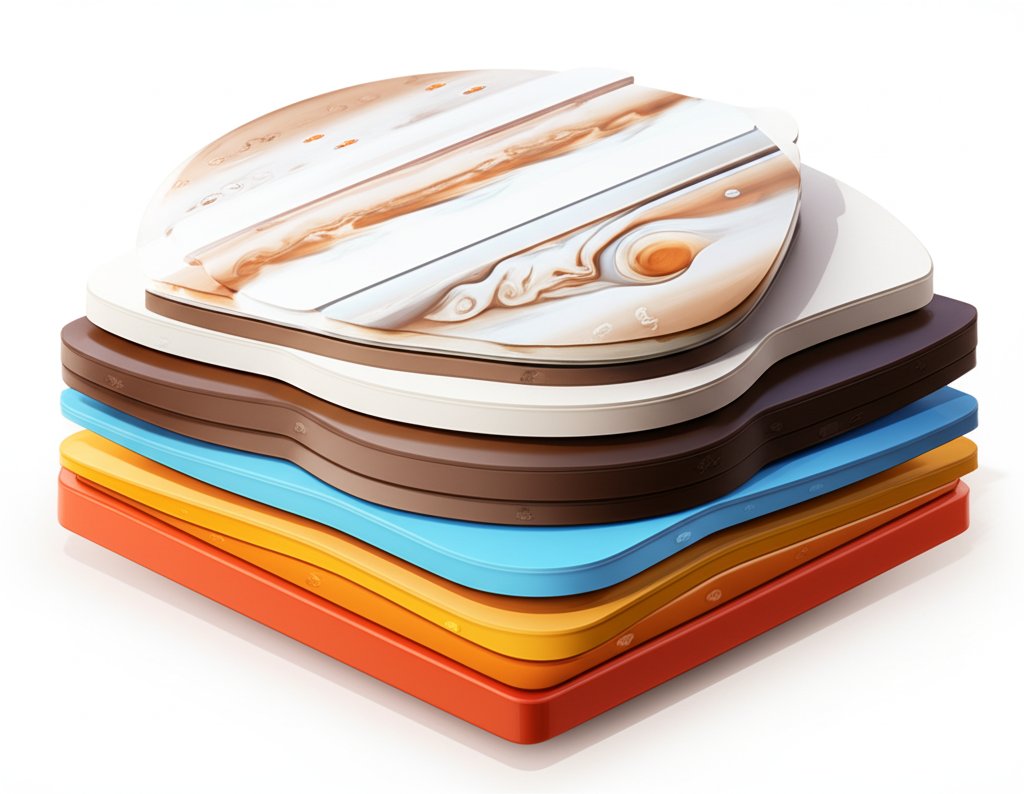
The vibrant colors of Jupiter’s atmosphere aren’t just random; they’re caused by the interaction of sunlight with different elements and compounds present in the clouds.
- Ammonia: A key player in the zones, creating the lighter, whitish hues.
- Methane: Contributes to various shades depending on its concentration and altitude.
- Ammonium Hydrosulfide: This compound is thought to react with UV radiation to produce reddish colors, potentially contributing to the famous Great Red Spot.
- Phosphorus and Sulfur: Storms can transport these elements from lower to higher altitudes, influencing the color palette.
Example: Imagine a chef using different spices to create a complex flavor profile. Similarly, Jupiter uses different chemical “spices” to create its unique visual appearance.
Jupiter’s Internal Engine: Heat and Rotation
Jupiter radiates 1.67 times more heat than it receives from the Sun. This internal heat, combined with Jupiter’s rapid spin (one rotation every 10 hours), dramatically impacts the planet’s atmospheric dynamics and the formation of its belts and zones. These two factors drive the strong zonal winds prevalent across the planet.
The rapid rotation also contributes to Jupiter’s “squashed” appearance, technically known as being an oblate spheroid.
The Great Red Spot and Other Storms: Disrupting the Bands

Jupiter’s atmosphere isn’t just about stable belts and zones; it’s also a hotbed for massive storms. The most famous, the Great Red Spot (GRS), is a persistent anticyclonic storm larger than Earth.
- Great Red Spot (GRS): A storm that has raged for at least 300 years, the GRS is believed to be fueled by the planet’s internal heat and maintained by the atmospheric flow patterns. It rotates counter-clockwise every six Earth days and is slowly shrinking. Ammonium hydrosulfide reacting with ultraviolet rays may contribute to its reddish color.
- Other Storms: Smaller storms, both cyclones and anticyclones, constantly form and dissipate, further contributing to the dynamic appearance of Jupiter’s bands. These storms often interact with the existing belts and zones, causing temporary disruptions and shifts in their boundaries.
You can delve deeper into the nature of storms and other atmospheric phenomena by checking out Explore Jupiter’s wild skies.
Practical Playbook: Observing and Appreciating Jupiter’s Zones and Belts
While landing on Jupiter is impossible, observing it is not! Here’s how you can appreciate Jupiter’s belts and zones, whether you’re an amateur astronomer or just curious.
- Use a Telescope: Even a small telescope can reveal Jupiter’s main belts and zones. Larger telescopes will show more detail, including smaller storms and color variations.
- Observe Regularly: Jupiter’s atmosphere is constantly changing. Observing over several weeks or months will allow you to witness these changes firsthand.
- Use Filters: Colored filters can enhance certain features. For example, a blue filter can highlight high-altitude clouds, while a red filter can enhance the contrast of the Great Red Spot.
- Consult Resources: Websites and books dedicated to amateur astronomy can provide detailed observing guides and predictions of Jupiter’s atmospheric activity.
Quick Answers: Common Questions About Jupiter’s Belts and Zones
Q: Can we land on Jupiter?
A: No. Jupiter lacks a solid surface. Any probe would be crushed by the immense atmospheric pressure.
Q: Are the belts and zones permanent?
A: No. While the general pattern is stable over long periods, the boundaries and intensity of the belts and zones can change due to storms and other atmospheric disturbances.
Q: What is the temperature inside Jupiter?
A: The temperature increases dramatically towards the interior. Near the “surface” (the upper atmosphere) temperatures range from -234°F, but deep within the planet, they can reach 64,000°F.
Q: How fast are the winds on Jupiter?
A: Wind speeds on Jupiter can reach 385 mph, far exceeding the strongest hurricanes on Earth.
Actionable Close: Unlock the Secrets of Jupiter’s Skies
Understanding Jupiter’s belts and zones isn’t just an academic exercise; it’s a window into the workings of a dynamic planetary atmosphere unlike any other in our solar system. By appreciating the interplay of atmospheric layers, chemical composition, internal heat, and rapid rotation, you can gain a deeper understanding of the gas giant’s wild skies. So next time you look at Jupiter, remember: you’re not just seeing stripes; you’re witnessing a complex weather system in action.










