Understanding the vast distances in our solar system can be challenging. One way astronomers make these distances more manageable is by using the astronomical unit, or AU. So, exactly how far is Jupiter, the solar system’s giant, when measured in astronomical units? Understanding Jupiter distance in astronomical units provides a crucial way to grasp its position and influence within our celestial neighborhood.
At a glance:
- Learn how astronomical units simplify measuring interplanetary distances.
- Understand the average and variable Jupiter distance in AU.
- Discover how Jupiter’s distance affects its appearance and exploration.
- Grasp the influence of Jupiter’s distance on the rest of the solar system.
What Exactly is an Astronomical Unit?
Before diving into Jupiter’s specific distance, let’s define the AU. An astronomical unit is the average distance between the Earth and the Sun, roughly 150 million kilometers (93 million miles). It’s a convenient “yardstick” for measuring distances within our solar system, eliminating the need for unwieldy numbers. For example, stating that Mars is 1.52 AU from the Sun is far easier than saying it’s 228 million kilometers away.
Jupiter’s Average Distance in Astronomical Units
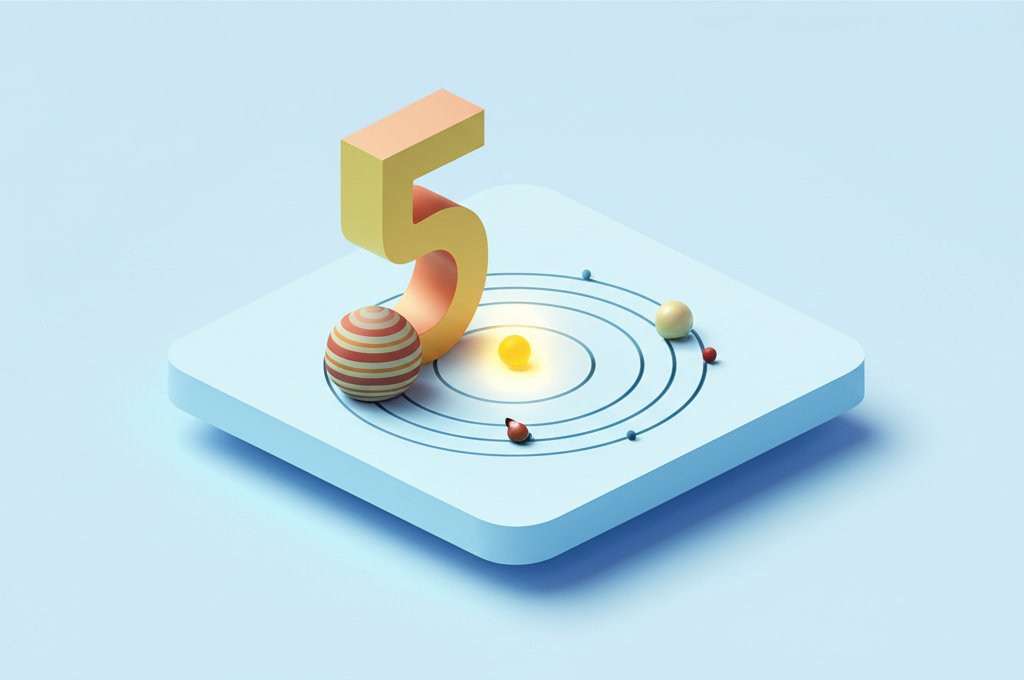
Jupiter orbits the Sun at an average distance of 5.2 AU. This means that Jupiter is, on average, 5.2 times farther from the Sun than Earth is. While the orbit isn’t a perfect circle, this average gives a good sense of its location relative to the Sun and other planets. This distance significantly impacts Jupiter’s temperature, orbital period, and even its influence on the asteroid belt.
Learn about Jupiter’s Size to better appreciate how distance affects our ability to study this planet.
The Variance: Jupiter’s Closest and Farthest Points

Planetary orbits aren’t perfectly circular; they’re elliptical. This means that a planet’s distance from the Sun varies as it moves along its orbit. For Jupiter, this variation is relatively small but still significant.
- Perihelion (closest point to the Sun): Jupiter’s closest approach to the Sun is about 4.95 AU.
- Aphelion (farthest point from the Sun): Jupiter’s farthest point from the Sun is approximately 5.46 AU.
While a difference of half an AU might seem small on a cosmic scale, it does affect the amount of sunlight Jupiter receives and therefore its temperature.
How Jupiter’s Distance Affects What We See
Jupiter’s great distance makes it appear smaller and dimmer in our night sky compared to closer planets like Mars or Venus. Even at its closest approach to Earth, Jupiter still requires telescopes to reveal its famous cloud bands and the Great Red Spot clearly.
- Telescopic Observations: Amateur astronomers rely on telescopes with apertures of at least 60-80mm to observe Jupiter’s atmospheric details.
- Brightness: Though visible to the naked eye, Jupiter’s brightness varies based on its position relative to Earth and the Sun. When Jupiter is at opposition (closest to Earth), it shines brightest.
Jupiter’s Distance and Spacecraft Travel Times
The vast Jupiter distance in astronomical units profoundly impacts space mission planning. Reaching Jupiter is a multi-year endeavor requiring careful trajectory calculations.
- Hohmann Transfer Orbit: Most missions use a Hohmann transfer orbit, an elliptical path around the Sun that takes a spacecraft from Earth’s orbit to Jupiter’s orbit.
- Travel Time: Depending on the mission’s trajectory and propulsion system, it generally takes spacecraft between two to six years to reach Jupiter. For example, the Juno mission took nearly five years to arrive.
- Gravity Assists: Spacecraft often use gravity assists from other planets, like Venus or Earth, to gain speed and alter their trajectory, shortening travel times and reducing fuel consumption.
How Jupiter’s Distance Influences the Solar System
Jupiter’s hefty mass (318 times Earth’s mass) combined with its distance from the Sun gives it a significant influence on the rest of the solar system.
- Asteroid Belt: Jupiter’s gravity has shaped the asteroid belt located between Mars and Jupiter. It has prevented the asteroids from coalescing into a planet and maintains their distribution.
- Orbital Resonances: Jupiter also influences the orbits of other planets through orbital resonances. For example, Neptune and Pluto are in a 3:2 orbital resonance, meaning Neptune orbits the Sun three times for every two orbits of Pluto. This resonance is partly influenced by Jupiter’s gravitational pull.
- Protecting the Inner Planets: Some scientists believe Jupiter’s gravity has helped protect the inner planets (including Earth) from frequent asteroid collisions by deflecting many potentially hazardous objects.
Jupiter in Astronomical Units: A Practical Example
Imagine you’re planning a hypothetical mission to Jupiter. Knowing its average distance of 5.2 AU helps you estimate:
- Fuel Requirements: The farther the distance, the more fuel needed for course corrections.
- Communication Delays: Radio signals travel at the speed of light, but at Jupiter’s distance, there’s a significant time delay for communication. Expect a round-trip communication delay of roughly 45 to 90 minutes, depending on the planets’ relative positions.
- Power Supply: Solar panels receive significantly less sunlight at 5.2 AU compared to Earth’s distance. Missions to Jupiter often rely on radioisotope thermoelectric generators (RTGs) to generate power from the heat produced by the natural decay of plutonium-238.
Quick Answers: Common Questions About Jupiter’s Distance
- Why not use kilometers/miles? While kilometers and miles are valid, AUs provide a more intuitive sense of relative distances within the solar system. It’s easier to grasp that Jupiter is 5.2 times farther than Earth than to visualize 778 million kilometers. Plus, using AUs avoids extremely large, cumbersome numbers.
- Does Jupiter’s distance affect its seasons? Jupiter’s axial tilt is only 3 degrees, compared to Earth’s 23.5 degrees. As a result, Jupiter experiences negligible seasonal variations despite its distance from the Sun.
- How did they figure out Jupiter’s distance originally? Early astronomers used Kepler’s laws of planetary motion and careful observations of Jupiter’s orbital period to calculate its average distance from the Sun. Parallax measurements, similar to how your eyes perceive depth, were also utilized.
Your Jupiter Distance Playbook: Key Takeaways
To solidify your knowledge of Jupiter’s distance in astronomical units, remember these key points:
- Average Distance: Jupiter orbits at an average of 5.2 AU from the Sun.
- Orbital Variation: Its distance varies slightly due to its elliptical orbit, ranging from 4.95 AU to 5.46 AU.
- Observational Impact: Jupiter’s distance makes it appear smaller and dimmer, requiring telescopes for detailed observation.
- Mission Planning: Astronautical units are crucial for planning space missions, estimating travel times, and accounting for communication delays.
- Solar System Influence: Jupiter’s distance and mass allow it to shape the asteroid belt and influence the orbits of other planets.
By understanding Jupiter distance in astronomical units, you gain a more profound appreciation for its place and role within our solar system. You can now explain to others why astronomers use AUs, how it affects Jupiter’s appearance, and why it matters for space exploration.










