Untuk gambaran yang lebih besar dan konteks penuh, pastikan Anda membaca panduan utama kami tentang Jupiter Size and Distance: How Big Is The Gas Giant?.
Understanding the scale of our solar system starts with grasping just how far is Jupiter from sun. It’s a distance that dwarfs anything we experience on Earth, impacting everything from Jupiter’s climate to its orbital period. Knowing this distance helps us appreciate the immense size of our cosmic neighborhood.
At a glance:
- You’ll discover the average and varying distances between Jupiter and the Sun, expressed in both kilometers and astronomical units (AU).
- You’ll understand how this distance influences Jupiter’s orbital period and the amount of sunlight it receives.
- We’ll explore how Jupiter’s distance and size compare with other solar system bodies, putting its location into perspective.
- You’ll learn how scientists measure these vast distances and what tools enable these calculations.
The Astronomical Unit: A Cosmic Yardstick
When dealing with the solar system, miles and kilometers become unwieldy. That’s where the Astronomical Unit (AU) comes in. One AU is defined as the average distance between the Earth and the Sun, which is approximately 150 million kilometers (93 million miles). Using AUs makes comparing planetary distances much easier.
Jupiter’s Average Distance From The Sun
Jupiter, the solar system’s behemoth, resides at an average distance of 5.2 AU from the Sun. In more relatable numbers, that’s roughly 778 million kilometers or 484 million miles. This means Jupiter is more than five times farther from the Sun than Earth is.
Elliptical Orbit: A Dance of Varying Distances
Planets don’t travel in perfect circles. Their orbits are elliptical (oval-shaped). This means the distance between Jupiter and the Sun varies throughout its orbit.
- Perihelion: The point in Jupiter’s orbit where it’s closest to the Sun. At perihelion, Jupiter is approximately 741 million kilometers (460 million miles) from the Sun.
- Aphelion: The point where Jupiter is farthest from the Sun. At aphelion, the distance stretches to about 817 million kilometers (508 million miles).
This variation, while significant, is relatively small compared to the overall distance, but it does have a slight effect on the intensity of sunlight Jupiter receives and the speed at which it travels in its orbit.
How Jupiter’s Distance Affects its Orbit
Jupiter’s distance from the Sun has a profound impact on its orbital period—the time it takes to complete one revolution around the Sun. Because of its vast distance, Jupiter’s orbital period is approximately 11.86 Earth years. That means a “year” on Jupiter is almost 12 times longer than a year on Earth! This is a direct consequence of Kepler’s Third Law of Planetary Motion, which states that the square of a planet’s orbital period is proportional to the cube of the semi-major axis of its orbit (essentially, its average distance from the Sun).
Sunlight Intensity at Jupiter
The amount of sunlight a planet receives decreases dramatically with increasing distance from the Sun. Given that Jupiter is 5.2 AU away, it receives only about 4% of the sunlight that Earth does. This reduced solar energy plays a crucial role in Jupiter’s atmospheric temperature. The cloud tops of Jupiter are extremely cold, averaging around -145 degrees Celsius (-230 degrees Fahrenheit).
Comparing Distances: Jupiter vs. Other Planets
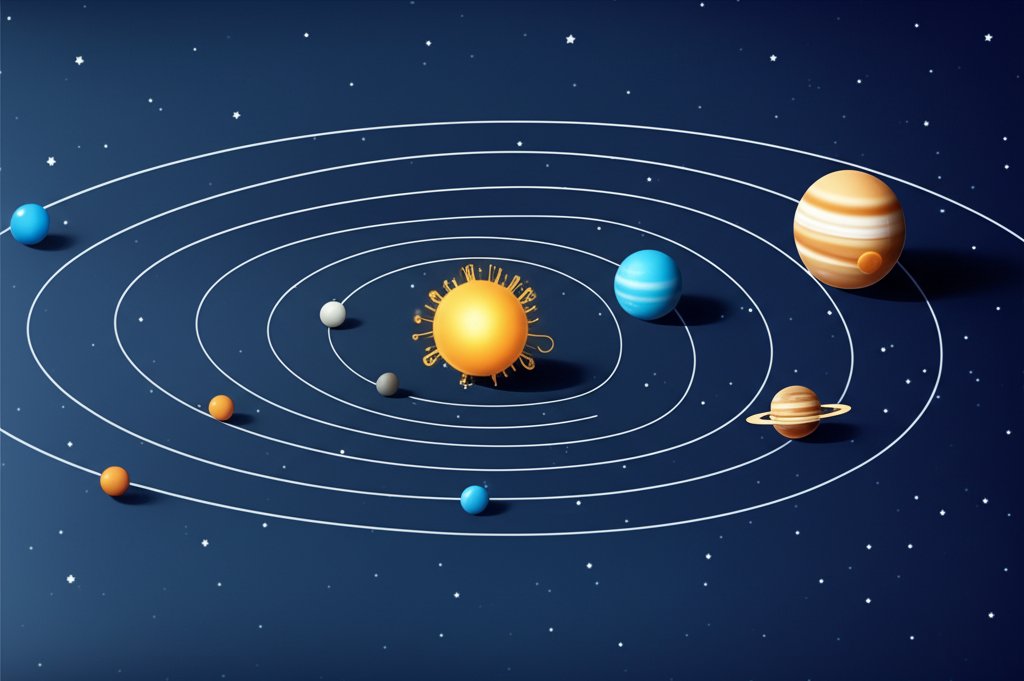
To truly appreciate the vastness of Jupiter’s orbit, let’s compare its distance to that of other planets in our solar system:
| Planet | Average Distance from Sun (AU) |
|---|---|
| Mercury | 0.39 |
| Venus | 0.72 |
| Earth | 1.00 |
| Mars | 1.52 |
| Jupiter | 5.20 |
| Saturn | 9.54 |
| Uranus | 19.22 |
| Neptune | 30.06 |
| As you can see, Jupiter resides significantly farther out than the inner, rocky planets. Understanding this placement is key to grasping how big is Jupiter actually? and its role in shaping the solar system’s dynamics. |
Measuring the Immense: How Scientists Determine Distances
So, how do scientists accurately measure the distance between Jupiter and the Sun? Several techniques are employed:
- Radar Ranging: Radio waves are bounced off Jupiter, and the time it takes for the signal to return is measured. Knowing the speed of light, the distance can then be calculated.
- Spacecraft Tracking: As spacecraft travel to Jupiter, their positions are precisely tracked using radio signals. This data helps refine our knowledge of Jupiter’s orbit and its distance from the Sun.
- Kepler’s Laws: By observing Jupiter’s orbital period and applying Kepler’s Laws of Planetary Motion, astronomers can calculate its average distance from the Sun.
- Parallax: Measuring the apparent shift of a star’s position as observed from different points in Earth’s orbit allows for distance calculations.
Jupiter’s Influence: Protector or Peril?
Jupiter’s massive gravity and distance from the Sun have a considerable influence on the entire solar system. Some scientists believe it acts as a “cosmic vacuum cleaner,” deflecting potentially hazardous asteroids and comets away from the inner planets. However, other studies suggest that Jupiter’s gravity can also redirect objects towards the inner solar system, increasing the risk of impacts. The jury is still out on whether Jupiter is ultimately a protector or a peril, but its gravitational influence is undeniable.
The View from Jupiter: What Does the Sun Look Like?
Imagine standing on Jupiter. Given its distance, the Sun would appear significantly smaller and dimmer than it does on Earth. It would still be the brightest object in the sky, but more like a very bright, distant star than the blazing disk we’re used to. The amount of sunlight reaching Jupiter is so reduced that it impacts its atmospheric processes and overall climate.
Practical Playbook: Visualizing Jupiter’s Distance
Here’s a way to conceptualize the massive separation of Jupiter from sun:
- Scale Model: Create a scale model of the solar system. If Earth is the size of a pea, Jupiter would be roughly the size of a golf ball, placed about 26 feet away from a “sun” that’s roughly the size of a beach ball placed at the center.
- Travel Time: Consider the travel time for spacecraft. It takes years for probes like Juno to reach Jupiter, highlighting the vast distances involved.
- Light Travel Time: The light from the Sun takes approximately 43 minutes to reach Jupiter. That means we are always seeing Jupiter as it was 43 minutes in the past.
- Compare to Familiar Distances: Relate Jupiter’s distance to familiar terrestrial distances. For example, the distance between New York and Los Angeles is approximately 4,000 kilometers. You would need to traverse that distance almost 200,000 times to cover the distance between the Sun and Jupiter.
Quick Answers: Addressing Common Questions
- Could humans live on Jupiter? No. Jupiter is a gas giant without a solid surface, experiences extreme temperatures, and has intense radiation.
- Does Jupiter have seasons? Jupiter’s axial tilt is very small (around 3 degrees), so it experiences minimal seasonal variation compared to Earth.
- Is Jupiter getting closer to or farther from the Sun? Over very long timescales (millions of years), Jupiter’s orbit, like all planetary orbits, undergoes slight changes due to gravitational interactions with other planets. However, these changes are very gradual and don’t represent a significant immediate shift in its distance from the Sun.
- Why is Jupiter so cold? Jupiter’s distance from the Sun means it receives very little solar energy.
Comparing Jupiter and Sun Size:
The Sun is the dominant force in our solar system, dwarfing all the planets. Jupiter is the largest planet, but it is still significantly smaller than the Sun. The sun is 11 times wider than Jupiter. The Sun’s radius is 696,340 km while Jupiter’s radius is 69,911 km. As a result, the sun could hold 1,000 Jupiter-sized planets. This size disparity reinforces the Sun’s central role in the solar system.
Actionable Close: See the Solar System in a New Light
Understanding how far is jupiter from sun isn’t just an abstract fact. It’s a key to understanding the dynamics of our entire solar system. By visualizing these distances and their effects, you gain a deeper appreciation for the scale and complexity of the cosmos.