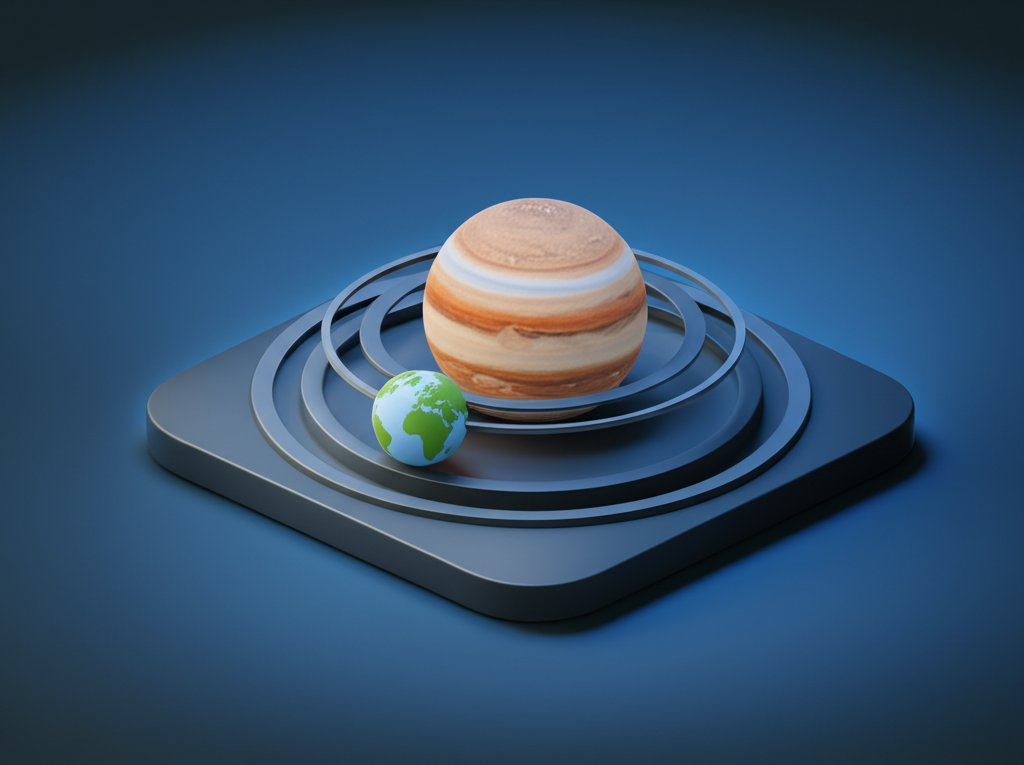
Imagine shrinking Earth, our entire planet, down until you could fit over 1,300 of them inside Jupiter. That’s the mind-boggling reality of the Jupiter size compared to Earth – a scale difference that reshapes our understanding of planetary proportions. But how does this immense difference affect everything from gravity to potential for life?
At a glance:
- Understand the sheer volume difference between Jupiter and Earth.
- Visualize practical examples that illustrate Jupiter’s massive scale.
- Learn how Jupiter’s size impacts its composition and environment.
- Debunk common misconceptions about Jupiter’s potential as a star.
- Answer key questions about Jupiter’s size and its place in the solar system.
The Immensity of the Gas Giant: Comparing Physical Dimensions
When we talk about Jupiter’s size, we’re dealing with numbers that are difficult to grasp. Its equatorial diameter clocks in at a staggering 142,984 kilometers (88,846 miles). Earth, in comparison, has an equatorial diameter of just 12,742 kilometers (7,918 miles). Essentially, you could line up about 11 Earths across Jupiter’s equator.
The difference isn’t just about diameter. Volume is where the comparison becomes truly astounding. Because Jupiter is so much larger in diameter, its volume is so much larger than Earth. It would take approximately 1,300 Earths to fill the volume of Jupiter. That number is crucial for understanding the planet’s composition and gravitational impact on the rest of the solar system, a topic explored in more detail in this article about the Size and Distance of Jupiter.
Visualizing the Scale: Everyday Analogies
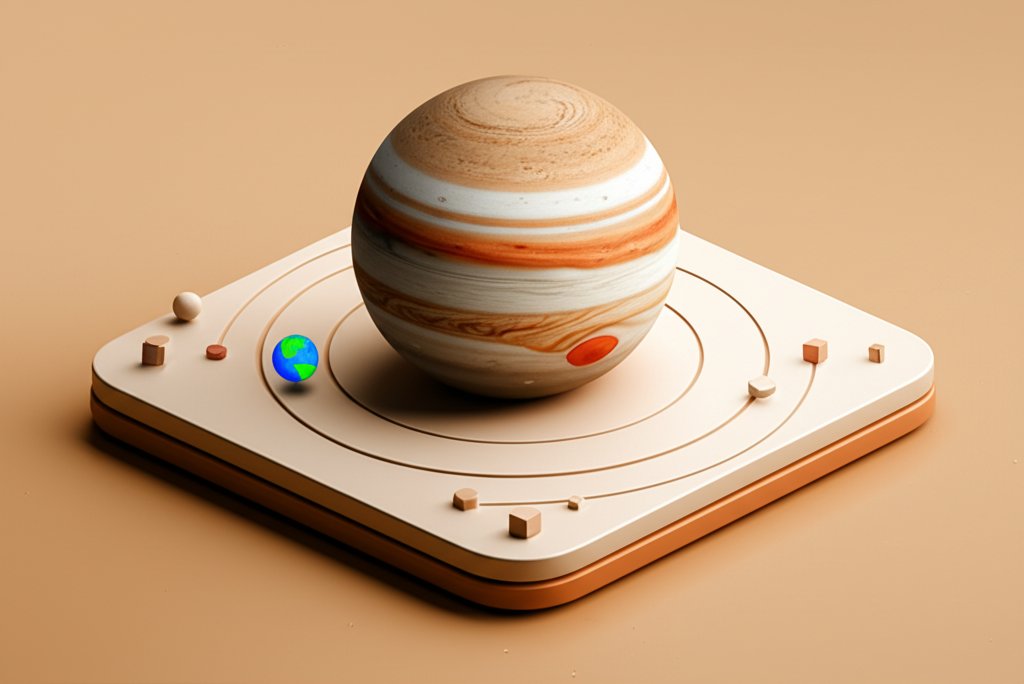
Numbers can be abstract. Let’s bring the Jupiter size compared to Earth down to earth (pun intended):
- Imagine Earth as a basketball: Jupiter would be roughly the size of a small school bus.
- Consider the Great Red Spot: This persistent storm on Jupiter is wider than Earth itself. It’s not just a blip; it’s a planet-sized weather system.
- Picture stacking: You could stack almost 11 Earths across Jupiter.
These comparisons help showcase the sheer magnitude we’re talking about. The greater size of Jupiter means it also has a much greater surface area, which impacts temperature regulation.
How Jupiter’s Size Affects Its Composition and Atmosphere
Jupiter’s enormous size has a direct impact on its composition. Its huge gravitational pull allowed it to accumulate vast amounts of hydrogen and helium from the early solar nebula. This is why it’s classified as a gas giant, primarily composed of these light elements.
This abundance of hydrogen and helium also contributes to Jupiter’s dynamic and turbulent atmosphere. The planet’s rapid rotation, combined with its size, creates powerful jet streams and swirling storms, like the iconic Great Red Spot. These atmospheric phenomena are far more intense and long-lasting than anything we experience on Earth, again, a direct consequence of its size and rotational speed.
Separating Fact from Fiction: Jupiter and Star Status

A common question is: could Jupiter have become a star? While Jupiter is massive, it lacks the necessary mass to initiate nuclear fusion in its core, the process that powers stars. It would need to be approximately 70 times more massive to even begin to resemble a small star.
Think of it like this: Jupiter is a giant ball of gas, but it doesn’t have the “fuel” (sufficient mass for sustained fusion) to ignite. Its size enabled it to accrete material, but a critical threshold for star formation was never crossed.
Jupiter’s Gravitational Influence: A Solar System Shepherd
Jupiter’s immense size isn’t just a matter of curiosity; it has profound implications for the entire solar system. Its powerful gravity has shaped the orbits of other planets and asteroids.
- Protecting Earth: Jupiter’s gravity deflects many asteroids and comets that might otherwise collide with Earth. It acts as a sort of “cosmic bodyguard” for us.
- Influencing the Asteroid Belt: Jupiter’s gravitational influence is responsible for the structure of the asteroid belt between Mars and Jupiter. It prevents these asteroids from coalescing into a planet and maintains their scattered distribution.
Without Jupiter’s size and consequent gravitational influence, the solar system’s architecture and Earth’s history would likely be very different.
Understanding the Numbers: A Size Comparison Table
| Feature | Jupiter | Earth | Comparison |
|---|---|---|---|
| Equatorial Diameter | 142,984 km (88,846 mi) | 12,742 km (7,918 mi) | ~11.2 Earths across Jupiter |
| Polar Diameter | 133,708 km (83,082 mi) | 12,714 km (7,900 mi) | ~10.5 Earths across Jupiter |
| Volume | 1.43 x 10^15 km³ | 1.08 x 10^12 km³ | ~1,300 Earths can fit inside Jupiter |
| Mass | 1.898 x 10^27 kg | 5.972 x 10^24 kg | ~318 Earths’ mass equals Jupiter’s mass |
| This table provides a clear snapshot of the Jupiter size compared to earth, highlighting the significant differences in key physical properties. |
Playbook: Visualizing Jupiter’s Size
Want to truly grasp Jupiter’s size? Here’s a practical exercise:
- Scale Modeling: Find a large inflatable ball (like a beach ball) to represent Jupiter. Then, find a small ball (like a marble) to represent Earth at the same scale. The size discrepancy will be immediately apparent.
- Volume Estimation: If you’re feeling ambitious, try filling the Earth-sized ball with water and see how many times you can pour that water into the Jupiter-sized ball. It won’t be exact, but it’ll give you a tangible sense of the volume difference.
- Compare to Landmarks: Imagine lining up 11 Earths across the United States. That gives you a sense of Jupiter’s diameter relative to something familiar.
Quick Answers: Common Questions About Jupiter’s Size
- Could humans ever live on Jupiter? No. Jupiter has no solid surface, and its atmosphere is extremely hostile, with intense radiation and crushing pressures.
- Is Jupiter getting bigger or smaller? Jupiter is slowly shrinking by about 2 cm per year as it radiates heat.
- Why is Jupiter so much bigger than Earth? Jupiter formed early in the solar system and had a significant gravitational advantage to accrete more gas and dust.
- Does Jupiter have a surface like Earth? No, Jupiter is a gas giant with no solid surface. Descending into Jupiter would be like descending into the ocean.
Takeaway: Rethinking Planetary Scale
The immense Jupiter size compared to Earth underscores the diversity of planets in our solar system. It challenges our Earth-centric view and reveals the dynamic processes that shaped our cosmic neighborhood. Grasping this vast difference in scale not only enhances our understanding of Jupiter itself but also provides critical insights into planet formation, gravitational dynamics, and even the conditions necessary for life.










