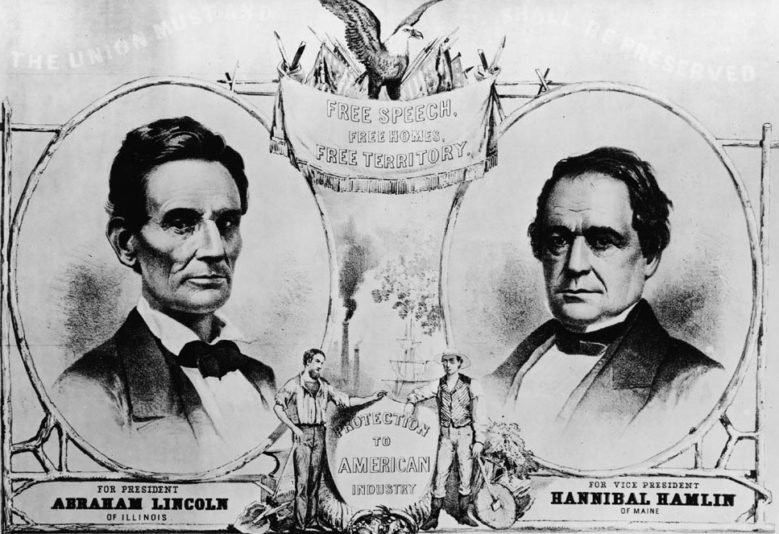
The year began with a tense quiet, but anyone paying attention could feel the tremors. To understand what was happening in 1860 is to watch a nation, built on fragile compromises, finally snap under the immense pressure of the slavery question. It wasn’t the year the first shots were fired, but it was the year the battle lines were drawn, not with soldiers, but with ballots and declarations that made the coming war all but inevitable.
This was the year of the most consequential presidential election in American history, an event that acted as the final catalyst for disunion. While farmers planted crops and inventors tinkered with new machines, the political machinery of the United States was grinding to a halt, ready to shatter into pieces.
At a Glance: The Breaking Point of 1860
- A Fractured Election: The presidential election featured four major candidates, a clear sign of the nation’s deep political divisions.
- The Democratic Party Splits: The nation’s last remaining truly national party broke apart over the issue of slavery’s expansion, ensuring a Republican victory.
- Lincoln’s Historic Win: Abraham Lincoln won the presidency without carrying a single Southern state, which many Southerners viewed as a hostile takeover of the federal government.
- Secession Begins: In response to Lincoln’s election, South Carolina formally seceded from the Union in December, setting a precedent for other Southern states to follow.
- A Nation in Limbo: The period between the election and Lincoln’s inauguration became a dangerous power vacuum, with an outgoing president unwilling to act decisively.
The Political Powder Keg: A Four-Way Presidential Race
The political landscape of 1860 was a minefield. The central issue was whether slavery should be permitted to expand into the new western territories. This question had been debated for decades, but by 1860, the middle ground had all but vanished. This division came to a head in the presidential election, where four distinct factions emerged, each reflecting a different vision for the country’s future.
The Democratic Party Implodes
For years, the Democratic Party was a powerful force that bridged the North and South. That bridge collapsed in 1860. At their convention in Charleston, South Carolina, Southern delegates demanded a platform that would explicitly protect slavery in all U.S. territories. When Northern Democrats, led by Stephen A. Douglas, refused, the delegates from the Deep South walked out.
The party tried to reconcile a few months later in Baltimore, but the split was permanent. This rupture created two Democratic tickets:
- Northern Democrats: Nominated Stephen A. Douglas, who advocated for “popular sovereignty”—letting settlers in each territory decide the slavery issue for themselves.
- Southern Democrats: Nominated John C. Breckinridge, the sitting Vice President, on a platform demanding federal protection for slavery in all territories.
The Rise of Lincoln and the Republicans
The newly formed Republican Party, just six years old, saw the Democratic split as a golden opportunity. Their platform was clear and, to the South, deeply threatening: slavery would be left alone where it already existed, but it would be prohibited from expanding into any new territories.
At their convention in Chicago, they bypassed more famous figures and nominated Abraham Lincoln, a former one-term congressman from Illinois. He was seen as a moderate who was firm on the issue of slavery’s expansion but less radical than other leading Republicans. This choice was a strategic masterstroke, appealing to a broad range of Northern voters.
Two Other Factions Enter the Fray
With the two major parties fractured, two other groups sought to find a path away from the abyss:
- The Constitutional Union Party: A new party formed by former Whigs and Know-Nothings, primarily from the border states. They nominated John Bell of Tennessee. Their platform was stunningly simple: they ignored the slavery issue entirely and ran on “the Constitution of the Country, the Union of the States, and the enforcement of the laws.”
- A Four-Way Contest: The stage was set for a chaotic and deeply regionalized election.
Here’s a simple breakdown of where each candidate stood:
| Candidate | Party | Core Stance on Slavery in Territories |
| :— | :— | :— |
| Abraham Lincoln | Republican | Prohibit its expansion entirely. |
| Stephen A. Douglas | Northern Democrat | Let settlers decide via popular sovereignty. |
| John C. Breckinridge | Southern Democrat | The federal government must protect it. |
| John Bell | Constitutional Union | Ignore the issue and uphold the Constitution. |
The Election That Broke America
On November 6, 1860, Americans went to the polls. The outcome laid bare the nation’s sectional divide.
How Lincoln Won Without a Single Southern State
Abraham Lincoln won a decisive victory in the Electoral College, securing 180 votes. However, he only received about 40% of the popular vote. His name didn’t even appear on the ballot in ten Southern states.
His victory was entirely dependent on the free states of the North and West. The concentration of population in the North meant he could win the presidency without any support from the South. For Southern leaders, this was their ultimate fear realized: a purely sectional president had been elected, one whose party they believed was fundamentally hostile to their way of life and economic system.
The election’s outcome was the final trigger for a conflict that would define the decade, as detailed in the broader 1860s Civil War Guide. It confirmed to the South that they had lost their political power to protect the institution of slavery within the Union.
The First Domino Falls: South Carolina Secedes
The reaction in the Deep South was swift and decisive. Southern “fire-eaters”—radical pro-slavery secessionists—had warned for months that a Lincoln victory would mean disunion. Now, they made good on their threat.
On December 20, 1860, a special convention in South Carolina voted unanimously to secede from the United States. Their “Declaration of the Immediate Causes Which Induce and Justify the Secession” was blunt. It argued that the Northern states had failed to uphold their constitutional obligations—specifically, returning fugitive slaves—and had elected a president “whose opinions and purposes are hostile to slavery.”
With this act, the abstract threat of disunion became a terrifying reality. The nation entered a perilous lame-duck period, with the ineffectual President James Buchanan presiding over a disintegrating country, waiting for Lincoln to take office in March 1861.
Beyond Politics: Daily Life on the Brink of War
While the political drama unfolded, what was happening in 1860 for ordinary Americans was a mix of anxiety and business as usual. The nation was still growing and changing at a rapid pace.
Westward Ho! The Pony Express and Frontier Life
The westward expansion continued unabated. In April 1860, the Pony Express began its first run, carrying mail on a thrilling 1,900-mile route from St. Joseph, Missouri, to Sacramento, California, in just 10 days. This legendary service, though short-lived, symbolized America’s relentless drive west.
Settlers were still moving into territories like Kansas, Nebraska, and beyond, seeking land and opportunity. For them, the political debates in Washington could feel distant, though the question of whether their new homes would be “free” or “slave” territories was of paramount importance.
Innovations Shaping the Future
Technology was also marching forward, producing inventions that would ironically play a role in the coming conflict. 1860 saw the patenting of the Spencer repeating rifle, a weapon that would later give Union soldiers a significant advantage with its rapid-fire capability. On a more peaceful front, the first commercially successful internal combustion engine was developed in Europe, a technology that would reshape the world.
The Economic Divide in Plain Sight
The economic differences between North and South were starker than ever. The North was an engine of industry and finance, with booming factories, extensive railroads, and a diverse agricultural system. The South, by contrast, was overwhelmingly agrarian. Its economy was dominated by a plantation system reliant on the labor of nearly four million enslaved people to produce lucrative cash crops, especially cotton.
This economic divergence fueled the political conflict. Northerners saw a dynamic, modernizing society, while many Southerners saw an aggressive industrial power threatening their static, slave-based social order.
Anatomy of a National Crisis: The Key Moments of 1860
To grasp how quickly the nation unraveled, consider this step-by-step timeline of the year’s pivotal events. Each moment pushed the country closer to the edge.
- April 23: Democratic Party Convention in Charleston Implodes. Southern delegates walk out, signaling the end of the party as a national institution.
- May 18: Republicans Nominate Abraham Lincoln. His nomination on a platform of halting slavery’s expansion solidifies the North-South political divide.
- June 28: The Democratic Split is Finalized. Northern and Southern Democrats officially nominate separate candidates (Douglas and Breckinridge).
- November 6: Lincoln is Elected President. His victory, achieved with only Northern votes, is the point of no return for the Deep South.
- December 18: The Crittenden Compromise is Proposed. A last-ditch effort in the Senate to find a compromise on the slavery issue fails to gain traction.
- December 20: South Carolina Secedes. The first state officially leaves the Union, turning the threat of secession into a constitutional crisis.
Clearing Up Common Questions About 1860
Understanding the events of 1860 often involves untangling some common misconceptions. Here are quick, direct answers to frequently asked questions.
Was the Civil War inevitable after Lincoln’s election?
While not absolutely inevitable, it was highly probable. Southern leaders had publicly and repeatedly stated that a Republican victory would be grounds for secession. The election was less a cause of the war and more the final, irreversible trigger for a conflict that had been building for decades over the future of slavery.
Did Abraham Lincoln run on a platform to abolish slavery?
No. This is a critical and common misunderstanding. The Republican platform of 1860 was explicitly anti-expansion, not abolitionist. Lincoln and his party pledged not to interfere with slavery in the states where it already existed. However, Southern leaders believed that hemming slavery in and preventing its growth would lead to its eventual demise and the ruin of their society.
Why didn’t President Buchanan do more to stop secession?
President James Buchanan, in the final months of his term, was paralyzed by a combination of factors. He believed secession was illegal but also that the federal government had no constitutional power to force a state to remain in the Union. A staunch Democrat, he was sympathetic to the South and hoped for a peaceful compromise, underestimating the secessionists’ resolve.
What was the average person’s life like in 1860?
Life varied immensely by region. A factory worker in Massachusetts worried about wages and working conditions. A farmer in Iowa was concerned with crop prices and railroad access. An enslaved person on a cotton plantation in Mississippi lived under a brutal system of forced labor, their entire existence defined by the institution at the center of the national crisis. While the political storm gathered, most people were absorbed in the daily struggles of life, though the rising tensions were inescapable.
1860: The Year the Arguments Ended and Actions Began
The year 1860 stands as a stark turning point in American history. It was the year when political discourse failed, when compromise became impossible, and when the foundational cracks in the nation finally split wide open. The arguments over states’ rights, economic policy, and national identity all revolved around one central issue: the moral and economic question of slavery.
When the ballots were counted and Lincoln was declared the victor, the long, simmering conflict moved from the halls of Congress to the statehouses of the South. The secession of South Carolina was not a beginning but an end—the end of the Union as it had existed for over 70 years. The fuse lit in 1860 would detonate with catastrophic force at Fort Sumter just a few months later, plunging the nation into the Civil War.










