It’s impossible to understand what happened in 1984 in the united states without hearing the sunny, optimistic soundtrack of Ronald Reagan’s re-election campaign. The iconic “Morning in America” ads painted a picture of a nation reborn—confident, prosperous, and leaving the malaise of the 1970s behind. For millions of Americans, this wasn’t just advertising; it was their reality. The year was defined by Reagan’s monumental electoral victory, a booming economy, and a palpable sense of national pride, yet beneath the surface, complex social and economic currents were setting the stage for the decades to come.
This was the year the Apple Macintosh told us why 1984 wouldn’t be like 1984, the year the Olympics came to Los Angeles without the Soviets, and the year a shooting on a New York City subway train ignited a fierce national debate about crime and justice. It was a fulcrum year, balancing dazzling optimism with gathering shadows.
At a Glance: Key Themes of 1984 in the U.S.
- A Historic Political Mandate: Ronald Reagan secured one of the most decisive landslide victories in U.S. history, validating his conservative agenda and reshaping the political landscape.
- “Reaganomics” at its Peak: The economy surged, with inflation under control and growth robust. However, deregulation, particularly in the financial sector, was quietly sowing the seeds of the future Savings and Loan crisis.
- Technological Leaps into the Mainstream: The launch of the Apple Macintosh made personal computing accessible and intuitive, while the first commercial cellular networks hinted at a connected future.
- Deepening Social Fractures: The AIDS epidemic gained a scientific face with the identification of its cause, even as official government response remained muted. Events like the Bernhard Goetz shooting exposed raw nerves around urban crime and race.
- Cold War Tensions and Triumphs: The U.S. hosted a successful, patriotic Summer Olympics, boycotted by the Soviet Union, while navigating deadly crises like the embassy bombing in Beirut.
The Anatomy of a Landslide: Reagan’s 1984 Re-election
By 1984, the economic anxieties of the late 1970s and early 1980s had begun to fade. The recession of 1981-82 was in the rearview mirror, and President Reagan’s central campaign message was simple and powerful: the country was back on track.
The “Morning in America” Message
The Reagan campaign masterfully captured the national mood. Their strategy wasn’t to debate policy details but to sell a feeling of renewed strength and prosperity. Commercials showcased images of families buying homes, flags waving, and communities thriving. The core message was one of stark contrast: remember the high inflation, gas lines, and “crisis of confidence” of the past? Now, it’s “Morning in America.”
This optimistic narrative resonated deeply with a public eager for good news. Reagan, “The Great Communicator,” embodied this confidence with his easy-going demeanor and unshakeable belief in American exceptionalism.
Mondale’s Uphill Battle
Democratic challenger Walter Mondale, who had served as Vice President under Jimmy Carter, faced an enormous challenge. He ran on a platform of “new realism,” arguing that Reagan’s policies were creating a massive federal deficit that would have to be paid for with tax increases. In a moment of political honesty that may have sealed his fate, Mondale declared at the Democratic National Convention, “He will raise taxes, and so will I. He won’t tell you. I just did.”
While historically significant for selecting Geraldine Ferraro as the first female vice-presidential candidate on a major party ticket, the Mondale-Ferraro campaign could not overcome the tide of Reagan’s popularity. They were framed as bearers of bad news and representatives of a past the country wanted to forget.
By the Numbers: How Dominant Was the Victory?
The election on November 6, 1984, was not just a win; it was a political realignment.
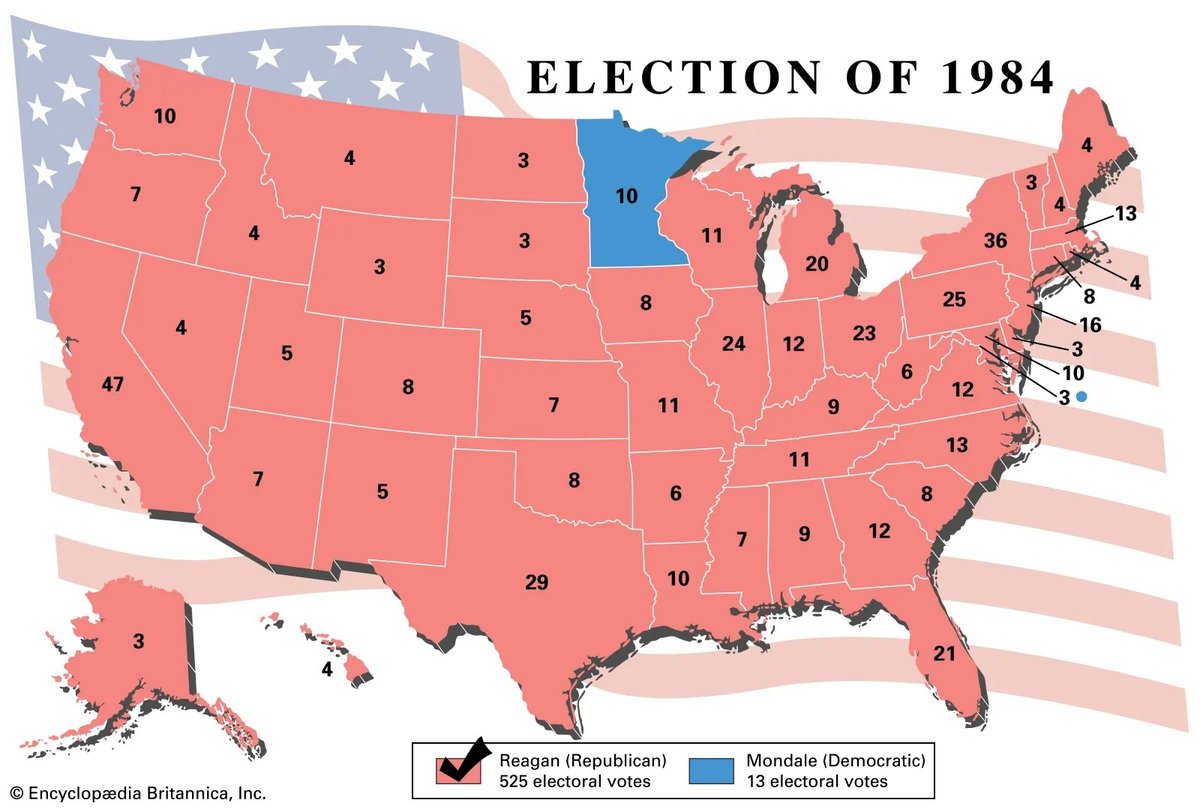
- Electoral Votes: Reagan won 525 electoral votes to Mondale’s 13.
- States Won: Reagan carried 49 out of 50 states. Mondale only won his home state of Minnesota and the District of Columbia.
- Popular Vote: Reagan secured nearly 59% of the popular vote, a clear and undeniable mandate from the American people.
This victory cemented the conservative shift in American politics and gave Reagan the political capital to pursue his second-term agenda with vigor.
“Reaganomics” in Action: The Economic Landscape of 1984
The economic story of 1984 is a tale of two realities. On one hand, the recovery was real and tangible. On the other, the policies driving it were creating long-term structural issues.
Supply-Side Economics and Deregulation Take Hold
“Reaganomics” was the popular term for the administration’s economic program, which centered on four pillars:
- Reducing government spending
- Cutting federal income and capital gains taxes
- Reducing government regulation
- Tightening the money supply to control inflation
The core idea, known as supply-side economics, was that cutting taxes on businesses and the wealthy would incentivize investment, leading to job creation and economic growth that would “trickle down” to everyone else. By 1984, this policy was in full swing. Inflation, which had been in the double digits just a few years earlier, had been tamed. The stock market was booming.
This economic confidence was a key factor in what happened in 1984 in the United States, but the full picture was more complex. To understand how these economic shifts intertwined with technological change and political will, you can Explore 1984’s converging forces for a broader perspective on the era.
The Hidden Costs: Seeds of the S&L Crisis
While Americans celebrated the recovery, the Reagan administration’s push for deregulation was having unintended consequences. The Depository Institutions Deregulation and Monetary Control Act of 1980, followed by the Garn-St. Germain Depository Institutions Act of 1982, had loosened restrictions on the Savings and Loan (S&L) industry.
This allowed S&Ls to move from their traditional role of providing home mortgages into riskier investments like commercial real estate and junk bonds. In 1984, many were leveraging this new freedom to chase high returns, often with poor oversight. This laid the foundation for the massive S&L crisis that would explode in the late 1980s, costing taxpayers billions of dollars.
A Nation in Transition: Technology, Tragedy, and Social Tensions
Beyond the ballot box and the stock market, 1984 was a year of profound cultural and social change.
The Macintosh Arrives: A Digital Revolution in a Box
On January 24, Apple Computer launched the Macintosh. It wasn’t the first personal computer, but it was the first to successfully popularize the graphical user interface (GUI) and the mouse. Suddenly, you didn’t need to know command-line code to use a computer; you could just point and click.
Its arrival was announced to the world during the Super Bowl with the legendary “1984” commercial. Directed by Ridley Scott, the ad depicted a lone heroine shattering a screen broadcasting a Big Brother-like figure. The message was clear: personal computing was a tool of empowerment for the individual, a direct challenge to a centralized, conformist world.
The AIDS Epidemic: A Growing Crisis Meets Public Silence
While the Macintosh promised a bright future, a devastating health crisis was escalating. On April 23, 1984, U.S. Health and Human Services Secretary Margaret Heckler announced that Dr. Robert Gallo and his team had identified the virus that caused AIDS, HTLV-III (later renamed HIV).
This scientific breakthrough was a crucial step, but it occurred against a backdrop of widespread fear, misinformation, and official neglect. The Reagan administration was largely silent on the issue, and the disease was heavily stigmatized as a “gay plague.” The identification of the virus in 1984 marked a turning point in the medical understanding of the disease, but the political and social will to fight it lagged far behind.
Urban Fears and Vigilante Justice: The Bernhard Goetz Case
On December 22, in a gritty New York City subway car, a quiet electronics technician named Bernhard Goetz shot four young Black men who he claimed were trying to rob him. The event became an instant media sensation, turning Goetz into a folk hero for some and a racist vigilante for others.
The “Subway Vigilante” case tapped into a deep well of public anxiety about urban crime, which many felt was out of control. The widespread support for Goetz revealed a sharp divide in American society and a profound frustration with the justice system, sparking a nationwide debate on self-defense, race, and the limits of law and order.
Your Quick-Answer Guide to 1984 in the U.S.
Here are concise answers to some of the most common questions about this pivotal year.
Q: Why was Ronald Reagan so popular in 1984?
A: Reagan’s popularity stemmed from a combination of factors: a recovering economy, a decisive and optimistic leadership style, and a successful campaign that contrasted his “Morning in America” vision with the economic and foreign policy struggles of the late 1970s. Many Americans felt the country was stronger and more prosperous under his leadership.
Q: Was 1984 a good year for the US economy?
A: For many, yes. GDP growth was strong, unemployment was falling, and inflation was low. It was a period of significant economic expansion. However, this growth was accompanied by a rapidly increasing national debt and deregulation that contributed to the S&L financial crisis later in the decade.
Q: What was the most significant technological event of 1984?
A: The launch of the Apple Macintosh on January 24 stands out as a landmark event. By introducing an affordable computer with a user-friendly graphical interface and mouse, it fundamentally changed personal computing and made the technology accessible to a non-technical audience, paving the way for the digital world we live in today.
Q: Did the 1984 election change American politics permanently?
A: Yes, in many ways. Reagan’s landslide victory solidified the conservative coalition of economic conservatives, social conservatives, and anti-communist hawks. It confirmed that the political center of gravity had shifted to the right and established a conservative framework for policy debates—on taxes, regulation, and the role of government—that would dominate American politics for decades.
The Dual Legacy of 1984: Optimism and Its Unseen Price
Looking back, 1984 stands as a monument to American optimism. It was a year of victory—at the polls, at the Olympics, and in the economy. The prevailing mood was that America had regained its confidence and its rightful place in the world.
Yet, that confidence came with a cost. The economic boom was fueled by debt, the celebration of individual success often overlooked growing inequality, and the focus on national strength abroad allowed a deadly epidemic to fester at home. The events of 1984 didn’t just define a year; they drew the blueprint for the rest of the 20th century, setting in motion forces of technological innovation, economic policy, and social change that continue to shape our world today. It truly was morning in America, but dawn always casts long shadows.










