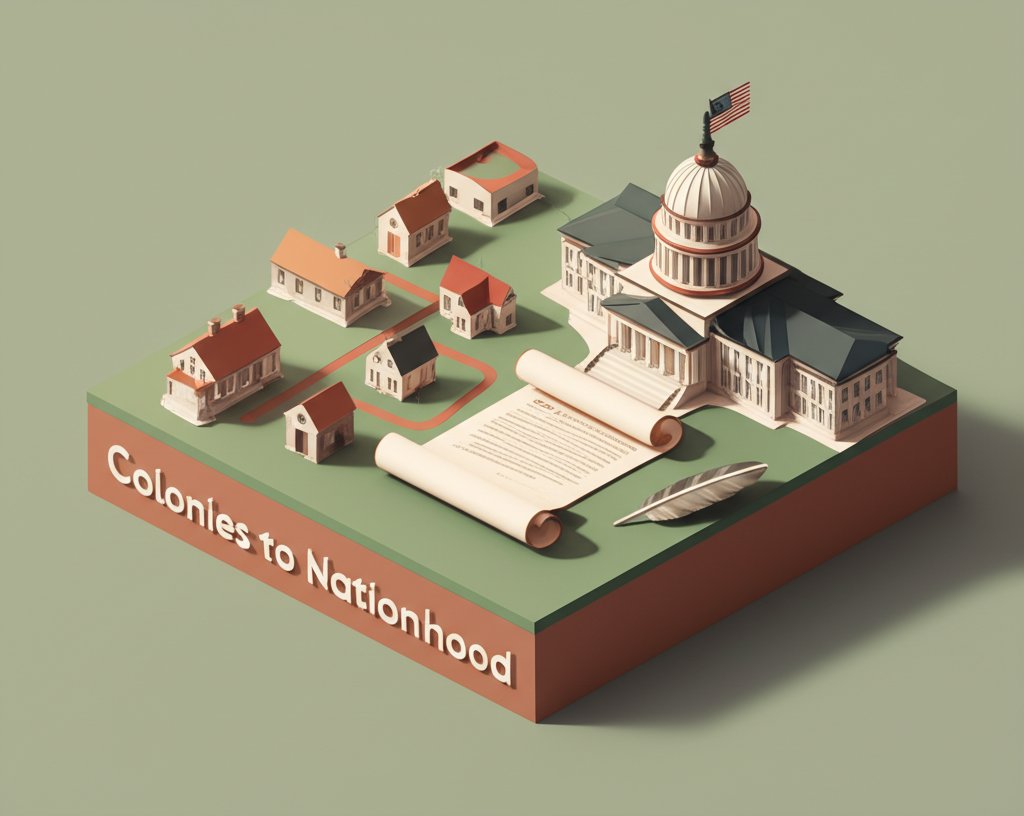
Pinpointing the exact usa country age feels like it should be simple, but the answer is more of a journey than a destination. While we celebrate on July 4th, the United States didn’t just appear fully formed on that day in 1776. Its creation was a deliberate, multi-stage process that unfolded over decades, transforming thirteen disparate British colonies into a single, sovereign nation. Understanding this timeline is key to grasping the country’s true origin story.
At a Glance: Your Guide to the USA’s Formation
- Four Key “Birthdays”: We’ll break down the four critical dates that mark the USA’s evolution: 1776, 1781, 1788, and 1789.
- Colony vs. Country: Learn why the 169 years of colonial history before 1776 are considered the nation’s “gestation period,” not its official lifespan.
- The Legal Framework: Discover how the Articles of Confederation and the Constitution represent two distinct phases of American government.
- A Practical Timeline: Get a clear, step-by-step view of how a declaration of ideals became a functioning government.
Why a Single Date Can’t Tell the Whole Story
When we talk about the usa country age, most people default to the Declaration of Independence. That day, July 4, 1776, is the nation’s official birthday—the moment the Second Continental Congress declared the colonies were “Free and Independent States.” It was a profound philosophical break and a declaration of intent.
But a declaration is not a government. The country still had to win a war and, more importantly, figure out how to govern itself. This process involved several distinct, crucial steps, each of which could be considered a “birth” in its own right. Think of it like building a company: you have the day you come up with the big idea (the Declaration), the day you file the initial paperwork (the Articles of Confederation), and the day you finalize the corporate structure and open for business (the Constitution).
This layered history is why the question of the usa country age is so fascinating. To see how these dates fit into the bigger picture, you can Explore US age complexities. Here, we’ll dive deep into the specific timeline of how the colonies evolved into the nation we know today.
The Colonial Cradle: 169 Years of Gestation

Before there was a United States, there were British colonies. This period, from the first permanent English settlement to the Declaration of Independence, is essential for understanding the nation’s DNA, even though it doesn’t count toward its official age.
The First Footprint: Jamestown (1607)
The story of the societies that would become America begins in 1607 with Jamestown, Virginia. This was the first permanent English settlement in North America. Its founding marks the beginning of a continuous English-speaking presence that shaped the language, laws, and customs of the future nation. While the colonists at Jamestown were loyal British subjects, their struggles and successes laid the groundwork for a unique American identity.
The Spread of Colonial DNA
Over the next 125 years, twelve more colonies were established, each with its own character, economy, and relationship with the British Crown. They were not a unified bloc but a patchwork of distinct entities.
- Virginia (1607): Founded for commercial purposes.
- Massachusetts (1620): Founded by Pilgrims and Puritans seeking religious freedom.
- Pennsylvania (1682): Established by William Penn as a haven for Quakers and other religious minorities.
- Georgia (1732): The last of the original thirteen, created as a buffer against Spanish Florida and a social experiment for debtors.
These colonies developed their own local governments and traditions of self-rule through colonial assemblies. This long period of semi-autonomy was a critical training ground for the leaders who would eventually declare independence.
What Changed? The Shift from Colonists to Americans
For over a century, the colonists largely saw themselves as Britons living abroad. This changed dramatically after the French and Indian War (1754–1763). To pay off war debts, Great Britain imposed a series of taxes and acts on the colonies—like the Stamp Act and the Tea Act—without the consent of their local assemblies.
This policy of “taxation without representation” ignited a shared sense of grievance. Colonists who had previously identified more with Virginia or Massachusetts began to see a common cause. They started thinking of themselves not just as colonists, but as Americans. This psychological shift was the final, essential step before the colonies could become a country.
Pinpointing the Nation’s Birth: A Step-by-Step Timeline
The transition from rebellious colonies to a stable republic happened in four distinct stages. Each one represents a different facet of the usa country age and answers a slightly different question about its origins.
Milestone 1: The Declaration (1776) – The Conceptual Birth
- Date: July 4, 1776
- What It Was: A formal, public declaration that the thirteen colonies were severing all ties with Great Britain. It was a statement of principles, articulating the philosophical basis for the new nation: that all men are created equal and have rights to life, liberty, and the pursuit of happiness.
- What It Wasn’t: A system of government. It announced the intent to form a new nation but didn’t create its structure. At this point, the Revolutionary War was in its early stages, and victory was far from certain.
This is the date we celebrate as the nation’s birthday because it marks the moment of conception—the unified decision to exist as an independent entity.
Milestone 2: The Articles of Confederation (1781) – The First Draft
- Date Ratified: March 1, 1781
- What It Was: The first written constitution of the United States. The Articles created a “league of friendship” among the states, establishing a central government with a Congress but no executive or judicial branch. It successfully managed the end of the war and negotiated the Treaty of Paris.
- What It Wasn’t: A strong, effective national government. The central government had no power to tax, regulate commerce, or raise an army, making it very weak. Each state retained most of its sovereignty.
Case Snippet: Shays’ Rebellion
The weakness of the Articles became glaringly obvious during Shays’ Rebellion (1786–87). When indebted farmers in Massachusetts revolted, the national government was powerless to intervene. The crisis highlighted the need for a stronger federal framework, directly leading to the Constitutional Convention.
Milestone 3: The Constitution (1788) – The Blueprint for Today
- Date Ratified: June 21, 1788
- What It Was: The ratification of the U.S. Constitution, the document that created the federal government we have today. It established three co-equal branches (legislative, executive, judicial), a system of checks and balances, and a stronger central authority.
- What It Wasn’t: The date the government actually started working. Ratification by the ninth state (New Hampshire) made the Constitution the law of the land, but the new government still needed to be elected and assembled.
This date represents the legal birth of the modern United States government. The blueprint was approved, and the foundation was officially set.
Milestone 4: The Government Becomes Operational (1789) – The Grand Opening
- Date: April 30, 1789 (Washington’s Inauguration)
- What It Was: The moment the new government became a functioning reality. The first U.S. Congress had convened in March, and on April 30, George Washington was sworn in as the first President. The new government began passing laws, creating departments, and putting the Constitution into practice.
- What It Wasn’t: The creation date, but rather the activation date. It’s like the grand opening of a business—the legal entity existed before, but this is when it opened its doors.
If theusa country agewere measured by its continuous operation under the current system, this would be the start date.
A Practical Comparison: The Four “Ages” of the USA

To make sense of these milestones, it helps to see them side-by-side. Each date provides a valid, though different, lens for viewing the nation’s age.
| Milestone | Date | What It Represents | Calculating Age From This Date (as of July 4, 2024) |
|---|---|---|---|
| Declaration of Independence | July 4, 1776 | The nation’s official birthday; a declaration of sovereignty. | 248 years |
| Articles of Confederation | March 1, 1781 | The first formal government, a loose confederation. | 243 years |
| Constitution Ratified | June 21, 1788 | The legal foundation of the modern federal government. | 236 years |
| Government Operational | April 30, 1789 | The day the new government began functioning. | 235 years |
Common Questions About America’s Age, Answered
Q: So, what’s the right answer for the USA country age?
A: July 4, 1776, is the officially celebrated and culturally accepted date. It’s the “birthday” that marks the nation’s founding ideal. The other dates are historically crucial for understanding the process of state-building, but 1776 remains the definitive starting point for the nation’s age.
Q: What about the colonial period before 1776? Does that count?
A: It counts as the history of the peoples and societies that would form the United States, but not as the age of the political nation itself. Until they declared independence, the colonists were legally British subjects. The colonial era is the essential prologue to the story of the usa country age, not chapter one.
Q: Doesn’t the history of Native Americans make the “country” thousands of years old?
A: This is a vital distinction. The landmass of North America has a human history stretching back 15,000 years or more, with thousands of years of complex societies and nations. However, the term usa country age refers specifically to the political entity known as the United States of America, which was established by European colonists. It is incorrect and ahistorical to conflate the two.
Q: Why isn’t the end of the Revolutionary War (1783) a key date?
A: The Treaty of Paris, signed in 1783, is a landmark event where Great Britain formally recognized American independence. While critical, it was an acknowledgment of a reality that the U.S. had already declared and was governing under the Articles of Confederation. It confirmed independence rather than creating it.
How to Think About the USA’s Age Like a Historian
Instead of searching for a single number, a more accurate approach is to think about American history in distinct layers.
- The Land (Pre-1492): A history of Indigenous peoples and nations spanning millennia.
- The Colonial Foundation (1607–1776): A 169-year period of settlement, development of self-governing traditions, and the forging of a distinct American identity under British rule.
- The Nation-State (1776–Present): The official
usa country age, starting with the Declaration of Independence and continuing through the creation and evolution of its government.
Ultimately, understanding theusa country ageis not about finding a single “gotcha” date. It’s about appreciating the deliberate, messy, and multi-stage process of building a nation from a patchwork of colonies. The real answer lies in the entire timeline, not just a single snapshot.










