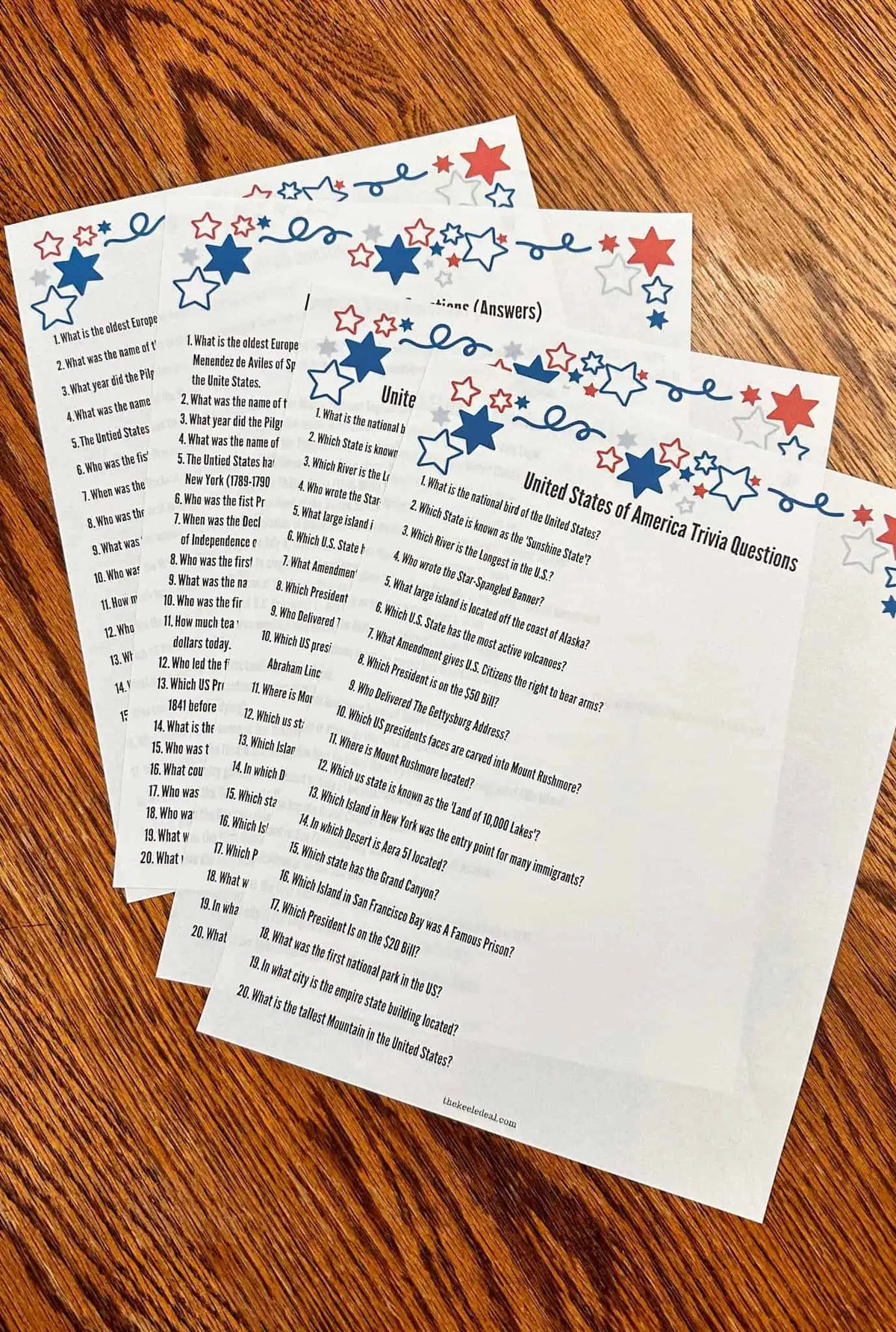
Think you have a solid grasp of American history? Most people can name the first president or the year the Declaration of Independence was signed, but the real story of the United States is woven into the details often skipped in class. Genuine united states trivia isn’t just about dates; it’s about understanding the pivotal decisions, forgotten figures, and surprising events that shaped a nation. It’s about knowing why things happened, not just that they happened.
This guide moves beyond the headlines. We’ll uncover the context behind the facts, from the first European footprints on American soil to the landmark decisions that define the country today. Get ready to challenge what you think you know.
At a Glance: What You’ll Uncover
- Pivotal Moments: Discover the true turning points in American history that are often overlooked.
- Key Figures Uncovered: Learn the stories behind the heroes, traitors, and reformers who drove change.
- The “Why” Behind the Law: Understand the origins of the Constitution and the amendments that transformed the nation.
- Challenging Misconceptions: Separate historical fact from popular myth with clear, concise explanations.
- Connect the Dots: See how events from centuries ago still influence modern American life and politics.
From Colonial Outposts to a New Republic (1565-1783)
The story of the United States doesn’t begin with the Pilgrims. Long before the Mayflower Compact was drafted, European powers were vying for a foothold in the New World, setting the stage for a clash of cultures and, eventually, a fight for independence.
Beyond the Mayflower: The First Settlements
A classic trivia question asks about the first permanent English settlement, which was Jamestown, Virginia, in 1607. Its survival was largely thanks to the lucrative, if labor-intensive, cultivation of tobacco. However, the first permanent European settlement in the current-day United States was actually established decades earlier. The Spanish founded St. Augustine, Florida, in 1565, making it the oldest continuously inhabited European-established settlement in the country.
This fact highlights a crucial aspect of early American history: it was a multi-national competition. While English colonies eventually dominated the eastern seaboard, the influence of Spain, France, and the Netherlands was profound and lasting.
Another foundational moment occurred in 1619 when Virginia established the House of Burgesses. This was the first representative assembly in the American colonies, a groundbreaking step toward self-governance that would become a core principle of the revolution a century and a half later.
The Seeds of Revolution: More Than Just a Tea Party
Tensions with Great Britain didn’t appear overnight. They simmered for years, fueled by a growing sense of a unique American identity and resentment over policies like taxation without representation. Events like the Boston Massacre (1770) and the Boston Tea Party (1773) were explosive flashpoints, but the intellectual fire was fanned by powerful arguments.
Thomas Paine’s pamphlet, Common Sense, published in 1776, was a runaway bestseller that made a clear, passionate case for independence in language everyone could understand. It shifted public opinion and emboldened colonial leaders. Understanding these early steps toward revolution is key to grasping the nation’s origins. To see how these facts fit into the bigger picture, you can Test your American knowledge with a broader set of questions.
The war itself officially began with the Battles of Lexington and Concord in 1775. The Declaration of Independence, primarily penned by Thomas Jefferson, was adopted on July 4, 1776, in Philadelphia, not as a law but as a profound statement of intent and philosophy.
Key Figures and Turning Points of the War
George Washington’s leadership of the Continental Army is legendary, especially his ability to hold the army together during the brutal winter at Valley Forge (1777-1778). But victory was far from a solo effort.
- The French Alliance: The single most important factor in the American victory was the alliance with France. The Battle of Saratoga in 1777, an American triumph, convinced the French that the colonists had a real chance of winning. French naval support was critical at the war’s final major conflict, the Battle of Yorktown (1781), where the British army surrendered.
- Famous and Infamous Names: Patrick Henry’s fiery speech declaring, “Give me liberty, or give me death!” captured the revolutionary spirit. On the other side, Benedict Arnold became America’s most famous traitor when the decorated general defected to the British. The war officially concluded with the Treaty of Paris in 1783, with King George III of Great Britain formally recognizing the United States as an independent nation.
Forging a Republic & Pushing West (1783-1860)
Winning the war was one thing; building a stable, functional country was another challenge entirely. The young nation struggled with its identity, governance, and the immense pressure of westward expansion.
From a Flawed Plan to a Lasting Constitution
The first attempt at a national government, the Articles of Confederation, was intentionally weak. States retained most of the power, and the central government couldn’t effectively levy taxes or raise an army. This weakness became glaringly obvious during Shays’ Rebellion (1786-1787), an uprising of debt-ridden farmers in Massachusetts that the federal government was nearly powerless to stop.
The crisis prompted the Constitutional Convention in Philadelphia in 1787. Here, delegates drafted the U.S. Constitution, a revolutionary document establishing a strong but balanced federal government. James Madison’s pivotal role in shaping its structure and arguments earned him the title “Father of the Constitution.” To appease fears of an overreaching government, the Bill of Rights—the first ten amendments—was added in 1791, guaranteeing individual liberties.
Doubling the Nation and Defining Its Power
Under President Thomas Jefferson, two events in 1803 profoundly shaped the nation’s future:
- Marbury v. Madison: This landmark Supreme Court case established the principle of “judicial review.” In simple terms, it gave the Supreme Court the final say on whether laws passed by Congress are constitutional, a power it still wields today.
- The Louisiana Purchase: In a stunning diplomatic deal, Jefferson bought the vast Louisiana Territory from Napoleon’s France, effectively doubling the size of the United States overnight. The territory was charted by the famous Lewis and Clark Expedition, guided by the indispensable Shoshone woman, Sacagawea.
The Human Cost of Manifest Destiny
The 19th-century belief in “Manifest Destiny”—the idea that the U.S. was destined to expand across the continent—drove incredible growth but also came at a terrible human cost. President Andrew Jackson’s Indian Removal Act of 1830 led to the forced relocation of thousands of Native Americans from the Southeast. The brutal, deadly journey of the Cherokee and other nations to designated territory in the West became known as the Trail of Tears.
This era of expansion also saw the rise of social reform movements. The Seneca Falls Convention in 1848, held in New York, was the first women’s rights convention in the United States, launching the organized movement for women’s suffrage.
A Nation Divided and Rebuilt (1860-1896)
The unresolved issue of slavery, coupled with disputes over states’ rights, eventually tore the nation apart. The Civil War remains the deadliest conflict in American history, and its aftermath continues to shape the country.
The Spark of Secession
When Abraham Lincoln was elected president in 1860 on an anti-slavery expansion platform, Southern states saw it as a direct threat to their way of life. South Carolina became the first state to secede from the Union on December 20, 1860. Ten other states followed, forming the Confederate States of America with Jefferson Davis as their president. The war began in April 1861 with the Confederate bombardment of Fort Sumter in Charleston, South Carolina.
Turning Points of the War
Two battles are essential united states trivia for understanding the Civil War’s trajectory:
| Battle | Date | Significance |
|---|---|---|
| Battle of Antietam | 1862 | The bloodiest single day in American history. The strategic Union victory gave Lincoln the confidence to issue the Emancipation Proclamation. |
| Battle of Gettysburg | 1863 | A major Union victory and the turning point of the war. It halted Confederate General Robert E. Lee’s invasion of the North. |
| Lincoln’s Emancipation Proclamation (1863) was a masterful strategic move. It declared that enslaved people in the rebellious Confederate states were free, transforming the war into a struggle for human liberation and preventing European powers from siding with the Confederacy. The war ended in April 1865 when Lee surrendered to Union General Ulysses S. Grant at Appomattox Court House. Days later, Lincoln was assassinated by John Wilkes Booth. |
Reconstruction: A Promise Unfulfilled?
The era following the war, known as Reconstruction, aimed to rebuild the South and integrate newly freed African Americans into society. Three crucial constitutional amendments were passed:
- 13th Amendment: Abolished slavery.
- 14th Amendment: Granted citizenship and equal protection under the law.
- 15th Amendment: Granted voting rights to Black men.
This period saw historic gains, including the election of Hiram Revels of Mississippi as the first African American U.S. Senator in 1870. However, Reconstruction effectively ended with the political Compromise of 1877. Federal troops withdrew from the South, and white supremacist power structures reasserted control. The 1896 Supreme Court case Plessy v. Ferguson, which upheld the racist doctrine of “separate but equal,” cemented segregation for decades to come.
Navigating the Tumultuous 20th Century
The turn of the century brought unprecedented change, from rapid industrialization and global conflicts to profound social movements that reshaped American society.
Titans of Industry and Progressive Reform
The late 19th and early 20th centuries were marked by the Gilded Age and the subsequent Progressive Era. Industrialists like John D. Rockefeller (Standard Oil) amassed enormous fortunes, but this came with harsh working conditions and unchecked corporate power.
In response, the Progressive movement sought to curb corporate excess and improve society. President Theodore Roosevelt earned the nickname “trust buster” for breaking up monopolies. He was also a passionate conservationist who established the National Park System. The power of investigative journalism was on full display when Upton Sinclair’s novel The Jungle exposed the horrific conditions of the meatpacking industry, leading directly to the passage of the Pure Food and Drug Act of 1906.
From Global Wars to a New Deal
The United States entered World War I in 1917 under President Woodrow Wilson. The post-war era brought the Roaring Twenties, a period of cultural dynamism that included the Harlem Renaissance. It also brought two major constitutional changes: the 18th Amendment (Prohibition) and the 19th Amendment (1920), which finally granted women the right to vote.
The decade’s prosperity ended abruptly with the 1929 stock market crash and the onset of the Great Depression. Franklin D. Roosevelt (FDR) was elected and implemented his New Deal programs to combat the economic crisis. FDR remains the only president to have been elected to four terms. The nation was pulled from the Depression by the industrial mobilization for World War II, which the U.S. entered after the attack on Pearl Harbor on December 7, 1941.
The Fight for Equality and the Cold War
The post-war era was dominated by the Cold War against the Soviet Union and a renewed, powerful push for civil rights at home.
The Civil Rights Movement achieved monumental victories through nonviolent protest and legal challenges. Key moments include:
- Brown v. Board of Education (1954): The Supreme Court declared state-sponsored segregation in public schools unconstitutional, overturning Plessy v. Ferguson.
- Montgomery Bus Boycott (1955): Sparked by Rosa Parks, it demonstrated the power of organized, nonviolent resistance.
- March on Washington (1963): Martin Luther King Jr. delivered his iconic “I Have a Dream” speech.
- Civil Rights Act of 1964: Signed into law by President Lyndon B. Johnson, it outlawed discrimination based on race, color, religion, sex, or national origin.
The late 20th century saw the U.S. land the first humans on the moon with Apollo 11 (1969), the divisive Vietnam War, and the Watergate scandal that led to President Richard Nixon’s resignation in 1974. In 1981, Sandra Day O’Connor was appointed as the first female Supreme Court Justice, a historic milestone for women in America.
Quick Answers to Common US History Questions
What’s the difference between the Declaration of Independence and the Constitution?
Think of the Declaration as the breakup letter and the Constitution as the new set of house rules. The Declaration (1776) was a philosophical argument for why the colonies were separating from Britain. The Constitution (ratified 1788) is the legal framework that establishes the U.S. government and outlines its powers.
Was the Boston Tea Party really about the price of tea?
Not exactly. It was about the principle of “no taxation without representation.” The British Parliament’s Tea Act actually made tea cheaper for colonists, but it also cut colonial merchants out of the deal and was seen as another attempt by Britain to impose taxes and control trade without the colonists’ consent.
Who wrote the Constitution?
It was a team effort, but James Madison is called the “Father of the Constitution” for his crucial role in drafting the document and advocating for its ratification. Other key figures included George Washington, who presided over the convention, and Alexander Hamilton.
Why was the capital moved to Washington, D.C.?
The move was part of a political deal known as the Compromise of 1790. Alexander Hamilton wanted the federal government to assume states’ debts from the Revolutionary War. Southern leaders like Thomas Jefferson and James Madison were skeptical. The compromise was that they would support Hamilton’s financial plan if the national capital was moved to a Southern location on the Potomac River.
History is not a static list of trivia; it’s a dynamic story of cause and effect, of progress and setback. The events of 1565, 1776, 1865, and 1964 are not just dates for a quiz—they are foundations upon which modern America was built. By understanding the details, the context, and the human stories behind the history, you gain a far richer appreciation for the nation’s complex and fascinating journey. Keep questioning, keep exploring, and never stop learning.










