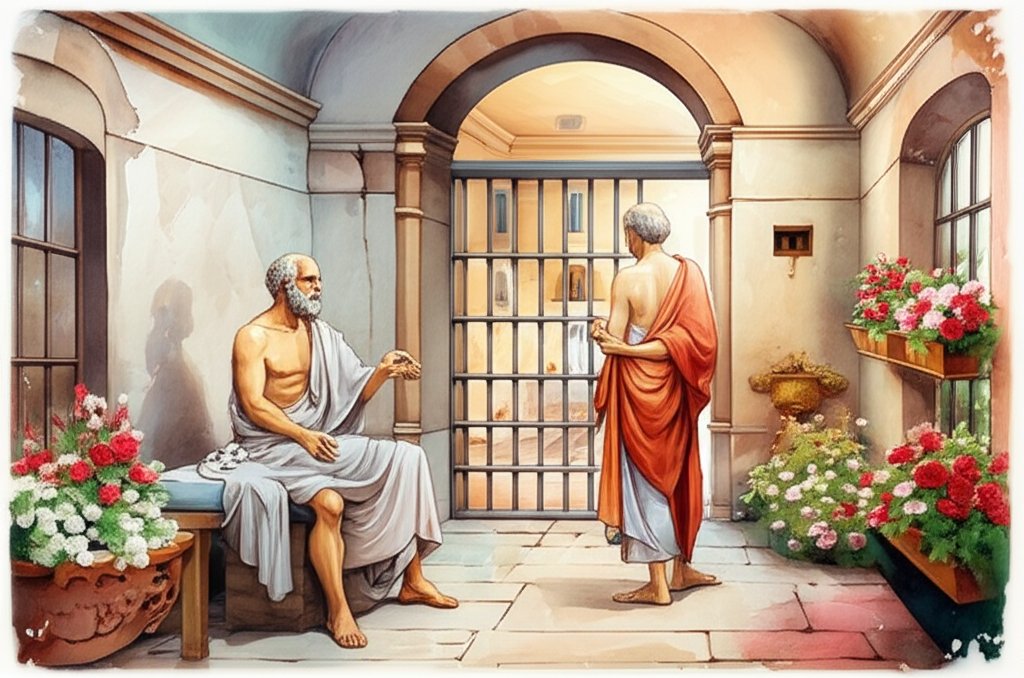
Imagine being sentenced to death, not for a crime of passion, but for challenging the status quo. That’s the reality Socrates faced, and his resulting socrates thoughts on death continue to resonate with us today. But it wasn’t fear that defined his final days, but rather a profound curiosity and acceptance.
At a Glance: Socrates on Death
- Death is not necessarily an evil, but a natural transition.
- The soul may be immortal, freed from the body’s limitations upon death.
- Philosophers should focus on separating the soul from the body, preparing for death.
- A virtuous life leads to a positive afterlife.
- Suicide is not acceptable, as humans are the property of the gods.
Who Was Socrates, and Why Does His Death Matter?
Socrates (470-399 BC) wasn’t just another philosopher spouting theories from an ivory tower. He was a stonemason turned intellectual revolutionary, roaming the streets of Athens, engaging citizens in relentless questioning. He left no written works; instead, we know him through the writings of his students, most notably Plato. His method, the “Socratic method,” involved a relentless pursuit of truth through dialogue, dissecting assumptions and pushing for clarity.
He constantly sought the truth about morality, looking for the definition of what made actions good. His relentless pursuit of truth, and public questioning of Athenian leaders, ultimately led to his trial and condemnation for impiety and corrupting the youth. In 399 BC, he was sentenced to death.
Why Socrates Didn’t Fear Death
Most people would be terrified facing execution. Yet, Socrates met his fate with remarkable composure. Why? Because his philosophical framework led him to believe death was not something to be feared. He saw it as one of two possibilities:
- Eternal Nothingness: Like a dreamless sleep, simply the end of consciousness. Socrates lack of fear explained.
- A Journey to the Afterlife: An opportunity to converse with the great thinkers and heroes of the past.
Either way, he saw no reason for dread. As he puts it, “To fear death, my friends, is only to think ourselves wise, without being wise: for it is to think that we know what we do not know.”
The Immortality of the Soul: Socrates’ Core Belief
A cornerstone of socrates thoughts on death is the belief in the immortality of the soul. He argued that the soul, being distinct from the physical body, is not subject to decay and destruction. He provides a few arguments for this:
- The Cycle of Opposites: Life arises from death, just as waking follows sleeping.
- The Theory of Recollection: We possess innate knowledge, suggesting the soul existed before birth and remembers truths from a previous existence. This “remembering” is only possible if we existed beforehand.
- Affinity with the Divine: The soul, being immaterial and intellectual, shares qualities with eternal and unchanging forms (like justice, beauty, and goodness).
- Arguments from Forms: He believed in the existence of “Forms,” perfect and unchanging ideals of concepts like beauty and justice. Because our souls can grasp these Forms, they must also be eternal.
Preparing for Death: The Philosopher’s Task

For Socrates, the life of a philosopher was, in essence, a preparation for death. This wasn’t about morbidly dwelling on mortality, but about detaching the soul from the distractions and desires of the body. He believed that true knowledge and virtue could only be attained when the soul was free from bodily influences.
This detachment is achieved through intellectual pursuits, self-reflection, and the cultivation of moral character. By focusing on what truly matters, such as wisdom, justice, and goodness, a philosopher minimizes the fear of death.
The Afterlife: A Reward for Virtue
Socrates envisioned the afterlife as a place where the virtuous would be rewarded. Those who had lived just and moral lives would find themselves in the company of gods and other virtuous souls. This vision provided a powerful incentive for living a good life, even in the face of adversity. Socrates Perspective on Death
He presents a compelling vision of what awaits such individuals. He argued that if death is a journey of the soul, then surely, it would be better to arrive pure and unburdened by earthly attachments.
Why Socrates Rejected Suicide
Despite his seemingly positive view of death, Socrates firmly opposed suicide. He believed that humans are the “property” of the gods and, therefore, do not have the right to end their own lives. Just as a slave cannot run away from their master, we cannot desert our post without the permission of the gods. This idea emphasizes the importance of fulfilling one’s duties and responsibilities, even in the face of suffering. His argument is basically that we are all the property of the god, and as such, we should not harm ourselves intentionally.
Socrates Legacy: Courage and Integrity in the Face of Death
Socrates’ death, particularly his acceptance of it, solidified his place as a philosophical icon. His unwavering commitment to his principles, even when facing execution, serves as a model of courage and integrity. His teachings continue to inspire people to confront their own mortality with greater awareness and acceptance. Socrates’ perspective on death is not just an academic curiosity; it’s a powerful call to live a more meaningful and examined life.
Practical Applications of Socrates’ Philosophy on Death
Socrates’ influence extends beyond academic circles. His ideas have found practical applications in various fields:
- Philosophical Counseling: Therapists often use Socratic questioning to help clients explore their fears about death and find meaning in their lives.
- End-of-Life Care: Socrates’ teachings can provide comfort and guidance to individuals facing terminal illness, helping them to approach death with greater equanimity.
- Mindfulness Practices: By encouraging self-reflection and detachment from material concerns, Socrates’ philosophy aligns with mindfulness practices that promote present-moment awareness and acceptance.
Addressing Common Questions & Misconceptions
Let’s tackle some frequent questions about Socrates’ views on death:
- Did Socrates want to die? No. He accepted his fate because he believed it was better to uphold his principles than to compromise them and live a life of falsehood. He was more concerned with living justly than with simply staying alive.
- Was Socrates’ view of the afterlife based on evidence? No. His views were based on philosophical arguments and faith. He acknowledged that he did not know for certain what awaited him after death, but he believed that his arguments provided a reasonable basis for hope.
- Does Socrates’ philosophy deny the reality of grief? Not at all. While he didn’t see death as something to be feared, he acknowledged that it can be a source of sadness and loss for those left behind. His philosophy encourages us to face these emotions with courage and acceptance, rather than denial or despair.
- What if you don’t believe in the immortality of the soul? You can still find value in Socrates’ teachings. His emphasis on living a virtuous life, pursuing knowledge, and detaching from material desires are all valuable principles, regardless of your beliefs about the afterlife.
How Socrates’ Arguments Stand Up Today
While Socrates lived over 2,400 years ago, his thoughts on death remain remarkably relevant. However, it’s important to evaluate his arguments through a modern lens. The arguments for the soul’s immortality face challenges from scientific understandings of consciousness and the brain.
The “Cycle of Opposites” argument, while appealing, relies on an analogy that may not hold true. Does life necessarily arise from death? We’re now more aware of the role of biological processes rather than a mystical transformation.
The “Theory of Recollection” is even more problematic in light of modern psychology and our understanding of how memory works.
Yet, even if the arguments about immortality don’t hold up, the ethical core of Socrates’ teaching remains powerful: Focus on living a virtuous, meaningful life, and death loses much of its sting.
Living Like Socrates: Embracing Mortality
You don’t have to be a philosopher to incorporate Socrates’ wisdom into your life. Here are a few practical steps you can take:
- Practice Self-Reflection: Regularly examine your beliefs, values, and actions. Ask yourself: Am I living in accordance with what I believe to be true and good?
- Cultivate Virtue: Strive to develop qualities such as honesty, justice, courage, and wisdom. These virtues will not only enrich your life but also prepare you for death.
- Detatch From Material Desires: Focus on what truly matters – relationships, knowledge, and personal growth – rather than material possessions or fleeting pleasures.
- Confront Fears: Don’t shy away from difficult questions. Instead, approach them with curiosity, courage and honesty.
- Seek Knowledge: Socrates believed that knowledge is essential for living a good life. Continue to learn and grow throughout your life, expanding your understanding of the world and yourself. Socrates View on Mortality.
Socrates’ Enduring Lesson: The Examined Life
Socrates famously said, “The unexamined life is not worth living.” This quote encapsulates his core message: that a life spent without reflection, self-awareness, and a pursuit of truth is a life wasted. By embracing Socrates’ philosophy, we can approach death with greater understanding and acceptance, and live our lives with greater purpose and meaning.
Socrates ultimately shows us that considering death is not morbid but, on the contrary, forces us to consider how we are living. Socrates outlook on mortality It compels us to examine our priorities, values, and actions, and to align them with what truly matters. By doing so, we can live more fully, more authentically, and more fearlessly, even in the face of death.










