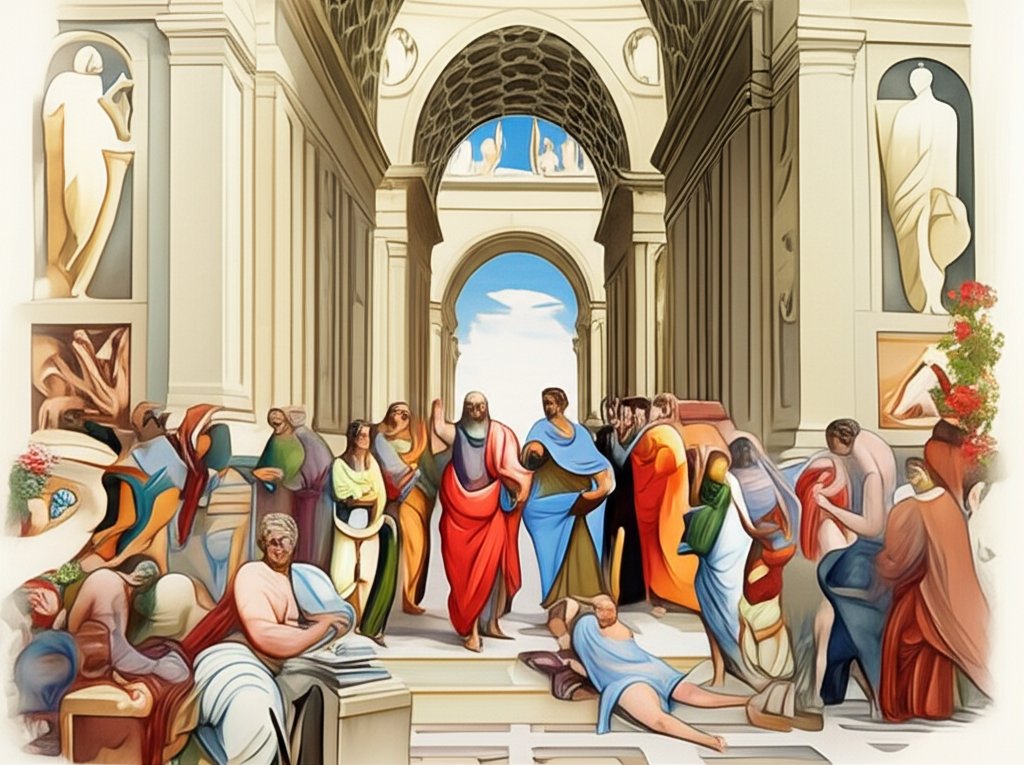
Socrates’ name often conjures images of philosophical debates in the Athenian agora. But what about Socrates and women? He actually pushed boundaries, suggesting women possessed intellectual capacities equal to men – a radical idea for his time.
At a glance:
- Understand Socrates’ revolutionary (for his time) stance on women’s intellectual capabilities.
- Explore practical examples of how Socrates interacted with and learned from women.
- Learn how his beliefs challenged the prevailing patriarchal norms of ancient Athens.
- Discover the implications of his ideas for our understanding of equality today.
- Distinguish between Socrates’ theoretical ideals and the practical limitations of his era.
Challenging Athenian Norms: Socrates’ Vision of Equality
Ancient Athenian society was deeply patriarchal. Women were largely confined to the domestic sphere with limited access to education or public life. Socrates, however, dared to propose a different vision. He argued that the differences between men and women were primarily physical, not intellectual. This bold assertion formed the foundation for his belief in intellectual equality, suggesting women were equally capable of reason and understanding. To further explore Socrates’ views in relation to preconceived notions, Unpack Socrates’s view on women.
Education as the Great Equalizer
Socrates championed education as the key to unlocking human potential, regardless of gender. He believed that if women received the same education as men, they could achieve the same intellectual heights. This idea wasn’t just theoretical. He seemed to be actively discussing philosophy with women, learning from them, and challenging them.
- Practical Implication: Advocate for equal educational opportunities for all genders. Identify and dismantle systemic barriers that prevent women from accessing quality education.
Beyond Intellect: Relational Equality in Practice

Socrates’ view extended beyond simply believing in equal intelligence. He recognized the unique strengths and perspectives that individuals, regardless of gender, bring to the table. He wasn’t suggesting treating everyone identically, but rather recognizing and valuing the diverse contributions of all.
- Mini-Example: Imagine a team project. Instead of assigning tasks based on traditional gender roles, identify each member’s strengths (communication, analytical skills, creativity) and allocate responsibilities accordingly.
Real-Life Examples: Socrates’ Relationships with Women
Socrates’ interactions with women provide valuable insights into his beliefs. Three figures stand out: Aspasia, Diotima, and Xanthippe.
Aspasia of Miletus: The Intellectual Partner
Aspasia, a prominent figure in Athenian society, was known for her intelligence and rhetorical skills. Many scholars believe she had a significant intellectual relationship with Socrates. She ran a salon that attracted intellectuals and politicians.
- Some credit her with composing the funeral oration that appears in Plato’s “Menexenus,” showcasing her intellectual prowess. This suggests Socrates valued her intellect and engaged with her as an equal.
Diotima of Mantinea: The Wise Teacher
In Plato’s “Symposium,” Socrates portrays Diotima as his teacher on the nature of love. He credits her with introducing the concept of love as a progressive ascent toward the divine. This depiction reveals Socrates’ willingness to learn from women, recognizing their wisdom and insights.
- Key Takeaway: Be open to learning from individuals regardless of their gender or social status. Actively seek out diverse perspectives and challenge your own assumptions.
Xanthippe: The Challenging Wife
Xanthippe, Socrates’ wife, is often portrayed negatively as temperamental. However, Xenophon suggests that Socrates married her precisely for her challenging nature, viewing it as a form of discipline. While the historical accuracy of these accounts is debated, they highlight the complexities of Socrates’ views on relationships.
- Potential Interpretation: Socrates may have valued strength of character, even if it manifested in ways considered unconventional or challenging. Don’t dismiss someone based on stereotypes; look deeper at their actions.
“Once Made Equal”: Unpacking the Quote
Socrates famously stated, “Once made equal to man, woman becomes his superior.” This seemingly paradoxical quote reveals a profound understanding of societal dynamics. It suggests that women, once liberated from the constraints of inequality, can surpass men in certain areas.
- Modern Application: Create opportunities for women to advance in leadership roles. Provide mentorship programs and remove systemic biases that hinder their progress.
A Word of Caution: Context Matters

It’s essential to remember that Socrates lived in a specific historical context. His views on equality, while progressive for his time, were still limited by the prevailing social norms. He wasn’t advocating for complete social revolution, but rather making a case for intellectual equality within limits.
- Consider this: Socrates’ ideas about women serving in the military were likely influenced by his vision of an ideal state, not necessarily a direct call for immediate change in Athenian society.
Socrates’ Legacy: A Foundation for Modern Equality
Despite the limitations of his time, Socrates’ advocacy for intellectual equality laid a crucial foundation for modern feminist thought. He challenged the notion that women were inherently inferior and promoted the idea that education could empower them to reach their full potential. His work inspires discussion on these topics.
Decision Tree: Applying Socrates’ Principles Today
- Assess the Situation: Are there gender inequalities present (e.g., pay gap, lack of representation)?
- Promote Education: Ensure equal access to quality education for all genders.
- Challenge Stereotypes: Actively combat gender stereotypes in language, media, and everyday interactions.
- Value Diverse Perspectives: Create inclusive environments where all voices, regardless of gender, are heard and valued.
- Empower Women: Provide opportunities for women to advance in leadership roles and achieve their full potential.
Quick Answers: Common Questions and Misconceptions
Q: Was Socrates a feminist?
A: Not in the modern sense. While he advocated for intellectual equality, his views were still shaped by the patriarchal norms of his time. However, his ideas laid groundwork for later feminist movements.
Q: Did Socrates treat all women equally?
A: His relationships with women like Aspasia and Diotima suggest he valued their intellect and wisdom. However, his relationship with Xanthippe is more complex and open to interpretation.
Q: Is Socrates’ view of equality relevant today?
A: Absolutely. His emphasis on education, valuing diverse perspectives, and challenging societal norms remains highly relevant in the ongoing fight for gender equality.
Q: Weren’t women expected to stay at home during Socrates lifetime?
A: Yes. While Socrates did not openly defy all traditional norms, he offered women a chance to become philosophers despite the limited options during his life.
Actionable Close
Socrates’ insights on ‘socrates and women’ resonate today within limitations. He prompts us to examine our own biases, promote equal educational opportunities, cultivate an environment that values diverse perspectives, and empower everyone to reach their full potential. Don’t just agree with Socrates. Apply his principles by challenging existing norms, opening doors for women, and fostering an inclusive future for all.










