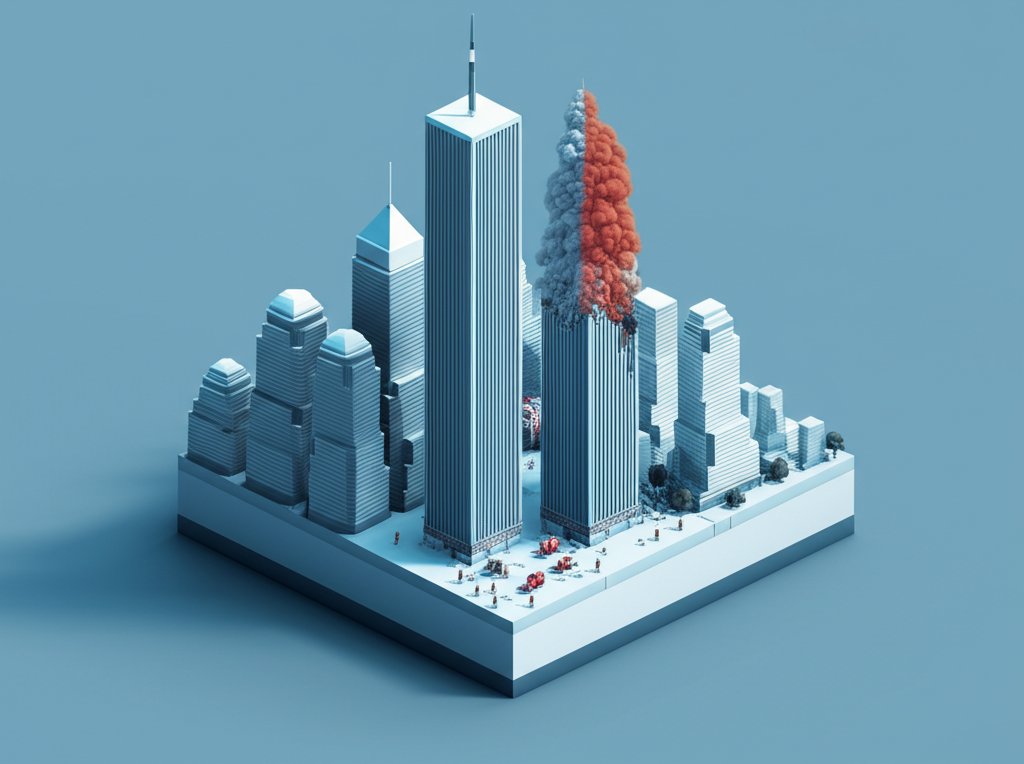
The morning of September 11, 2001, began like any other for many Americans, but within hours, the United States faced an unprecedented tragedy: the September 11 Attacks. Nineteen al-Qaeda terrorists hijacked four commercial airplanes, transforming ordinary commutes into instruments of mass destruction. The coordinated attacks on the World Trade Center and the Pentagon, and the heroic resistance aboard United Airlines Flight 93, reshaped American life in ways that continue to resonate today.
At a glance:
- Four planes were hijacked by al-Qaeda terrorists.
- The World Trade Center’s Twin Towers were struck and collapsed.
- The Pentagon was damaged.
- Passengers and crew fought back on Flight 93, which crashed in Pennsylvania.
- Nearly 3,000 people died.
- The U.S. launched the “War on Terror.”
- The attacks led to increased security measures and the creation of the Department of Homeland Security.
What Happened on 9/11: A Sequence of Terror
Understanding the events of that day requires a look at the timeline. At 8:46 a.m., American Airlines Flight 11 crashed into the North Tower of the World Trade Center. Just seventeen minutes later, at 9:03 a.m., United Airlines Flight 175 struck the South Tower. The images of smoke billowing from the skyscrapers were instantly broadcast around the world, signaling that America was under attack.
Then, at 9:37 a.m., American Airlines Flight 77 slammed into the Pentagon in Arlington, Virginia. 9/11 Attacks: A Detailed Timeline can provide a more granular look at each event as it unfolded. The final act occurred at 10:03 a.m., when United Airlines Flight 93 crashed in a field near Shanksville, Pennsylvania. This was thanks to the brave actions of the passengers and crew who fought back against the hijackers, preventing the plane from reaching its intended target, believed to be the U.S. Capitol or the White House.
Why the World Trade Center and Pentagon? Understanding the Targets
Al-Qaeda, founded by Osama bin Laden, deliberately chose symbolic targets. The World Trade Center represented American capitalism and economic power, while the Pentagon symbolized the nation’s military might. By attacking these iconic structures, the terrorists aimed to strike at the heart of American identity and influence. Understanding the 9/11 Attacks helps to illuminate the motives and planning behind this devastating event.
The choice of airplanes was also strategic. The hijackers selected flights traveling from the East Coast to California because these planes carried large amounts of fuel. This fuel acted as an accelerant, increasing the destructive impact of the crashes. It’s chilling to know that something as commonplace as a cross-country flight could be weaponized.
The Human Cost: Remembering the Victims
The September 11 Attacks resulted in 2,977 fatalities. In New York City, 2,753 people died at the World Trade Center, including 343 firefighters and paramedics, 23 New York City police officers, and 37 Port Authority police officers who rushed to the scene to help. At the Pentagon, 189 lives were lost, and in Pennsylvania, 44 people perished. The youngest victim was just two years old, and the oldest was 82, a somber reminder of the indiscriminate nature of the attacks. You can View 9/11 victim names and pay your respects.
These numbers, however, cannot fully convey the depth of the loss. Each victim was a person with dreams, families, and stories cut short by an act of terror. The ripple effects of their deaths continue to be felt by loved ones and communities across the nation.
The Immediate Aftermath: Chaos and Response

In the immediate aftermath of the attacks, the focus was on rescue and recovery. Firefighters, police officers, and other first responders worked tirelessly to search for survivors amidst the rubble. The scale of the devastation was overwhelming, and the emotional toll on those involved was immense.
Airspace across the United States was shut down, stranding thousands of travelers. The New York Stock Exchange closed for six days, the longest shutdown since the Great Depression. The nation was in a state of shock and mourning, grappling with the reality of what had occurred.
The “War on Terror”: A Nation Responds
In response to the September 11 Attacks, the United States launched the “War on Terror.” On October 7, 2001, U.S. forces invaded Afghanistan to target al-Qaeda and the Taliban regime that harbored them. Congress passed the Authorization for Use of Military Force (AUMF), granting the President broad authority to wage war against those responsible for the attacks.
The “War on Terror” expanded beyond Afghanistan, leading to the invasion of Iraq in 2003 and military operations in other countries. The long-term consequences of these actions continue to be debated and analyzed.
Strengthening Homeland Security: Preventing Future Attacks
The September 11 Attacks exposed significant vulnerabilities in America’s security infrastructure. In response, the U.S. government took several steps to strengthen homeland security.
The Department of Homeland Security (DHS) was created in 2002 to coordinate domestic anti-terrorism efforts. The Transportation Security Administration (TSA) was established to tighten security at airports and on planes, implementing new screening procedures and security measures. The Patriot Act expanded government surveillance powers, sparking controversy over privacy concerns.
These changes aimed to prevent future attacks, but they also raised questions about the balance between security and civil liberties.
The Hunt for Bin Laden and Justice for the Masterminds
Osama bin Laden remained at large for nearly a decade after the September 11 Attacks. Possible Options: 9/11s Enduring Legacy Aftermath highlights some of the legal and political challenges that followed. On May 2, 2011, U.S. Navy SEALs killed bin Laden in a raid on his compound in Pakistan, a major victory in the “War on Terror.”
Khalid Sheikh Mohammed, considered the mastermind behind the 9/11 attacks, was captured in 2003 and is detained at Guantanamo Bay. He and several other alleged co-conspirators are still awaiting trial, facing charges related to the planning and execution of the attacks.
The Economic Impact: Beyond the Immediate Costs

The September 11 Attacks had a significant economic impact, both in the short term and the long term. The immediate costs included an estimated $60 billion in damages to the World Trade Center and significant job losses, particularly in the finance and air transportation industries. Cleanup costs at Ground Zero totaled $750 million.
Beyond the immediate costs, the attacks led to increased spending on homeland security and military operations. The “War on Terror” cost trillions of dollars and had a profound impact on the U.S. economy.
Honoring the Fallen: Memorials and Remembrance
Numerous memorials have been established to honor the victims of the September 11 Attacks. The National September 11 Memorial & Museum, located at the World Trade Center site, is a place of remembrance and reflection. The “Tribute in Light,” an annual art installation that projects two beams of light into the sky, also serves as a powerful symbol of remembrance. Remembering 9/11 at the Memorial explores the meaning and impact of these tributes.
One World Trade Center (Freedom Tower) was built at the original World Trade Center site and stands 1,776 feet tall, a symbol of resilience and hope. These memorials provide spaces for people to grieve, remember, and honor the lives lost.
The Long-Term Health Effects: Supporting First Responders and Survivors
The September 11 Attacks had long-term health consequences for first responders, survivors, and residents of the affected areas. Exposure to toxic dust and debris at Ground Zero led to a range of health problems, including respiratory illnesses, cancer, and mental health issues.
The James Zadroga 9/11 Health and Compensation Act was enacted to provide health monitoring and compensation for those affected by the attacks. This legislation has been crucial in supporting the health and well-being of first responders and survivors.
Gifts of Remembrance: A Personal Connection
For some, tangible reminders can provide comfort and connection. Gifts that Honor 9/11 can serve as a personal way to keep the memory of that day alive and show support for those affected.
Reflecting on 9/11: Lessons Learned and a Path Forward
The September 11 Attacks were a watershed moment in American history, leaving an indelible mark on the nation’s psyche. The attacks exposed vulnerabilities in our security infrastructure, shaped our foreign policy, and transformed our society in profound ways.
As we remember the victims and honor the heroes of that day, it is essential to reflect on the lessons learned and reaffirm our commitment to preventing future acts of terror. This includes strengthening our security measures, addressing the root causes of extremism, and promoting understanding and tolerance across cultures. The legacy of 9/11 challenges us to build a more secure and just world for future generations and to never forget the sacrifices made.










