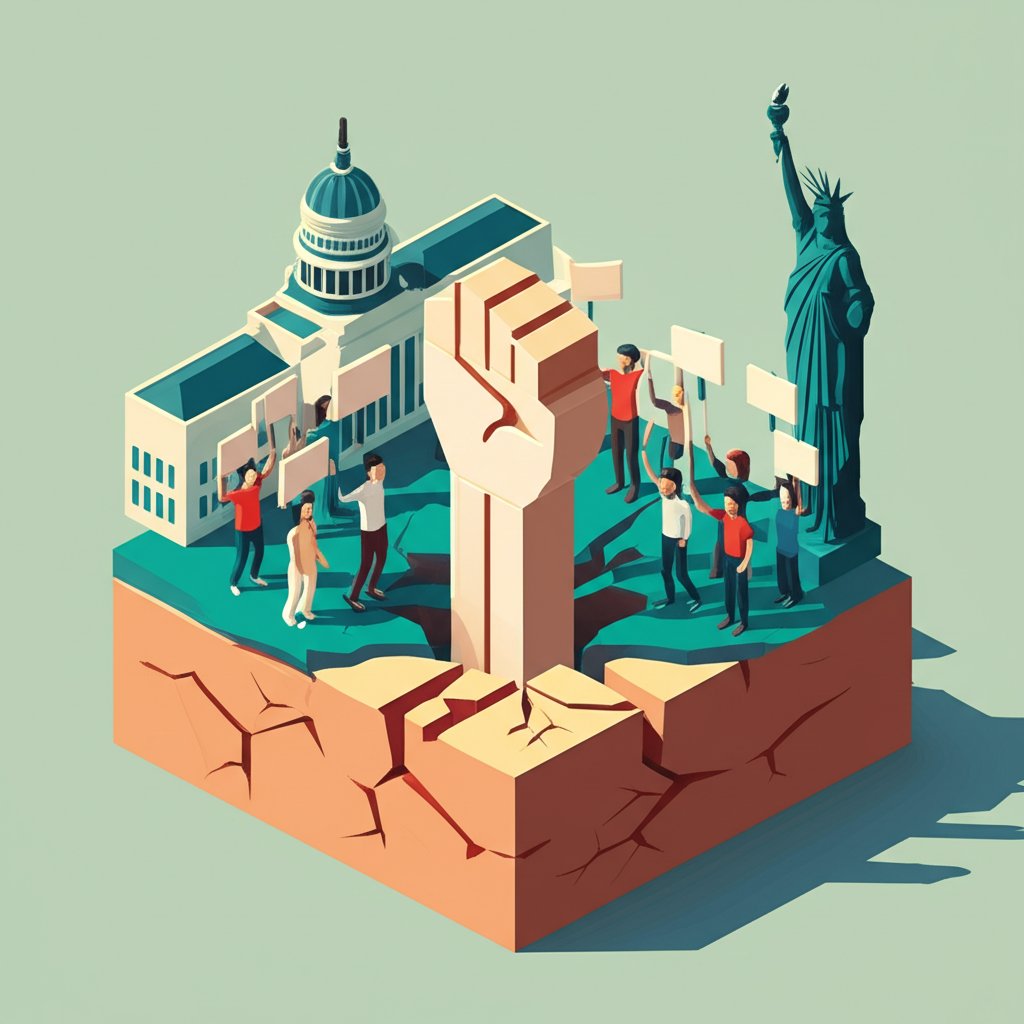
The version of American history most of us learned in school is a story of inevitable progress, guided by visionary founders and heroic presidents. But the real history of America is often a far more complex and confrontational story, one written not in capitols but in cotton fields, factory floors, and protest lines. It’s a history of fierce resistance against overwhelming power, where the most significant gains were won by ordinary people whose names rarely appear in textbooks.
This isn’t about erasing figures or achievements; it’s about adding the inconvenient truths and silenced voices back into the narrative. By looking at history from the bottom up, we can see the deep conflicts over wealth, race, and power that truly forged the nation.
At a Glance: What This Unfiltered View Reveals
- History as a Battleground: Understand that American history wasn’t a smooth march of progress but a series of intense struggles between the powerful and the marginalized.
- The Economic Engine: Uncover how economic motives—the need for land, resources, and cheap labor—were the primary drivers behind major events, from colonization to war.
- Power and Control: Learn to identify the mechanisms, like legal systems and cultural narratives, that elites used to maintain control and justify inequality.
- Resistance as a Constant: Recognize that from slave revolts to labor strikes, resistance by oppressed groups is not an exception but a constant, powerful force in the American story.
- A New Lens for Today: Gain a framework for critically analyzing current events by understanding their deep historical roots in these hidden struggles.
Beyond the Textbook: Re-examining America’s Origin Stories
To grasp the real history of America, we have to start by challenging its foundational myths. As historian Howard Zinn powerfully argued in A People’s History of the United States, many of our most cherished stories sanitize brutal realities to create a more comfortable, unified narrative.
Columbus: Discovery or Invasion?
The story of Christopher Columbus “discovering” America is a classic example. From the perspective of the Arawak people living in the Bahamas, his arrival was an invasion. Columbus’s own diaries reveal his mission was driven by a ruthless quest for gold. When gold was scarce, he turned to the next most valuable commodity: human labor.
The Arawak were enslaved, forced into brutal labor, and systematically annihilated. Within a century of Columbus’s landing, their entire society was virtually wiped out. Traditional history often frames this as an unfortunate “price of progress.” A bottom-up view calls it what it was: genocide, driven by economic greed. This reframing is essential because it shows that from the very beginning, the “advancement” of one group often came at the direct and violent expense of another.
The Revolution: A Fight for Whose Freedom?
The American Revolution is remembered as a heroic struggle for liberty. And for the wealthy, white, land-owning men who led it, it was. They masterfully used the language of freedom and equality to mobilize farmers and artisans against the British elite.
But their vision of freedom was radically limited.
- Slavery: The institution of slavery wasn’t challenged; it was protected. The new Constitution counted enslaved people as three-fifths of a person for political representation, giving slave states more power without granting any rights to the enslaved.
- Indigenous Peoples: The Proclamation of 1763, which had limited colonial expansion into Native American lands, was eliminated. The Revolution opened the floodgates for westward expansion and the violent dispossession of native tribes.
- Poor Whites: Events like Bacon’s Rebellion in 1676, decades before the Revolution, showed the raw class tensions in the colonies. Poor white indentured servants and enslaved Black people united to burn Jamestown and challenge the ruling elite. The memory of this cross-racial alliance terrified the wealthy, who later hardened racial laws to divide and control the poor.
The Revolution replaced a distant British elite with a local American one, but it did not fundamentally alter the nation’s class or racial hierarchy.
Unmasking the Mechanisms of Power and Control

Understanding the real history of America requires seeing not just what happened, but how a small, wealthy minority managed to maintain control over a diverse and often rebellious majority. The system rested on a sophisticated blend of force, law, and ideology.
Racism as a Deliberate Strategy
Slavery in the American colonies wasn’t a natural or inevitable outcome; it was a calculated economic decision to solve a labor shortage, particularly in the tobacco fields of Virginia. But to sustain it, a powerful ideology was needed. Racism was manufactured to justify the brutal exploitation of African people.
By defining people with black skin as subhuman, the elite could rationalize a system that was otherwise indefensible. More strategically, it created a permanent wedge between poor whites and enslaved Blacks. By giving poor whites a marginal status and a sense of racial superiority, the wealthy ensured their most likely allies—other poor people—would instead become their enforcers. This “divide and conquer” strategy was one of the most effective tools of control in American history.
“Progress” as a Justification for Conquest
As the nation expanded, a powerful idea called “Manifest Destiny” took hold. It was the belief that the United States was divinely ordained to expand across the continent. This noble-sounding concept served as a moral justification for brutal actions:
- Indian Removal: The forced displacement of the Cherokee, Choctaw, and other nations from their ancestral lands.
- The Mexican-American War: An expansionist war that resulted in the U.S. seizing half of Mexico’s territory.
Later, at the turn of the 20th century, this same logic was applied overseas. The Spanish-American War wasn’t just about “liberating” Cuba; it was a pivot to American imperialism, leading to the takeover of Puerto Rico, Guam, and the Philippines for strategic and economic gain. In each case, a narrative of progress, liberty, or divine will was used to mask the raw pursuit of land and resources.
The Real Engine of Change: Resistance from the Ground Up
If the story so far seems bleak, that’s because it’s only half the picture. The other half—the most vital part of the real history of America—is the story of relentless resistance. Progress was rarely granted from on high; it was demanded, fought for, and won from below.
While the traditional focus on presidents and generals provides one lens, the real history of America is often found in the collective action of the masses. To understand the full spectrum of individuals who left their mark, from the top down and the bottom up, you can Explore influential American figures and see how these different stories intersect.
Everyday Resistance and Organized Uprisings
Oppressed groups never accepted their condition passively. Their resistance took many forms:
| Form of Resistance | Example |
|---|---|
| Covert Sabotage | Enslaved people breaking tools, feigning illness, or intentionally slowing down the pace of work to disrupt the plantation economy. |
| Armed Rebellion | Slave revolts, such as Nat Turner’s Rebellion in 1831, which sent shockwaves of fear through the slave-holding South. |
| Labor Strikes | The massive railroad strike of 1877, where workers across the country shut down rail traffic to protest wage cuts, leading to violent clashes with militias. |
| Collective Organizing | The formation of labor unions like the Knights of Labor and feminist groups that organized for suffrage, despite facing arrests and public scorn. |
| These acts were often brutally suppressed, but they demonstrated a constant refusal to submit and kept the powerful on edge. |
The Long, Bloody Fights for Basic Rights
Nearly every major social justice victory in American history was the result of decades of grassroots struggle against violent opposition.
- The Eight-Hour Day: This wasn’t a gift from benevolent factory owners. It was the central demand of a militant labor movement that saw activists jailed, beaten, and killed for decades.
- Women’s Suffrage: Women were arrested, imprisoned, and force-fed for demanding the right to vote. The movement took nearly a century of marches, protests, and civil disobedience.
- Civil Rights: The Civil Rights Movement didn’t start with Martin Luther King Jr.’s “I Have a Dream” speech. It was built on generations of local organizing against lynching, segregation, and voter suppression—a fight that cost thousands of lives.
These movements prove that real change is rarely orderly or polite. It is born from disruption and sustained by the courage of ordinary people who refuse to accept injustice.
A Practical Guide to Reading History Critically

You can apply this “people’s history” lens yourself. When you encounter any historical account—in a book, a documentary, or a museum—ask these four questions to uncover the story behind the story.
- Who Benefits from This Narrative?
Follow the money and the power. Does the story celebrate a government action while ignoring its economic motives? Does it praise an industrialist’s “ingenuity” while glossing over the exploitation of his workers? Every story serves an interest; your job is to identify it. - Whose Voices Are Missing?
Look for the silences. If the story is about a war, are you hearing from the soldiers and the civilians, or just the generals? If it’s about building a railroad, are you hearing from the Chinese and Irish immigrant laborers who laid the tracks? Actively seek out the perspectives of the powerless. - Question the Narrative of “Progress.”
Be skeptical of any story that presents history as a smooth, inevitable upward curve. Ask, “Progress for whom?” The invention of the cotton gin was “progress” for plantation owners and textile mills, but it was a disaster for the enslaved people whose labor became even more hellish. - Connect Past Struggles to Present Issues.
The conflicts of the past don’t disappear; they evolve. Debates over fair wages, racial justice, immigration, and corporate power are not new. Understanding their historical roots gives you a powerful tool for making sense of the world today.
Frequently Asked Questions About America’s “Real History”
Q: Isn’t this view just anti-American and overly negative?
This perspective isn’t anti-American; it’s profoundly pro-democracy. Acknowledging the nation’s injustices and the struggles against them is a more honest—and ultimately more inspiring—form of patriotism than clinging to sanitized myths. It suggests that the country’s highest ideals have been advanced not by ignoring its flaws, but by confronting them head-on.
Q: Why wasn’t I taught this in school?
Mainstream historical education often aims to create a sense of national unity and pride. This can lead to curricula that emphasize consensus over conflict and heroes over movements. The stories of class conflict, racial oppression, and grassroots rebellion are often seen as too disruptive or complex for a standard curriculum.
Q: Does this mean famous figures like the Founding Fathers weren’t important?
Not at all. Figures like Thomas Jefferson and Abraham Lincoln were undeniably influential. But a “people’s history” approach insists on viewing them in their full context. It acknowledges Jefferson’s brilliance in writing the Declaration of Independence and the profound hypocrisy of his owning hundreds of enslaved people. It credits Lincoln with the Emancipation Proclamation while also recognizing that the actions of enslaved people fleeing to Union lines forced his hand. It’s about seeing historical figures as complex and often compromised, not as marble saints.
Your History, Your Power
Looking at the real history of America is not about memorizing a new set of facts. It’s about adopting a new way of seeing. It’s the recognition that history is not a static story handed down from on high, but an ongoing argument.
The comforting narratives are easier to accept, but the hidden stories of struggle and resistance hold the real lessons. They show that even in the face of immense power, ordinary people have always found ways to fight for justice. They prove that the world we have today wasn’t inevitable; it was built, and it can be rebuilt. By understanding how change has happened in the past, you are better equipped to shape it in the future.










