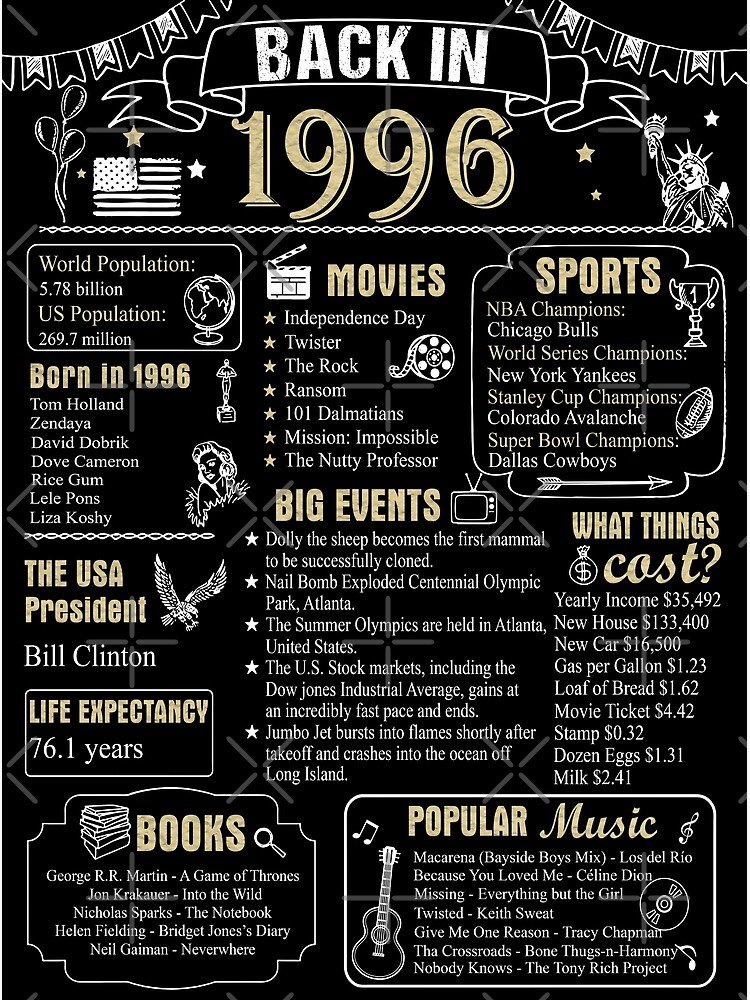
Nineteen ninety-six wasn’t just another notch on the calendar; it was a year of seismic shifts, where the internet began its rapid ascent, geopolitical tensions flared, and daily life experienced transformations both subtle and stark. The sheer breadth of notable events in 1996 — from technological breakthroughs that laid the groundwork for our digital future to pivotal political realignments and tragic human events — etched it into history as a truly transitional period. We saw the first glimpses of a connected world taking shape, alongside stark reminders of enduring conflicts and challenges.
At a Glance: Key Insights from 1996
- Digital Foundations Laid: Witness the nascent steps of the modern internet and mobile communication taking hold.
- Geopolitical Chessboard: Understand the complex interplay of peace efforts, regional conflicts, and emerging global agreements.
- Social & Legal Evolution: See landmark court rulings and the genesis of critical safety systems that still protect us today.
- Unforgettable Tragedies: Reflect on the human cost of both natural disasters and deliberate acts, shaping societal responses.
- Cultural Milestones: Recount the moments that captured public imagination, from sports comebacks to musical breakouts.
- The Blueprint for Today: Connect these 1996 events to the long-term trends and societal structures we navigate presently.
The Digital Roar: How 1996 Wired Our Future
Nineteen ninety-six often feels like a distant past, but it was, in many ways, the calibration year for the digital era. The underlying infrastructure and key technologies we now take for granted truly began to coalesce, marking some of the most notable events in 1996.
Mobilizing the Masses: The StarTAC and Beyond
On January 3rd, the Motorola StarTAC hit the market, offering a glimpse into the future of personal communication. This wasn’t just another phone; it was the first successful clamshell flip phone, compact and stylish, eventually selling 60 million units. Its design philosophy — smaller, sleeker, more personal — directly influenced generations of mobile devices. It signaled a move away from bulky car phones to truly portable communicators, fundamentally changing how people connected on the go.
Java’s Genesis: Powering the Web
While the World Wide Web was still finding its footing, the official release of the first version of the Java programming language by Sun Microsystems on January 23rd was a game-changer. Java promised “write once, run anywhere” capabilities, offering a universal language for the internet. This was crucial for developing the interactive web applications that would soon define the digital experience, far beyond static webpages. Imagine trying to build today’s complex online services without a versatile, cross-platform language – Java started that revolution.
When AI Challenged Humanity: Deep Blue vs. Kasparov
A truly groundbreaking moment arrived on February 10th when IBM’s chess-playing computer, Deep Blue, defeated reigning world champion Garry Kasparov in a game. Although Kasparov ultimately won the match, this single game marked the first time a computer had beaten a human world champion in a classical chess match. It wasn’t just about chess; it was a profound demonstration of artificial intelligence’s potential, igniting conversations about machine learning and computational power that continue today. It showed us that AI wasn’t just science fiction, but a tangible, advancing reality.
Navigating the Wild West: Early Internet Regulation Attempts
The rapid growth of the internet brought with it new challenges, particularly around content. On February 1st, the U.S. Congress passed the Communications Decency Act (CDA) as part of the Telecommunications Act of 1996. This controversial legislation aimed to regulate indecent and offensive material on the internet. However, its broad provisions immediately faced legal challenges, with a U.S. federal court striking down its child protection portion on July 29th. This early struggle highlighted the difficulty of applying traditional laws to a borderless digital realm and sparked ongoing debates about online censorship, free speech, and jurisdiction. The digital era was truly beginning to test old legal frameworks.
Transparency in the Digital Age: The Electronic FOIA
In a quieter yet significant move, President Bill Clinton signed the Electronic Freedom of Information Act Amendments on October 2nd. This legislation updated the original FOIA to explicitly cover electronic records, ensuring that government information accessible via computers and the internet would also be available to the public. It was a crucial step in maintaining government transparency in an increasingly digitized world, laying the groundwork for digital public access that we often take for granted today.
Shifting Global Plates: Politics, Conflict, and Human Rights
Beyond the digital sphere, 1996 was a year of profound political turbulence and significant social shifts worldwide. From peace efforts in Bosnia to landmark legal decisions in the U.S., these events underscored a dynamic global landscape. For a broader view of the year’s context, including how these events fit into the overarching narrative of the digital era’s dawn, you can explore the comprehensive guide, What happened in 1996?
Peacekeeping and Persistent Conflicts
The early days of 1996 saw the U.S. deploy troops to Northern Bosnia on January 2nd, joining a multinational force to maintain peace between Bosnian Serbs and Muslims. This was a direct response to the Dayton Agreement, an attempt to stabilize a region ravaged by war. While peace efforts were underway, other conflicts intensified. Fighting in Chechnya escalated on January 9th, with a Russian offensive met by Chechen separatist raids, leading to a brutal hostage crisis. This demonstrated the complex nature of post-Cold War security, where international peacekeeping efforts coexisted with fierce regional conflicts.
Meanwhile, the Middle East saw cautious diplomatic steps and renewed violence. King Hussein of Jordan visited Israel on January 10th, symbolizing thawing relations, even as the killing of Hamas operative Yahya Ayyash on January 5th by an Israeli-planted booby-trapped cell phone underscored the deep-seated tensions. Yasser Arafat’s re-election as President of the Palestinian National Authority with 88% of the vote on January 20th signaled a public mandate for his leadership in the ongoing peace process, despite the persistent challenges. The Israeli shelling of a UN compound in Qana, Lebanon, on April 18th, killing over 100 civilians, served as a grim reminder of the region’s volatility.
Global Security and Democratic Stirrings
Taiwan held its first direct presidential elections on March 23rd, a significant step toward solidifying its democratic identity amidst ongoing tensions with mainland China. This bold move showcased a burgeoning commitment to self-determination in Asia. Later in the year, representatives from 71 nations signed the Comprehensive Nuclear-Test-Ban Treaty at the United Nations on September 24th, a crucial multilateral effort to curb the proliferation of nuclear weapons and promote global stability. It represented a collective international commitment to a safer world, even as France concluded its controversial nuclear testing program on January 29th.
However, democratic aspirations faced setbacks. On January 25th, a military coup overthrew Niger’s democratically elected government, replaced by Colonel Ibrahim Baré Maïnassara on January 27th. This underscored the fragility of democratic transitions in various parts of the world. In Afghanistan, the Taliban’s capture of Kabul on September 27th and the brutal murder of former President Mohammad Najibullah on September 28th marked a grim turning point, plunging the country into a new and devastating chapter of civil war under strict fundamentalist rule.
Social Justice and Domestic Policy Shifts
In the United States, significant legal and social policy changes unfolded. The US Supreme Court ruled in ‘Romer v. Evans’ on May 20th, striking down a Colorado law that would have prevented anti-discrimination measures based on sexual orientation. This was a landmark victory for LGBTQ+ rights, signaling a shift in legal protection and public discourse. On August 22nd, President Bill Clinton signed welfare reform into law, a major overhaul of the US welfare system designed to encourage work and reduce dependency. This represented a significant philosophical shift in social policy, sparking considerable debate about government’s role in poverty alleviation.
A more direct measure for public safety emerged from tragedy. After the abduction and murder of 9-year-old Amber Hagerman in Texas on January 17th, the AMBER Alert system was created. This system, which rapidly disseminates information about abducted children, became a vital tool in law enforcement and a testament to community mobilization in response to devastating loss.
Culture & Everyday Impact: From Blockbusters to Biotechnology
Beyond the headlines of politics and technology, 1996 was rich with moments that shaped daily life, from sports and entertainment to scientific breakthroughs that challenged our understanding of life itself.
The Sports Spectacle and Cultural Icons
Super Bowl XXX on January 28th saw the Dallas Cowboys defeat the Pittsburgh Steelers, a classic showdown that captivated millions. In basketball, Magic Johnson’s dramatic return from a 5-year retirement to play for the LA Lakers on January 30th was a feel-good story that thrilled fans and showed the enduring power of sports legends. On the music scene, February 13th was a big day: the Fugees released their critically acclaimed album “The Score,” and Tupac Shakur’s “All Eyez on Me” also dropped, cementing their places in music history and reflecting the vibrant sounds of the era.
Television continued to evolve, with the sitcom “3rd Rock from the Sun” debuting on NBC on January 9th, bringing quirky humor and a fresh premise to prime time. These cultural touchstones provided a backdrop of normalcy and entertainment amidst a rapidly changing world.
Redefining Life Itself: Dolly the Sheep
Perhaps one of the most astonishing scientific notable events in 1996 occurred on July 5th with the birth of Dolly the sheep. Dolly was the first mammal cloned from an adult somatic cell, a monumental achievement that sparked global scientific and ethical debates about the implications of cloning technology. It opened up possibilities for medical advancements and agricultural improvements, but also raised profound questions about the sanctity of life and genetic manipulation. Dolly’s existence forced humanity to confront new frontiers in biotechnology.
The Royal Separation and Public Obsession
On August 28th, Charles, Prince of Wales, and Diana, Princess of Wales, formally divorced. This highly anticipated event, following years of public marital strife, marked the end of a fairy-tale romance turned tabloid drama. It captivated global audiences, highlighting the intense public scrutiny faced by the British Royal Family and feeding into a pervasive cultural fascination with celebrity lives.
When Disaster Struck: Unforgettable Tragedies of 1996
While much of 1996 pointed toward progress, the year also brought its share of heart-wrenching disasters and tragedies, reminding us of nature’s power and humanity’s vulnerabilities.
Catastrophes in the Air and Sea
The skies saw multiple devastating incidents. On February 6th, Birgenair Flight 301 crashed off the Dominican Republic, killing all 189 people and becoming the worst Boeing 757 accident. A Long March 3 rocket carrying an Intelsat 708 crashed in China on February 15th, causing an unknown number of fatalities and significant controversy. The tragedy intensified on July 17th, when TWA Flight 800, a Boeing 747, exploded off Long Island, New York, killing all 230 on board. Investigations into TWA 800 would span years, becoming one of the most extensive air accident investigations in history. Later, Vnukovo Airlines Flight 2801 crashed on Spitsbergen on August 29th, killing all 141 aboard, followed by Aeroperú Flight 603 on October 2nd, which crashed into the Pacific, killing 70. These events collectively highlighted the persistent risks of air travel despite technological advancements.
The seas also claimed many lives. On May 21st, the ferry Bukoba sank in Tanzanian waters on Lake Victoria, killing nearly 1,000 people in one of Africa’s worst maritime disasters. Earlier, the North Cape oil spill off Rhode Island on January 19th released 828,000 gallons of heating oil, devastating marine life and closing a vast fishing area, demonstrating the environmental vulnerability of coastal ecosystems.
Acts of Violence and Mass Casualties
The Dunblane massacre in Scotland on March 13th sent shockwaves across the globe when Thomas Watt Hamilton shot and killed 16 primary school children and one teacher. This horrific event led to significant changes in UK gun control laws, demonstrating how tragedy can catalyze policy reform. A nightclub fire in Quezon City, Philippines, on March 18th killed 162 people, a stark reminder of the dangers of inadequate safety regulations.
Terrorism also left its mark. The IRA ended its 18-month ceasefire on February 9th, followed by a large bomb in London’s Canary Wharf on February 10th. On June 15th, the Provisional Irish Republican Army exploded another large bomb in Manchester, England, causing extensive damage and numerous injuries. Domestically, a pipe bomb exploded during the 1996 Summer Olympics at Centennial Olympic Park in Atlanta on July 27th, killing one woman and injuring many, disrupting the spirit of international unity. Sri Lanka suffered a devastating suicide bombing by separatist Tamil Tigers on January 31st, killing at least 86 people and injuring 1,400 at the Central Bank.
Nature’s Fury
A severe blizzard in the eastern US on January 8th caused at least 50 deaths, highlighting the destructive power of winter storms. Floods in Oregon’s Willamette Valley on February 6th caused over $500 million in damages. The 1996 Mount Everest disaster on May 11th saw eight people die during summit attempts, a tragic reminder of the unforgiving nature of extreme environments. Severe thunderstorms and a tornado in Bangladesh killed 600 people on May 13th, and Hurricane Fran made landfall as a Category 3 storm in North Carolina on September 5th, causing over $3 billion in damage and killing 27 people. These events underscored humanity’s enduring vulnerability to natural forces.
Beyond the Headlines: Lasting Legacies and Unfolding Futures
Looking back at the notable events in 1996, it’s clear that the year was a crucible for many trends we now consider commonplace. The nascent internet wasn’t just a novelty; it was beginning to reshape commerce, communication, and information access. Political shifts, while often rooted in historical conflicts, also laid the groundwork for new international alliances and human rights dialogues. The year’s tragedies, too, had lasting impact, spurring legislative changes and advancements in public safety protocols that continue to protect us. Understanding these pivotal moments helps us grasp the foundations of our modern world and appreciate the often-unseen forces that continue to shape our lives.
Navigating the Aftermath: Key Lessons from 1996’s Unpredictability
The events of 1996 offer practical insights into rapid change and long-term consequences:
- Embrace Technological Inflection Points: The rise of Java and the StarTAC demonstrated how quickly new technologies can become indispensable. Organizations and individuals that recognized and adapted to these early digital shifts gained a significant advantage. Don’t wait for perfection; iterate and integrate.
- Anticipate Regulatory Challenges: The CDA’s struggle showed that new technologies quickly outpace existing legal frameworks. Businesses operating in emerging spaces should actively engage with policy discussions and prepare for evolving regulatory landscapes rather than reacting defensively.
- Build Resilience into Systems: From air travel to public gatherings, the year’s disasters highlighted vulnerabilities. For any system – be it a digital platform or an operational workflow – building in redundancy, safety protocols, and crisis management plans is paramount.
- Recognize Global Interconnectedness: Conflicts and peace efforts in one region, like Bosnia or the Middle East, had ripple effects on international diplomacy and security. In today’s hyper-connected world, understanding global dependencies is critical for strategic planning.
- Champion Social Progress: The Romer v. Evans decision and the creation of the AMBER Alert system demonstrated how legal and community actions can drive meaningful social change. Identifying areas for improvement and mobilizing collective efforts can lead to lasting positive impact.
Quick Answers to Your 1996 Questions
Q: Was 1996 a significant year for the internet?
A: Absolutely. While the internet existed before 1996, it was the year Java officially launched and the Communications Decency Act highlighted the regulatory challenges of a rapidly growing online world. These events laid crucial groundwork for the internet’s future development and user experience.
Q: What major political shifts occurred in 1996?
A: Politically, 1996 was marked by both peace efforts (US troops in Bosnia, Middle East diplomacy) and intensifying conflicts (Chechnya, IRA bombings, Taliban’s rise in Afghanistan). Significant internal policy changes also occurred, such as US welfare reform and landmark civil rights rulings like Romer v. Evans.
Q: What were some of the biggest scientific breakthroughs of 1996?
A: The cloning of Dolly the sheep was undoubtedly the most significant scientific breakthrough. It shattered previous assumptions about genetic engineering and opened profound discussions about bioethics and the future of reproductive technologies.
Q: Were there any major cultural moments in 1996?
A: Culturally, 1996 saw the debuts of hit TV shows like “3rd Rock from the Sun,” major music releases from artists like the Fugees and Tupac Shakur, and iconic sports moments like Magic Johnson’s comeback. The divorce of Charles and Diana also captured global attention.
Q: How did 1996 impact safety and security?
A: Tragedies like the Dunblane massacre spurred stricter gun control in the UK, while the abduction of Amber Hagerman led to the creation of the AMBER Alert system in the US. The year also saw intense debates over internet content regulation with the CDA, reflecting growing concerns about digital safety.
Seizing the Insights from a Pivotal Year
The tapestry of 1996’s notable events is rich and complex, offering a compelling narrative of a world on the cusp of profound change. From the quiet hum of a new programming language to the roar of a jet engine tragedy, each event contributed to shaping the reality we inhabit today. By dissecting these moments, we gain more than just historical facts; we acquire a deeper understanding of technological adoption, the dynamics of global power, and the enduring human spirit in the face of both innovation and adversity. Recognizing these foundational shifts empowers us to better anticipate and navigate the continuous evolution of our interconnected world.










