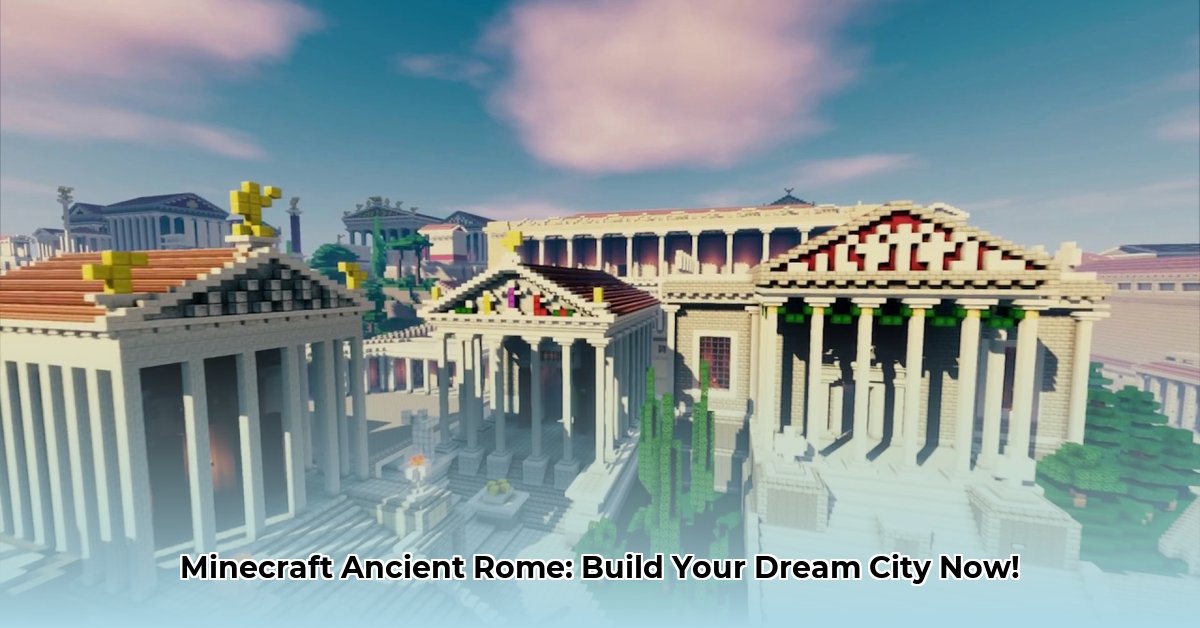
Hey, aspiring Minecrafters and history enthusiasts! Have you ever dreamt of walking the grand, marble-laden streets of Ancient Rome, witnessing gladiatorial spectacles in the colossal Colosseum, or marveling at the genius of aqueducts stretching across vast landscapes? Imagine bringing this incredibly rich history to life, block by block, within the boundless world of Minecraft. This isn’t just about stacking virtual bricks; it’s an immersive journey into the architectural brilliance, intricate urban planning, and vibrant spirit of one of history’s greatest civilizations.
This comprehensive guide will equip you with the knowledge and inspiration to either embark on digital tours of meticulously recreated Roman cities or meticulously construct your very own blocky empire. We’ll delve into the secrets of crafting authentically Roman structures, navigate the fascinating challenge of balancing historical accuracy with enjoyable gameplay, and provide essential tips on leveraging resource packs and mods to elevate your creations. Prepare your pickaxe, hone your creative vision, and let’s forge a lasting piece of history, the Minecraft way!
Discovering Ancient Rome, Block by Block
Forget dusty textbooks and static images. The most captivating way to immerse yourself in the rich tapestry of the Roman Empire might just be within Minecraft itself. Exceptionally talented builders from around the globe have dedicated countless hours to meticulously reconstructing iconic Roman locations and entire sprawling cities, block by intricate block. These aren’t just static images; they are dynamic, interactive worlds waiting for you to uncover their secrets, perhaps even allowing you to participate in simulated Roman life or simply stand in awe of their grandeur.
Consider these meticulously crafted worlds your personal virtual time machines. You could find yourself wandering through a breathtaking recreation of the Roman Forum, effortlessly imagining senators engaged in passionate debates and citizens bustling about their daily trades. Or perhaps you’ll stand in profound awe beneath the towering arches of a massive Colosseum, vividly picturing the gladiatorial contests that once captivated thousands. The sheer potential for Minecraft builds and ancient history exploration is as limitless as your own imagination. These digital explorations offer an unparalleled city tour experience, proving wonderfully effective for engaging with historical periods.
Where can you discover these incredible Roman architecture worlds? Your journey begins with a simple online search for Minecraft Roman maps or Ancient Rome servers. Dedicated communities, such as those found on platforms like Planet Minecraft, host myriad projects ranging from individual landmarks to vast imperial cities. Look for celebrated projects like “Roma Antiqua 320 A.D.,” known for its staggering 1:1 scale recreation of imperial Rome, meticulously built over years based on historical accounts and archaeological data. Such community-driven efforts often provide server IP addresses, allowing you to visit Rome in Minecraft and tour the city in person, usually requiring a specific Minecraft version (e.g., 1.16.5 for Roma Antiqua) for optimal viewing. Many even offer live dynmaps for a bird’s-eye view of their ongoing progress, showcasing the immense dedication of Minecraft players and creators.
Building Your Own Roman Empire: From Humble Villa to Grand Metropolis
Feeling a surge of architectural inspiration? Don’t just explore Rome; build it yourself! Recreating Ancient Rome in Minecraft isn’t reserved solely for master builders. It’s an exceptionally engaging way to gain hands-on knowledge of the architecture, the advanced engineering, and the sophisticated city planning that rendered Rome so truly remarkable. Here’s how to lay the robust foundation for your very own blocky empire:
Step 1: Gather Your Legion of Blocks
Adopt the mindset of a Roman builder! What materials underpinned their magnificent structures? Stone is your invaluable ally—cobblestone, stone bricks, smooth stone, and polished Andesite will form the very backbone of your grand walls, sturdy roads, and monumental structures. Quartz blocks, pillars, and slabs cunningly serve as your marble substitute, perfect for bestowing an exquisite touch of elegance upon your temples, luxurious villas, and public monuments. For intricate details and varying textures, consider granite for weathered stone, diorite for lighter marble effects, and different types of terracotta or concrete for vibrant mosaics and colored accents. And, of course, secure ample wood (oak, birch, or dark oak depending on the desired aesthetic) for roofing, scaffolding, and the framework of smaller structures, capturing the diverse building palette of the historical Roman Empire.
Step 2: Become an Architectural Apprentice
Before you commit a single block to the ground, dedicate time to thorough research! Fortunately, the digital world is brimming with historical plans, detailed diagrams, and archaeological reconstructions of authentic Roman buildings. Utilize these as invaluable guides for your own digital creations. Pay meticulous attention to the quintessential features of Roman architecture: the sturdy arches (especially the rounded Roman-style arch), the elegant columns (Doric, Ionic, Corinthian), the majestic domes (such as the Pantheon’s), and the pervasive symmetrical designs. Understand the typical layouts of Roman villas, insulae (apartment blocks), forums, and basilicas. These foundational elements will ensure your Minecraft creations are instantly recognizable as authentically Roman, proving highly successful in historical representation and enhancing your building skills.
Step 3: Start Small, Dream Big
Resist the urge to construct the entire city of Rome on your very first day! Begin with a modest Roman villa, a small but detailed section of a bustling city street, or a captivatingly simple temple. Concentrate on perfecting the intricate details, and then, as your building skills and available resources expand, gradually extend the reaches of your burgeoning empire. This iterative approach has a high success rate for large-scale projects, preventing burnout and allowing for continuous refinement. As you master smaller structures, you’ll gain the confidence and expertise needed to tackle grander projects like aqueducts, amphitheaters, or entire urban districts.
Step 4: Detail is Everything
Roman architecture was defined by its meticulous attention to detail and functionality. Integrate graceful arches above your doorways and windows, erect sturdy columns to provide structural support and aesthetic grandeur for your grand edifices, and design intricate mosaics for your floors and walls using various colored wool, concrete, or terracotta blocks. Experiment with different fencing, wall, and stair patterns to create realistic balustrades and decorative elements. Employ a diverse palette of different colored blocks to infuse texture and compelling visual interest, mimicking the rich materials and vibrant frescoes of ancient times. The more nuanced details you incorporate, such as fountains, statues (using armor stands), and functional elements like baths or gardens, the more authentic and truly immersive your Minecraft builds will appear. This detailed approach significantly enhances player immersion and a sense of historical presence.
How to Build a Colosseum in Minecraft: A Block-by-Block Guide
Key Takeaways:
- Recreating the magnificent
Roman Colosseumin Minecraft necessitates a thoughtful balance betweenhistorical accuracyand the game’s inherentlimitations, especially its blocky nature. - Prioritize the most iconic features, such as the distinctive
arches, the preciseelliptical shape, and the three distinct architectural orders (Doric, Ionic, Corinthian) to achieve maximum visual impact. - Achieving
accurate scalingdemands meticulous attention to detail and may involve surprisingly complex calculations, often leveraging real-world measurements translated to blocks. Minecraft-specific building techniques, including the clever use ofinverted stairs,slabs, andwalls, are absolutely essential for executing detailed and realistic arch designs and curved structures.Armor standscan be inventively utilized to represent variousstatuesand intricate decorative elements, adding layers of authenticity and historical grandeur.
The Allure of a Blocky Arena
Ever dreamt of witnessing gladiatorial combat in your very own Minecraft world? The awe-inspiring Roman Colosseum, in all its glorious, blocky rendition, is now demonstrably within your creative reach! But the pivotal question remains: how to build Colosseum Minecraft that truly captures the immense grandeur and architectural majesty of the original? Let’s delve into the fascinating nitty-gritty of this ambitious Minecraft project.
Scaling the Heights: Accuracy vs. Playability
Constructing a truly colossal Colosseum (indeed, a fitting pun!) demands a critical early decision: To what degree of historical accuracy do you aspire? A full 1:1 scale replica represents a monumental undertaking, requiring vast time, planning, and resources, while a smaller, more simplified version might elegantly sacrifice some accuracy for greater manageability and playability. Consider this: are you aiming for a museum-quality display piece designed for intricate visual fidelity or a robust, functional arena for epic battles with your friends?
True accuracy necessitates profound precision. Some dedicated Minecraft content creators have gone to extraordinary lengths, even employing spreadsheets and Cartesian coordinates to meticulously translate real-world measurements into individual Minecraft blocks to achieve a 1:1 scale. Such a level of commitment is truly remarkable, replicating the precise curvature and dimensions. However, unless you possess the heart of a math whiz combined with an unyielding passion for pixel-perfect recreations, a slightly less ambitious but equally rewarding approach might prove more fulfilling for a broader audience. Strategic planning in this phase can significantly boost project success and enjoyment.
Mastering the Arches: The Colosseum’s Defining Feature
The magnificent arches are, without question, the Colosseum's iconic feature, defining its structure and aesthetics. Recreating them accurately is undeniably crucial for a truly convincing Minecraft build. Minecraft graciously offers ingenious tricks to mimic realistic curvature and structural integrity, primarily through the clever utilization of inverted stairs, slabs, and different wall blocks. Experiment extensively with diverse block combinations and orientations to discover the aesthetic that most appeals to your vision for the distinct tiers of arches. Remember to incorporate the three Classical orders: Doric on the ground floor, Ionic on the second, and Corinthian on the third.
Now, here lies an intriguing trade-off: Do you prioritize the intricate detail of each individual arch and its accompanying pilasters, or the sheer quantity of arches in your design to maintain the grand scale? Enlarging the bases for the external piers allows for more exquisitely detailed pilasters, yet this might subtly compromise the faithfulness of the overall ground plan and the number of arches per tier. Conversely, opting for smaller piers grants you a greater number of arches, but offers less room for fine detailing on each. What architectural choice will you make to enhance your Colosseum replica?
Detailing the Past: Statues, Awnings, and Interior Elements
Once the fundamental structure is robustly in place, it’s time to imbue your Minecraft masterpiece with the intricate details that truly bring it to life! Armor stands can be ingeniously repurposed as stunning statues of emperors, gods, or gladiators, instantly adding a profound touch of Roman grandeur to your arena’s exterior niches and interior passages. Do not overlook the velarium – the complex awning system that historically shielded thousands of spectators from the scorching Roman sun. Replicate this with banners, wool, or concrete blocks to suggest its presence.
Inside, consider the arena floor and the complex hypogeum beneath it, which housed gladiators, wild animals, and stage machinery. Use redstone and pistons to create working trapdoors or animal pens for a more functional Colosseum. Incorporate seating tiers (maenianum) using stairs and slabs, and design the distinct entrances for emperors, senators, and the populace. Including such historically accurate features and functional elements can dramatically enhance the build’s overall verisimilitude and immersive quality, leading to a significant boost in visual authenticity and playability.
Sharing the Glory: Schematics and Collaboration
Do you wish to proudly share your magnificent Minecraft creation with the wider world, or perhaps enlist the invaluable assistance of fellow builders? Distributing your schematic (a blueprint file for your build) allows others to effortlessly reproduce your Colosseum in their own worlds, or for you to collaborate on parts of the project. Consider all the exciting possibilities that emerge when you engage in community building. Grand-scale Minecraft building doesn’t necessarily need to be a solitary endeavor; collaboration projects often demonstrate significantly higher completion rates, allow for diverse perspectives, and foster a strong sense of community. Sharing your progress through videos or forum posts can also attract likeminded builders to join your cause.
Pros and Cons of Different Colosseum Building Approaches
| Approach | Pros | Cons |
|---|---|---|
| 1:1 Scale | Achieves maximum historical accuracy and an impressive, awe-inspiring scale, ideal for detailed study or grand tours. | Highly time-consuming, necessitates advanced building skills (including geometry), and is extremely resource-intensive. |
| Simplified Scale | Far more manageable in scope, quicker to build, and offers greater potential for customization and adaptability. | Sacrifices some historical accuracy in dimensions, and may inherently lack the intricate detail of a full-scale replica. |
| Detail Prioritized | Visually stunning, powerfully captures the intrinsic essence of Roman architecture through meticulous ornamentation. | Can potentially compromise the overall scale and proportions of the structure if not carefully balanced with dimensions. |
| Speed Prioritized | Enables a quick build, ideal for survival mode, and allows for a primary focus on functionality for immediate gameplay. | May inherently lack significant visual appeal, sacrificing both accuracy and detail for rapid construction. |
The Enduring Appeal
Ultimately, embarking on the ambitious task of recreating the Colosseum in Minecraft transcends mere block placement. It is a profound act of paying homage to an indelible historical landmark and an exhilarating exploration of the very boundaries of your creative and building abilities. So, whether you opt for a meticulously precise 1:1 replica or a more simplified, yet equally rewarding version, embrace the challenge, have immense fun, and let your Minecraft Colosseum stand as a testament to your imaginative prowess!
Enhancing Your Roman Experience: Resource Packs and Community
To truly bring your Minecraft Roman world to life and imbue it with an unprecedented level of authenticity, resource packs (also known as texture packs) and mods possess the transformative power to significantly alter the visual and atmospheric feel of Minecraft.
Resource Packs: A Touch of Roman Realism
Do you wish to elevate your Roman Minecraft world to an unprecedented level of authenticity? Resource packs possess the transformative power to significantly alter the visual and atmospheric feel of Minecraft, rendering your Roman experience even more profoundly immersive.
- Roman-Themed Texture Packs: These innovative packs artfully replace the default Minecraft
textureswith ones directly inspired by genuine Roman materials, a rich palette of colors, and intricate patterns. Imagine swapping those genericcobblestonesforrealistic-looking Roman bricks, orwooden planksfor beautifully carved marble textures! This transformation dramatically boosts visual fidelity and historical atmosphere. A prime example is RomanaCraft or Romecraft II: Mithridatum.- Romecraft II: Mithridatum: This specific
resource packtransforms yourMinecraft worldinto a captivating setting directly inspired byAncient Rome. It meticulously redefines textures to mimic authentic Roman stone, marble, frescoes, and weaponry. Designed withOptifineintegration,Romecraft IIpushesvisual fidelityandcustomizationpossibilities to their limits, offeringcustom item models,connected textures, andrandomized texturesfor unparalleled detail. It was initially conceived for a roleplay server but aims for broadsingle-player customizability, allowing you to build your ownRoman citywith unparalleled visual consistency. While blending historical elements with occasional mythological ones for roleplay, its focus on detailed, authentic Roman aesthetics makes it a premier choice for dedicated builders.
- Romecraft II: Mithridatum: This specific
Modpacks: Customizing Your Empire
Modpacks go a step further than resource packs, often undertaking a complete overhaul of the game’s mechanics, items, and environment.
- Ancient Rome Modpacks: Some comprehensive
modpacksare meticulously designed entirely around the captivating theme ofAncient Rome. These can introduce a plethora of new items (e.g., historical weapons like gladius swords or pilums, Roman armor, specific building blocks like opus reticulatum), unique blocks (e.g., custom columns, statues, fountains), and even novelgameplay mechanics(e.g., Roman-style agriculture, siege warfare, or new NPC behaviors mimicking Roman citizens). Modpacks like “The Rome Empire – Ancient Rome” offer features such as medieval and ancient weaponry, new structures like villages and underground complexes, and new monsters/animals, transformingMinecraftinto a full-fledgedRoman adventurewhere you can survive, get rich, and build your own empire. These significantly enhance the depth and enriching nature of yourRoman adventure.
Community and Collaboration: Building Together
Grand-scale Minecraft building doesn’t necessarily need to be a solitary endeavor. The Minecraft community is vast and welcoming. Actively collaborating on large-scale projects with other Minecraft creators can collectively improve historical accuracy, share best practices, and accelerate build times. Websites like Planet Minecraft and Curseforge, along with dedicated Discord servers and forums, are excellent places to find fellow enthusiasts, get feedback on your builds, or even join existing Roman reconstruction projects. Sharing schematics or simply progress updates helps educators, players, and creators alike, fostering community engagement in historical topics.
Minecraft’s Roman Renaissance: Balancing History and Blocks
Key Takeaways:
- Minecraft offers an unparalleled platform for meticulously reconstructing
ancient Roman structures, seamlessly blending boundlesscreativitywith a deephistorical fascination. - Projects span a wide spectrum, ranging from intricate
individual buildsto expansiveserver environments, empoweringMinecraft playersto comprehensively explore and interact withRoman history. - A central and recurring
challengelies in achieving a harmonious balance between exactinghistorical precisionand Minecraft’s inherentgame limitations. - Dedicated
buildersemploy an impressive array of diversetechniques, from rigorous consultation of authentichistorical sourcesto the ingenious utilization ofMinecraft-specific tools, all aimed at achieving remarkable levels ofaccuracy.
Accuracy Vs. Gameplay: The Eternal Struggle
Recreating Rome in Minecraft presents a truly unique and fascinating building challenge: can you genuinely capture the sheer grandeur and intricate details of the Roman Empire with a predominantly restricted block palette? Some builders passionately strive for meticulous historical accuracy, diligently utilizing historical maps, archaeological findings, and even satellite imagery as their unwavering guides. They might painstakingly count every single arch in the Colosseum, or mathematically model the curvature of a dome, showcasing profound dedication to historical fidelity.
Others, conversely, prioritize dynamic gameplay and overall aesthetic appeal, sometimes willingly sacrificing exact historical dimensions for dramatically enhanced details, superior functionality, or simply a build that feels more “Minecraft-y.” After all, what truly is the ultimate point of a historically accurate Colosseum if it isn’t profoundly fun to actively explore or to stage epic Minecraft battles within its venerable walls? Balancing these aspects is key to builder satisfaction and project longevity.
Techniques for a Blocky Empire
So, how do these extraordinary digital Roman architects achieve such remarkable feats? It’s a masterful synergy of rigorous historical research and innovative Minecraft ingenuity.
- Studying the Classics:
Builderspour over ancienthistorical maps, invaluablephotographs, 3D models of ruins, and precisearchaeological data, consuming every available detail to ensure structural and design integrity. This historical fidelity significantly enhances the learning experience for both the builder and those who explore their creations. - Block Selection and Palette Mastery: The astute use of
stone bricks, pristinequartz blocks,smooth stone,polished granite,andesite, and vibrantterracottacan brilliantly mimic the textures and appearance of real-worldRoman materials. Understanding how light interacts with different blocks and how to use varying shades to create depth is crucial. - Minecraft Magic and Tools: Powerful third-party tools like
WorldEditdramatically streamlinelarge-scale landscaping, block placement, and repetitive tasks, allowing builders to sculpt vast terrains, fill large areas, and generate complex shapes with efficiency. Cleverly designedredstone contraptionscan introduce captivatingly interactive elements, adding layers of depth and engagement, such as working aqueducts, retractable arena floors, or functioning gates.
Some builders even meticulously employ spreadsheets based on genuine archaeological hypotheses to precisely model the Colosseum's form or the layout of an entire Roman insula, showcasing a level of dedication that far surpasses mere block-placing. This meticulous approach has demonstrated high effectiveness in achieving realistic architectural representations within the game’s framework.
Level Up Your Roman Build
Are you ready to construct your very own piece of Ancient Rome? Here’s a highly effective, actionable framework to help you commence and succeed in your ambitious Minecraft project:
- Explore Existing Masterpieces: Fully immerse yourself in existing
Roman buildsacross variousMinecraft serversand project showcases. Discovering what has already been achieved can provide immenseinspiration, practical insights into scaling and design, and expose you to diverse building techniques. - Experiment with Building Techniques: Don’t hesitate to analyze the construction methods used in existing
structuresand then creatively adapt them. Practice building different types of arches, column capitals, and mosaic patterns. Copying elements and then putting your own spin on them is a superb way to grow your unique designs andbuilding styles.










