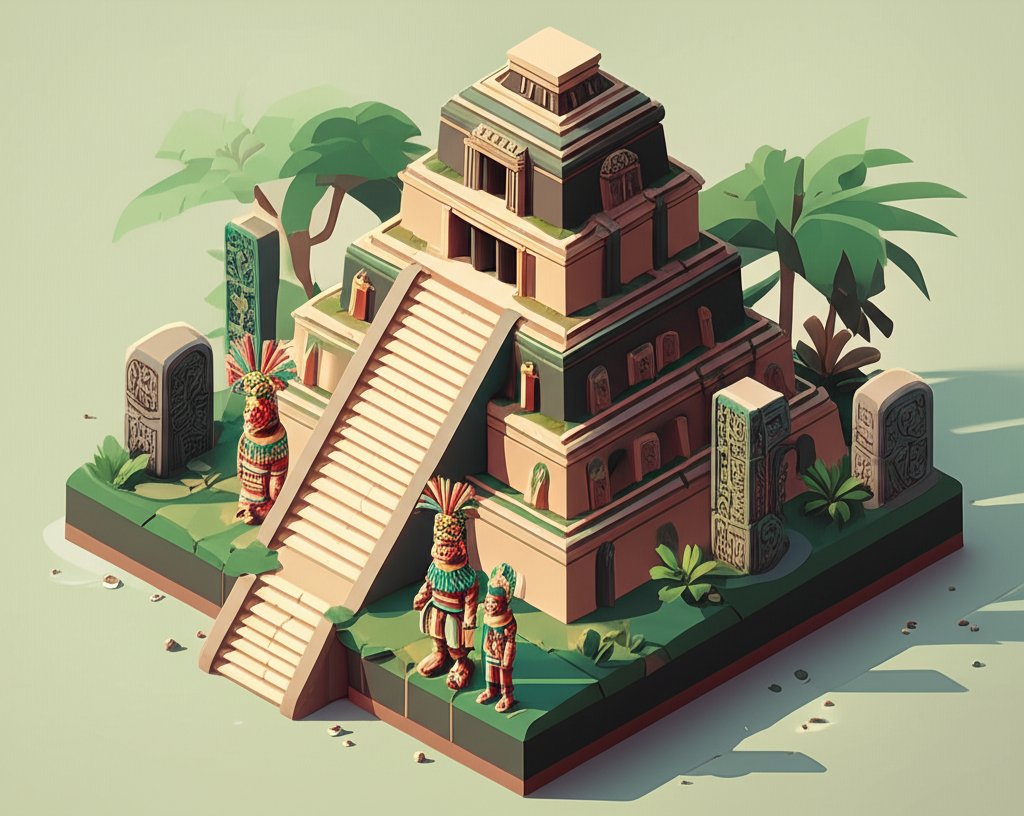
The classic image of a Mayan king is one of divine authority, adorned with brilliant jade and the iridescent feathers of the quetzal bird. But the reality for the leaders of the mayan empire was far more complex and dangerous. They weren’t just figureheads; they were warrior-priests, master architects, and shrewd political operators in a landscape of competing city-states where a single military defeat could mean a dynasty’s end. Understanding their strategies reveals a sophisticated system of power that has been literally carved into the stone ruins of their cities.
This deep dive moves beyond the basics to explore the specific tactics, personal stories, and lasting impact of these influential rulers. We’ll examine how they built their power, the unique roles women played, and what their magnificent structures truly represented.
At a Glance: The Mayan Ruler’s Blueprint for Power
- Divine Right Was Earned and Performed: Mayan leaders, or k’uhul ajaw (holy lords), were seen as divine, but they had to constantly prove it through successful warfare, elaborate rituals, and building monumental works.
- Architecture Was Propaganda: Temples and palaces weren’t just buildings; they were political statements designed to legitimize a ruler’s reign, celebrate victories, and serve as their own sacred tombs.
- Warfare Was Politics by Other Means: Capturing rival kings, securing tribute, and controlling trade routes were central to a ruler’s success. Defeat often meant ritual sacrifice and historical erasure.
- Women Wielded Immense Influence: Beyond being consorts, women ruled as queens, warrior-regents, and founders of new dynasties, shattering any simple stereotype of male-dominated leadership.
- Legacy Was Written in Stone: Rulers meticulously recorded their achievements on stelae, altars, and stairways, ensuring their version of history would survive for millennia.
The Divine Mandate: More Than a Crown
A Mayan ruler’s authority stemmed from a sacred connection to the gods. They were not merely appointed; they were believed to be divine beings who could mediate between the earthly realm and the supernatural world. This status, however, came with immense pressure and a specific set of responsibilities.
The ruler was the state’s chief priest, leading critical ceremonies like bloodletting rituals to nourish the gods. They were also expected to be formidable military commanders, leading their soldiers into battle. Their very identity was woven into the prosperity of their city-state. A drought, a lost battle, or a failed harvest could be interpreted as a sign of divine displeasure, weakening their grip on power.
This divine status was visually reinforced at every turn. Coronation ceremonies involved a high priest placing an elaborate feathered headdress on the new king as he sat upon a jaguar-pelt cushion. Their garments—intricate robes and loincloths—and jade jewelry signaled their unique standing. This constant performance of divinity was essential to maintaining control.
Building a Legacy in Stone: The Architect Kings
For many leaders of the mayan empire, the most enduring path to immortality was through architecture. Commissioning a grand pyramid, a sprawling palace, or a temple complex was the ultimate display of power and resources. These structures legitimized their reign, intimidated rivals, and created a sacred landscape centered around their lineage.
Case Snippet: Pakal the Great of Palenque
No ruler exemplifies the architect-king better than K’inich Janaab Pakal. During his extraordinary 68-year reign (615–683 AD), he transformed Palenque into a masterpiece of Mayan art and architecture. His crowning achievement was the Temple of the Inscriptions, a towering pyramid he designed to be his own tomb. When his sarcophagus was discovered in 1952, it revealed not only his famous jade death mask but also a detailed record of his ancestry, cementing his divine right to rule for all eternity.
Case Snippet: Jasaw Chan K’awiil I of Tikal
Power shifts were often celebrated with new construction. After Jasaw Chan K’awiil I led Tikal to a decisive victory over its arch-rival Calakmul in 695 AD, he initiated a building boom to mark the city’s resurgence. He commissioned the iconic Temple I (the Temple of the Great Jaguar), which would serve as his tomb, and Temple II, honoring his wife. These pyramids, facing each other across Tikal’s Great Plaza, became a permanent symbol of his victory and the restored might of his dynasty.
The Battlefield as a Political Arena

Warfare in the Mayan world was rarely about annihilating an enemy population. Instead, it was a highly ritualized and political activity focused on capturing high-status individuals, especially the rival ajaw. A captured king could be publicly humiliated and sacrificed, a devastating blow to the enemy’s morale and cosmic order.
Military success brought tangible rewards: control over valuable trade routes for goods like obsidian and jade, tribute from conquered cities, and captives for labor and sacrifice. A ruler’s military prowess was a key part of their historical record, often depicted in vivid detail on carved stone monuments called stelae.
While these individual stories of conquest are fascinating, they are part of a larger pattern of governance and rivalry among Mayan city-states. To understand the broader political landscape and the common roles these rulers played, it’s helpful to Learn about Mayan leaders and the structures they operated within.
Case Snippet: The Conquests of Yik’in Chan K’awiil
Following his father’s success, Yik’in Chan K’awiil of Tikal proved to be an even more aggressive expansionist. In 736 AD, he conquered Calakmul itself. Over the next decade, he defeated Calakmul’s key allies, El Peru and Naranjo. His military campaigns effectively shattered the rival alliance and established Tikal as the dominant superpower in the southern Maya lowlands. To commemorate his reign, he commissioned the construction of Temple IV, the tallest pyramid at Tikal, which is believed to be his final resting place.
Case Snippet: The Humiliation of a King
The risks of warfare were immense. A stela from Naranjo depicts the fate of Itzamnaaj Bahlam, the king of Ucanal. After being defeated by Naranjo’s ruler K’ak’ Tiliw Chan Chaak in 698 AD, a carving dated more than three years later shows him as a bound and humiliated captive. This served as powerful propaganda, a stark warning to other rivals of the consequences of opposing Naranjo’s might.
Shattering Stereotypes: The Power of Mayan Queens
While the historical record is dominated by male rulers, Mayan women often wielded significant political and religious power. They were not merely pawns in marriage alliances; in many cases, they were the linchpins of dynasties and even formidable leaders in their own right.
Their influence took several forms:
- Queens Regent: Ruling in place of a son who was too young to take the throne.
- Dynastic Founders: Women from powerful lineages could be sent to marry into a weaker royal family, effectively founding a new dynasty with ties to her powerful home city.
- Spiritual Leaders: Royal women, like Lady Xoc of Yaxchilan, played central roles in state religious ceremonies, performing bloodletting rituals that were vital to the kingdom’s spiritual health.
Case Snippet: Lady Six Sky, the Warrior Queen of Naranjo
One of the most powerful women known from the Mayan world is Lady Wac Chanil Ahau, or Lady Six Sky. The daughter of a king from Dos Pilas, she arrived in Naranjo in 682 AD to re-establish a dynasty that had been decimated. Far from being a mere consort, she took on the role of a warrior ruler, commissioning monuments that depicted her standing over trampled captives. She governed for years, likely as regent for her young son, K’ak’ Tiliw Chan Chaak, and her military campaigns stabilized Naranjo and established it as a major regional power.
Case Snippet: The Child Ruler of Tikal
Lineage was so critical that sometimes even a child could take the throne. The “Lady of Tikal” became the 19th ruler of the city in 511 AD at the age of just six. While she likely ruled alongside a co-regent, possibly her husband Kaloomte’ Bahlam, her ascension underscores the supreme importance of maintaining the dynastic bloodline, even if it meant placing a child in power.
The Mayan Ruler’s Playbook: A Guide to Ancient Power
Mayan leaders followed a distinct set of strategies to gain, maintain, and expand their power. By examining their actions, we can assemble a practical playbook they all seemed to understand.
| Strategy | How They Did It | Real-World Example |
|---|---|---|
| 1. Solidify Divine Right | Used specific titles like K’inich (“Great Sun”) and commissioned art depicting themselves with gods. | Kan Bahlam I of Palenque was the first known ruler to use the K’inich prefix, directly linking his identity to the power of the sun god. |
| 2. Control the Narrative | Recorded histories on stone monuments, emphasizing military victories, royal marriages, and divine ancestry. | Lachan Kʼawiil Ajaw Bot of La Amelia oversaw the construction of Hieroglyphic Stairway 1, which contained the last known reference to the great kingdom of Mutal, ensuring his city’s place in the final chapter of a regional history. |
| 3. Project Power with Architecture | Built taller temples and more expansive palaces than rivals, often integrating their own tombs into these sacred structures. | K’inich Kan B’alam II of Palenque continued his father Pakal’s legacy by building the impressive Cross Group complex, a trio of temples that reinforced his family’s divine charter. |
| 4. Forge Strategic Alliances | Used royal marriages to create political and military bonds between city-states. | Lady K’atun Ajaw of Namaan was married to the king of Piedras Negras at age 12, a clear political move to cement an alliance between the two cities. |
| 5. Leverage External Influence | When internal power failed, sometimes an outside force could reset the board. | Siyaj K’ak’, a general from or allied with the great central Mexican city of Teotihuacan, arrived at Tikal in 378 AD and installed a new, Teotihuacan-aligned dynasty, completely changing the political landscape. |
Quick Answers to Common Questions
Q: Was there a single emperor for the entire Mayan empire?
A: No. The term “Mayan empire” is a bit of a misnomer. The Maya were organized as a collection of independent city-states. At various times, powerful cities like Tikal, Calakmul, or Copan acted as regional superpowers, demanding tribute from smaller neighbors, but there was never a single, unified empire under one emperor.
Q: How did someone become a Mayan ruler?
A: The primary path was hereditary succession, typically passed down from father to son. However, the system was flexible. If the heir was a child, a regent (often their mother) could rule. In times of crisis, a successful warrior or a figure with strong external backing could seize power and start a new dynasty, as Siyaj K’ak’ did at Tikal.
Q: Were all leaders of the mayan empire men?
A: Absolutely not. While male rulers were the norm, powerful women played crucial roles. Figures like Lady Six Sky of Naranjo governed as warrior-queens, while others like the Lady of Tikal held the throne in their own right. Women were essential for diplomacy, forming alliances through marriage, and for performing key religious rituals.
Q: What happened when a ruler died?
A: The death of a ruler was a major event. They were buried in elaborate tombs, often located within the city’s most important temples. These tombs were filled with rich offerings, such as jade, pottery, and food like maize, meant to sustain them in the afterlife. This practice reinforced their divine nature and ensured their continued spiritual presence in the city.
A Legacy of Power and Ambition
The leaders of the mayan empire were not distant, ceremonial figures. They were active, ambitious, and often ruthless individuals at the center of a complex world. They masterfully blended religion, warfare, and architecture to project an image of divine authority and earthly power. From the golden age of Pakal in Palenque to the warrior-queen Lady Six Sky in Naranjo, their stories reveal the incredible sophistication of Mayan political life. Their legacy, carved in stone and glyphs, remains a powerful testament to their drive to build, to conquer, and to be remembered forever.










