
Untuk gambaran yang lebih besar dan konteks penuh, pastikan Anda membaca panduan utama kami tentang Jupiters Formation and Composition: Unlocking the Secrets of a Gas Giant.
Could Jupiter have become a star? The immense gas giant, while not quite a star, shares striking similarities in composition and formation, leading scientists to explore what separates a planet from a failed star. This exploration helps us understand not just Jupiter, but planetary systems throughout the galaxy.
At a Glance:
- Explore the key differences between Jupiter and a star, focusing on mass requirements for sustained nuclear fusion.
- Understand the primary components of Jupiter’s atmosphere and interior, highlighting the roles of hydrogen and helium.
- Learn how scientists use various methods, including gravity mapping, seismology, and data from the Juno probe, to study Jupiter’s composition.
- Examine Jupiter’s role as a protector of the inner solar system and how its position influences the distribution of asteroids and comets.
- Address common questions about Jupiter’s potential to become a star and its distinct characteristics.
What Makes Jupiter a Gas Giant, Not a Star?
The fundamental difference hinges on mass. Stars, like our Sun, achieve nuclear fusion in their cores, converting hydrogen into helium and releasing tremendous energy. This process requires an immense amount of mass to create the necessary pressure and temperature. Jupiter, while massive, lacks the critical mass to ignite sustained nuclear fusion.
- The Mass Threshold: Brown dwarfs, often called “failed stars,” represent a gray area. They are more massive than planets like Jupiter but lack sufficient mass to sustain hydrogen fusion. Jupiter would need roughly 75 to 80 times its current mass to even begin hydrogen fusion.
- Deuterium Fusion: Some brown dwarfs can fuse deuterium (heavy hydrogen) for a brief period, but this is a much lower-energy process than hydrogen fusion. Jupiter’s core pressure is insufficient even for deuterium fusion.
- Heat Dissipation: Even if Jupiter could briefly fuse deuterium, the energy released wouldn’t be enough to prevent it from cooling and dimming over time, unlike a true star.
Inside Jupiter: Unpacking the Composition of a Gas Giant
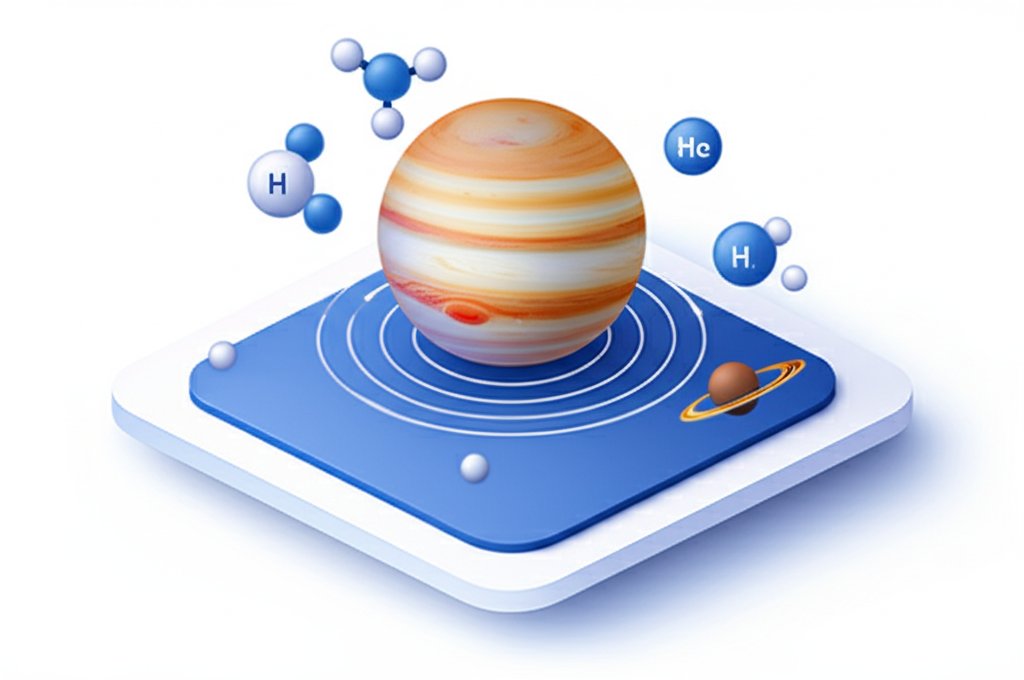
While Jupiter fails to achieve stardom, its composition provides valuable insights into the formation of gas giants. Like stars, Jupiter is predominantly composed of hydrogen and helium, but their states and distribution differ significantly.
- Hydrogen and Helium Domination: Approximately 75% of Jupiter’s mass is hydrogen, and 24% is helium. This proportion is similar to the Sun and other stars. However, in Jupiter’s interior, hydrogen transitions from a gaseous state in the upper atmosphere to a liquid metallic state deeper within due to immense pressure.
- Trace Elements: The remaining 1% includes trace amounts of methane, ammonia, water vapor, and sulfur compounds. These elements, while present in small quantities, play a crucial role in shaping Jupiter’s atmosphere, creating colorful cloud bands and contributing to weather phenomena.
- The Core Conundrum: Scientists believe Jupiter has a dense core composed of rock and metal, roughly the size of Earth. However, the exact composition and structure of this core remain a subject of ongoing research. The Juno mission is providing valuable data to help refine our understanding of Jupiter’s core.
Probing Jupiter’s Depths: How Scientists Unravel the Mysteries
Studying Jupiter’s interior is challenging because we can’t directly observe it. Scientists rely on a combination of methods to infer the planet’s composition and structure. Learn about Jupiter’s formation and how it influences its current state.
- Gravity Mapping: By precisely measuring Jupiter’s gravitational field, scientists can infer the distribution of mass within the planet. Variations in the gravitational field reveal information about the density and structure of different layers.
- Seismology: Although Jupiter lacks a solid surface, scientists can study the propagation of waves through its interior using models. These waves can be generated by atmospheric disturbances or potentially by “Jupiterquakes” within its liquid metallic hydrogen layer.
- Spectroscopy: Analyzing the light reflected and emitted by Jupiter’s atmosphere provides information about its chemical composition. Spectroscopic observations can identify the presence and abundance of various molecules, such as ammonia, methane, and water vapor.
- The Juno Mission: NASA’s Juno probe is orbiting Jupiter and providing unprecedented data about the planet’s atmosphere, magnetic field, and interior. Juno’s instruments are measuring the composition of the atmosphere, mapping the magnetic field, and probing the depths of the planet using microwave radiometry.
Example: Juno’s Microwave Radiometer (MWR) is allowing scientists to “see” beneath Jupiter’s cloud tops and study the planet’s deep atmosphere. This data is helping to understand the dynamics of the atmosphere and the distribution of water.
Jupiter’s Guardian Role: A Cosmic Protector?
Jupiter’s immense gravity plays a significant role in shaping the solar system. It acts as a kind of cosmic vacuum cleaner, deflecting asteroids and comets that might otherwise threaten the inner planets, including Earth.
- Deflecting Asteroids and Comets: Jupiter’s gravity can alter the orbits of asteroids and comets, either ejecting them from the solar system or steering them into different paths. This gravitational influence reduces the number of potentially hazardous objects that could collide with Earth.
- The Trojan Asteroids: Jupiter’s gravity also traps asteroids in stable orbits known as the Trojan points, located 60 degrees ahead and behind the planet in its orbit. These asteroids provide valuable clues about the early solar system.
- Orbital Resonance with Asteroid Belt: Jupiter’s gravitational influence has sculpted the asteroid belt, creating gaps and concentrations of asteroids due to orbital resonances.
Example: The Kirkwood gaps in the asteroid belt are caused by Jupiter’s gravitational perturbations disrupting the orbits of asteroids with periods that are simple fractions of Jupiter’s orbital period.
Practical Playbook: Understanding Jupiter’s Composition
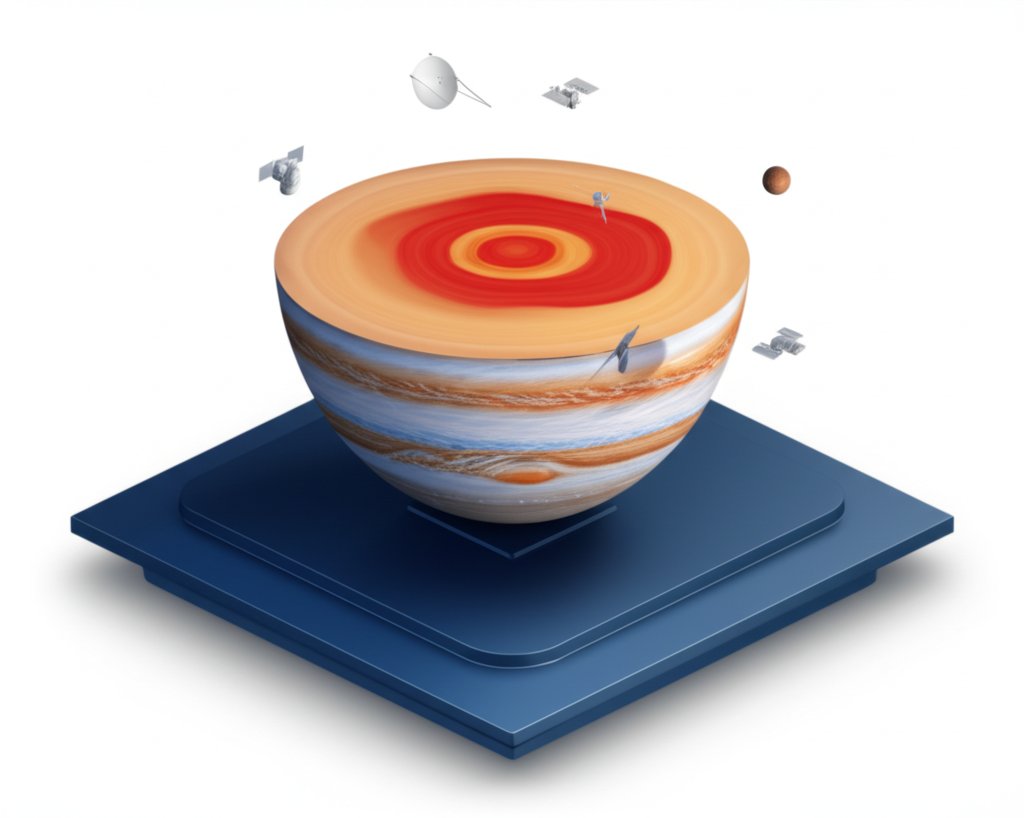
How can we apply our understanding of Jupiter’s composition? Here’s a quick guide:
- Evaluate atmospheric data: Analyze spectroscopic data to identify the presence and abundance of different molecules in Jupiter’s atmosphere.
- Model planetary interiors: Use gravity mapping data to create models of Jupiter’s interior, estimating the density and composition of different layers.
- Consider the influence of magnetic fields: Analyze Jupiter’s magnetic field data and correlate it with interior models to improve our understanding of the planet’s dynamics.
- Review ongoing mission data: Stay updated with the latest findings from the Juno mission to refine our knowledge of Jupiter’s composition and structure.
Quick Answers: Common Questions about Jupiter
- Could Jupiter ever become a star? No, Jupiter lacks the necessary mass to initiate and sustain nuclear fusion. It would need approximately 75 to 80 times its current mass.
- What is Jupiter made of? Primarily hydrogen (75%) and helium (24%), with trace amounts of methane, ammonia, water vapor, and sulfur compounds. It likely has a core of rock and metal.
- Why does Jupiter have such a strong magnetic field? Jupiter’s strong magnetic field is generated by electric currents within its liquid metallic hydrogen layer.
- How do we know what’s inside Jupiter? Scientists use gravity mapping, seismology (modeling wave propagation), spectroscopy, and data from the Juno probe to study Jupiter’s interior indirectly.
- Is Jupiter a failed star? No, Jupiter is a gas giant that lacks the mass to become a star. It’s fundamentally different from brown dwarfs, which are considered “failed stars.”
Actionable Close
While Jupiter may not be a star, studying its composition and formation offers invaluable insights into the nature of gas giants and planetary systems. By utilizing various methods like gravity mapping, spectroscopy, and data from missions like Juno, we continue to unravel the secrets of this fascinating planet and its role in the cosmos. Keep exploring, keep questioning, and keep pushing the boundaries of our knowledge about the universe.










