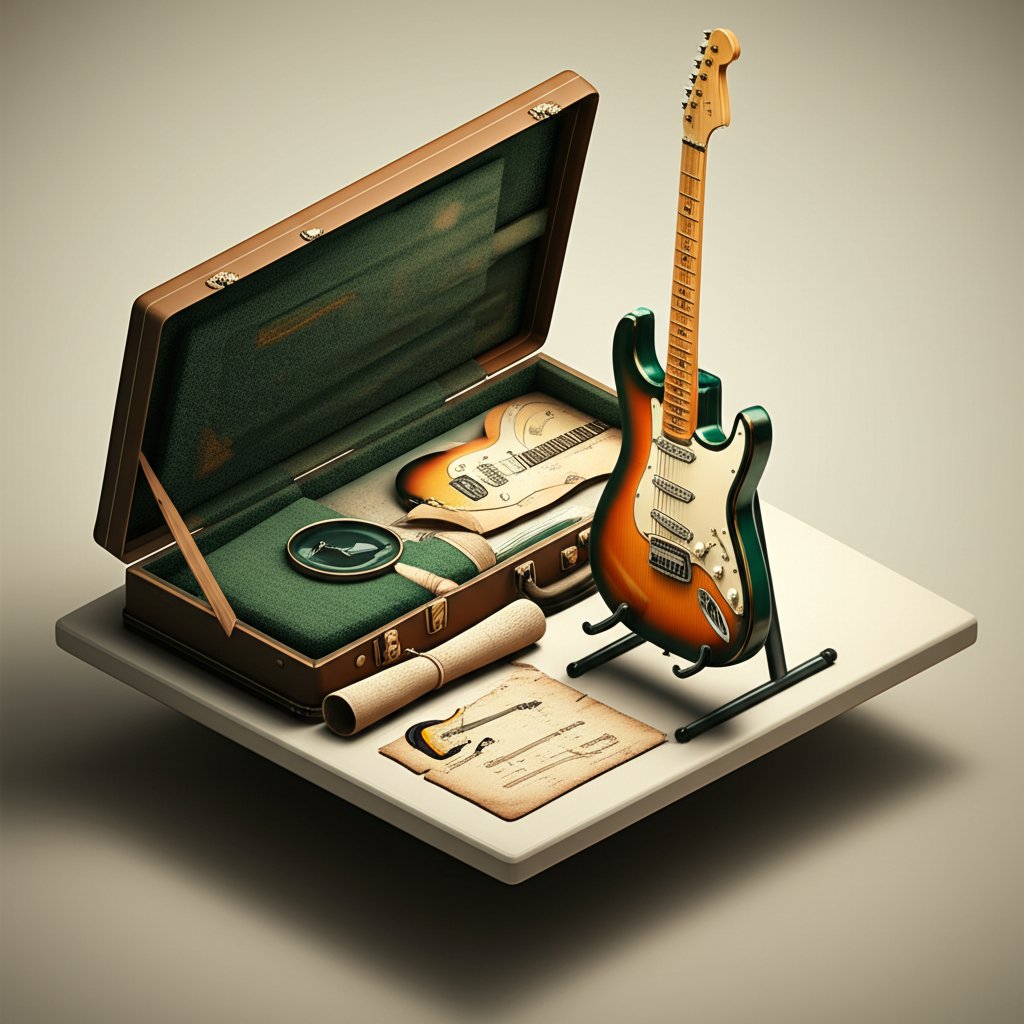
Step into the captivating universe of the electric guitar, an instrument that has not merely played music but shaped it, etched its sound into history, and inspired countless generations. From its innovative inception to its current status as a cultural icon, the electric guitar holds a trove of intriguing guitar facts and untold secrets waiting to be discovered. Whether you’re a seasoned guitarist, a music aficionado, or simply curious, prepare to embark on an exhilarating journey through the guitar history of this electrifying instrument. We’ll delve into its groundbreaking origins, explore its intricate anatomy, uncover astonishing trivia, and celebrate its monumental impact on the world of sound. Get ready to gain a profound appreciation for the instrument that redefined musical expression forever.
The Electrifying Genesis: A Deep Dive into Electric Guitar History
The story of the electric guitar is one of ingenuity born from necessity. As orchestras grew louder and big band jazz gained popularity in the early 20th century, acoustic guitars struggled to cut through the mix. Guitarists needed volume, and engineers were ready to deliver. This quest for amplification marks the true beginning of electric guitars.
From Humble Beginnings: The Quest for Volume
Acoustic guitars, particularly archtops favored by jazz musicians, faced a fundamental limitation: their sound was produced by vibrating strings amplified by a hollow wooden body. This natural amplification simply couldn’t compete with horns, drums, and pianos. The solution? Electronic amplification. The core idea was simple: convert the string vibration directly into an electrical signal that could then be sent to an amplifier and speaker.
Early Innovators and the “Frying Pan” Era
The very first efforts to electrically amplify a guitar date back to the late 1920s and early 1930s.
- Stromberg-Voisinet (1931): While not the most famous, Stromberg-Voisinet produced one of the earliest known amplified guitars. This model utilized a pair of horseshoe magnets and a coil of wire to convert string vibration into an electrical signal.
- The “Frying Pan” (1931): The most legendary early example is the “Frying Pan” (officially the Electro A-22 “Frying Pan”), designed by George Beauchamp and manufactured by Rickenbacker (then Electro String Instrument Corporation). This lap steel guitar was almost entirely made of aluminum and featured a pioneering horseshoe pickup that completely surrounded the strings. Its solid body was crucial; it minimized feedback, a common issue with amplified hollow-body instruments. The patent for this device was granted in 1937, cementing its place in guitar history.
- Dobro and Vivi-Tone: Other early players like Dobro (with their “All-Metal” electric guitar) and Vivi-Tone (Lloyd Loar, former Gibson engineer) also contributed to the nascent field, experimenting with various pickup designs and body constructions. These early models, often crude by modern standards, laid the groundwork for everything that followed.
The Post-War Revolution: Solidbodies Emerge
The 1940s and 50s saw the rapid evolution of electric guitars, moving beyond the lap steel and into the familiar Spanish-style guitar.
- Fender’s Breakthrough: Leo Fender, an electronics repairman, revolutionized the industry with his practical, mass-producible solidbody designs. His first commercially successful solidbody electric guitar was the Broadcaster (later renamed Telecaster) in 1950. Its simple, bolt-on neck, durable construction, and twangy tone made it an instant hit with country and blues musicians. The Stratocaster, launched in 1954, with its sleek contours, three single-coil pickups, and innovative tremolo system, became another iconic design, fundamentally defining the look and sound of rock and roll.
- Gibson’s Response: Gibson, a long-established acoustic guitar manufacturer, initially hesitated but soon entered the solidbody market. Their collaboration with jazz legend Les Paul resulted in the iconic Gibson Les Paul in 1952. This heavier, richer-sounding instrument, typically featuring humbucking pickups, contrasted with Fender’s brighter tones and found favor with blues and rock guitarists.
Evolution and Innovation: Beyond the Classics
The foundational designs of Fender and Gibson spurred an explosion of innovation. Manufacturers began experimenting with different woods, pickup configurations, tremolo systems, and body shapes. The 1960s saw the rise of more avant-garde designs (e.g., Gibson Flying V, Explorer), while the 70s and 80s prioritized playability and heavier tones, leading to superstrats and guitars optimized for shredding. This continuous drive for improvement and distinct tonal palettes continues to shape guitar history.
Decoding the Electric Guitar: Anatomy and Intriguing Mechanics
Understanding what makes an electric guitar truly “electric” involves exploring its unique components and how they interact to produce its signature sounds. These intriguing guitar facts reveal the engineering marvels behind the music.
Pickups: The Magnetic Magic Behind the Sound
Unlike acoustic guitars that rely on body resonance, electric guitars depend on pickups to translate string vibrations into electrical signals. This is perhaps the most fundamental and intriguing guitar fact about them.
- How They Work: Pickups consist of magnets wrapped with thousands of coils of fine copper wire. When a steel guitar string vibrates within the magnetic field, it creates a small electrical current in the coil. This current is then sent to an amplifier, where it’s boosted to produce audible sound.
- Single-Coil Pickups: Known for their bright, clear, and articulate sound, single-coils (like those found on Fender Strats and Teles) are often associated with blues, country, and surf rock. A notable “secret” is their susceptibility to 60-cycle hum, a buzzing noise from electrical interference, which early players learned to live with or cleverly minimize.
- Humbucking Pickups: Developed by Seth Lover at Gibson in the mid-1950s, humbuckers consist of two single-coil pickups wired out of phase. This ingenious design cancels out the notorious 60-cycle hum (hence “humbucker”), while also producing a thicker, warmer, and higher-output sound. They are staples in rock, jazz, and metal.
- P90 Pickups: A unique single-coil design from Gibson, P90s offer a fatter, grittier tone than traditional Fender single-coils, with more output, while still retaining some of the single-coil’s clarity. They are often considered a “middle ground” and are a favorite for blues and punk tones.
Tonewoods, Body Types, and Resonance
While less impactful than on an acoustic guitar, the wood used in an electric guitar still influences its tone and sustain, an intriguing guitar fact often debated among purists.
- Solid-Body Guitars: The most common type. Their dense, solid wood construction minimizes unwanted feedback, allowing for high-gain amplification. Woods like alder, ash, mahogany, and maple each contribute distinct tonal characteristics (e.g., alder for balanced tone, mahogany for warmth and sustain).
- Hollow-Body Guitars: These have fully hollow bodies, similar to archtop acoustic guitars, but are equipped with pickups. They offer a warm, airy, and resonant tone, often favored in jazz and blues. However, they are highly prone to feedback at high volumes.
- Semi-Hollow Body Guitars: A popular compromise, these guitars feature a central wood block running through a hollow body. This design provides some of the warmth and resonance of a hollow-body while significantly reducing feedback, making them versatile for blues, rock, and jazz (B.B. King’s “Lucille” is a famous example).
- Neck Construction:
- Bolt-on: Neck is bolted to the body (e.g., Fender). Offers snap and brightness.
- Set-neck: Neck is glued into a pocket in the body (e.g., Gibson). Promotes sustain and warmth.
- Neck-through: The neck runs the entire length of the body, with “wings” glued on. Maximizes sustain and resonance.
Electronics and Controls: Shaping Your Tone
The circuitry within an electric guitar gives players immense control over their sound, long before it even reaches an amplifier or effects pedal.
- Volume and Tone Pots: Potentiometers (pots) control volume and tone. Tone pots typically filter out high frequencies, allowing players to dial in warmer or darker sounds.
- Pickup Selectors: Toggle switches or blade switches allow players to select individual pickups or combinations, offering a wide array of tonal options.
- Coil-Splitting/Tapping: Some humbuckers can be “split” to operate as single coils, adding versatility. This is an advanced guitar fact for those looking for more tonal options.
Bridges, Tremolos, and Tuning Stability
The bridge system critically affects sustain, intonation, and playability.
- Fixed Bridges: Simple and stable, like the Tune-o-matic on Les Pauls or hardtail Stratocaster bridges. Excellent for tuning stability and direct string vibration transfer.
- Tremolo Systems: Allow for pitch bending (vibrato) effects.
- Synchronized Tremolo (e.g., Fender Stratocaster): Allows strings to be loosened or tightened for subtle pitch changes.
- Bigsby Vibrato: A distinctive trapeze-style vibrato, known for its smooth, subtle pitch bends.
- Floyd Rose: A locking tremolo system that provides extreme pitch manipulation without going out of tune, popular in metal and shred genres. This is a crucial intriguing guitar fact for modern guitar players.
Beyond the Fretboard: Amazing Electric Guitar Facts & Untold Secrets
The world of electric guitars is rich with quirky stories, design marvels, and surprising innovations. Here are some truly intriguing guitar facts that showcase the instrument’s enduring allure.
Exploring the electric guitar’s impact also shines a light on the personalities behind the music, and you might find some surprising facts about musicians who helped popularize the instrument.
The Firsts: What Came Before?
While Rickenbacker is credited with the first commercially viable electric, the idea of electrifying a stringed instrument was in the air:
- Viola-Phonique (1923): Lloyd Loar, while at Gibson, experimented with an electro-acoustic viola that used a pickup to amplify its sound. This showed early understanding of the principles.
- Early Pickup Patents (1909 onwards): Patents for pickups designed for musical instruments appeared even earlier, though they weren’t specifically for guitars as we know them today. The desire for amplified sound pre-dates the guitar’s electric revolution.
Strange and Wonderful Electric Guitar Designs
Innovation wasn’t always about sound; sometimes it was about pushing boundaries of form.
- Multi-Neck Guitars: Iconicized by Jimmy Page’s Gibson EDS-1275 double-neck, these guitars combine two (or more!) different guitars (e.g., 6-string and 12-string) into one instrument, allowing for instant switching between sounds during a performance.
- Headless Guitars: Developed by Ned Steinberger in the late 1970s, these guitars eliminate the traditional headstock, making them more compact, lighter, and often more stable in tuning.
- Extended Range Guitars: Beyond the standard six strings, electric guitars come in 7-string, 8-string (or even more) configurations, popular in genres like progressive metal for their expanded sonic range and lower tunings.
- The World’s Smallest Electric Guitar: In 2017, Cornell University researchers created the world’s smallest electric guitar, measuring just 10 micrometers (about the size of a human blood cell), as a demonstration of nanotechnology. It even had strings that could be plucked with atomic force microscope tips! This is a truly amazing electric guitar fact!
The Power of Pedals: Sonic Transformations
One of the most profound “secrets” to the versatility of electric guitars lies in their interaction with external effects. The guitar itself produces a clean, raw signal, but pedals allow for an almost infinite array of sonic textures.
- Overdrive and Distortion: These pedals are the bedrock of rock
nroll, blues, and metal, adding natural or aggressive gain to the signal, creating crunchy riffs and screaming solos. - Delay and Reverb: Essential for adding depth and space, mimicking echoes in a large hall or creating expansive soundscapes.
- Wah-Wah Pedal: Invented in the 1960s, this pedal acts like a filter, allowing players to manually sweep through frequencies, creating the distinctive “wah” vocal-like sound.
- Fuzz Pedals: Deliberately distort the signal in a unique, often vintage-sounding way, contributing to the aggressive tones of early psychedelic and hard rock.
Celebrity Guitars and Their Stories
Many electric guitars have become legendary themselves, intrinsically linked to the artists who wielded them. These become guitar facts woven into cultural fabric.
- B.B. King’s “Lucille”: The blues icon named all his cherished Gibson ES-335, ES-345, and ES-355 guitars “Lucille” after nearly losing his life in a fire caused by two men fighting over a woman named Lucille. His signature model is a semi-hollow without f-holes, designed to minimize feedback.
- Eddie Van Halen’s “Frankenstrat”: A prime example of DIY innovation, Van Halen famously pieced together parts from different guitars (a Stratocaster body, a Gibson humbucker, a Charvel neck) and painted it himself, creating a unique instrument that delivered his groundbreaking sound. It’s a testament to the customizability of electric guitars.
- Jimi Hendrix’s Monterey Pop Stratocaster: Famously set ablaze and smashed at the 1967 Monterey Pop Festival, this Fender Stratocaster became an enduring symbol of rock ‘n’ roll rebellion and the raw power of Hendrix’s performances.
- Eric Clapton’s “Blackie”: Another iconic Stratocaster, assembled by Clapton himself from three different guitars, “Blackie” was his primary stage and studio guitar for years and sold for nearly a million dollars at auction.
The Electric Guitar’s Unrivaled Impact on Music & Culture
Few instruments have had as profound and widespread an impact on music history as the electric guitar. Its amplified voice didn’t just add volume; it created entirely new sonic possibilities, spawning genres and shaping the very fabric of popular culture.
Sound of a Generation: Shaping Genres
The electric guitar wasn’t merely adopted by existing genres; it catalyzed the birth of entirely new ones.
- Blues and Jazz: African-American blues musicians like T-Bone Walker and Muddy Waters were among the first to truly harness the electric sound, giving their music a raw, powerful edge that could fill juke joints and dance halls. Jazz guitarists like Charlie Christian used early electric models to step out of the rhythm section and become prominent soloists.
- Rock ‘n’ Roll: The electric guitar is the undisputed cornerstone of rock ‘n’ roll. From Chuck Berry’s iconic riffs to Elvis Presley’s stage presence with his guitar, the instrument became inseparable from the genre’s rebellious spirit.
- Rock and Beyond: The sound of the electric guitar exploded in rock music, leading to the diverse subgenres we know today. Psychedelic rock distorted and manipulated its sound; heavy metal pushed its overdrive to extreme limits; punk rock stripped it down to raw aggression; and alternative rock explored its textural possibilities. Its versatility is an incredible guitar fact.
- Pop, R&B, Funk, and Reggae: While often associated with rock, the electric guitar is a vital component in countless other genres, providing rhythmic grooves, melodic hooks, and textural layers that define their sounds.
Cultural Icon and Symbol of Rebellion
Beyond its musical applications, the electric guitar quickly transcended its role as an instrument to become a powerful cultural symbol.
- Youth Rebellion: In the mid-20th century, wielding an electric guitar became synonymous with youth rebellion, freedom, and counter-culture movements. It offered a voice to a generation seeking change and challenging norms.
- Stage Presence: The visual aspect of the electric guitar – its sleek designs, impressive size, and the way it’s held and played – made it a focal point of live performances, contributing to the mystique of rock stars.
- Fashion and Art: Guitar designs themselves became works of art, influencing fashion, graphic design, and popular imagery. Its silhouette is instantly recognizable worldwide.
The Enduring Legacy and Future Innovations
Even in the digital age, the electric guitar remains a vibrant and evolving instrument. While digital modeling and virtual instruments have provided new avenues for sound creation, the tactile experience and unique sonic character of physical electric guitars continue to inspire. Innovations persist, from integrated digital effects and MIDI capabilities to sustainable manufacturing and ergonomic designs. The electric guitar isn’t just a relic of the past; it’s a dynamic instrument with a future as bright and loud as its history.
Conclusion
The journey through the history of electric guitars reveals far more than just technological advancements; it uncovers a story of passion, innovation, and profound cultural impact. From the initial quest for volume that birthed the “Frying Pan” to the iconic solidbodies that defined rock ‘n’ roll, these instruments have continuously pushed the boundaries of sound. We’ve explored the intriguing guitar facts behind their magnetic pickups, the secrets of their tonewoods, and the amazing stories of the artists and their legendary axes.
The electric guitar stands as a testament to human creativity – an instrument that not only makes music but also shapes identities, sparks revolutions, and inspires dreams. Its legacy is etched into every power chord, every soaring solo, and every melody that has captivated hearts across generations. So, the next time you hear the electrifying roar of a guitar, remember the rich guitar history and the untold secrets held within its strings.
FAQ
Q1: When was the first electrically amplified guitar discovered?
A: The first electrically amplified guitar, often referred to as the “Frying Pan” (Rickenbacker Electro A-22), was designed in 1931 by George Beauchamp.
Q2: What was the primary motivation behind the invention of the electric guitar?
A: The primary motivation was the need for guitarists to be heard over louder ensembles like big bands and orchestras, as acoustic guitars lacked sufficient volume.
Q3: What are the main types of electric guitar body constructions?
A: The main types are solid-body, hollow-body, and semi-hollow body, each offering distinct tonal characteristics and levels of feedback resistance.
Q4: How do electric guitar pickups work?
A: Pickups use magnets wrapped with wire coils. When steel guitar strings vibrate within the magnetic field, they induce a small electrical current in the coil, which is then sent to an amplifier.
Q5: What is the difference between single-coil and humbucking pickups?
A: Single-coil pickups produce a brighter, clearer sound but are prone to hum. Humbucking pickups use two coils wired out of phase to cancel hum, resulting in a fatter, warmer sound with higher output.
Q6: What significant impact did the electric guitar have on music history?
A: The electric guitar revolutionized music by enabling the birth and rapid evolution of genres like rock ‘n’ roll, blues, jazz, and heavy metal, and profoundly influenced popular music across the globe.
Q7: Can the type of wood used in an electric guitar affect its sound?
A: Yes, while the pickups and electronics are dominant, the “tonewoods” used for the body and neck can still subtly influence the instrument’s sustain, resonance, and overall tonal character.
Q8: What are some famous examples of early electric guitars that shaped the industry?
A: Key examples include the Rickenbacker “Frying Pan” (lap steel), the Fender Broadcaster/Telecaster, and the Gibson Les Paul.
Q9: Are there electric guitars with more or fewer than six strings?
A: Yes, while six strings are standard, electric guitars are available in extended range versions with 7, 8, or even 9 strings, as well as 4-string bass guitars, and 12-string electric guitars (like a 12-string acoustic).
Q10: How do effect pedals enhance the sound of electric guitars?
A: Effect pedals modify the electrical signal from the guitar, allowing players to create a vast array of sounds like distortion, overdrive, delay, reverb, wah, chorus, and more, adding depth and texture to the music.










