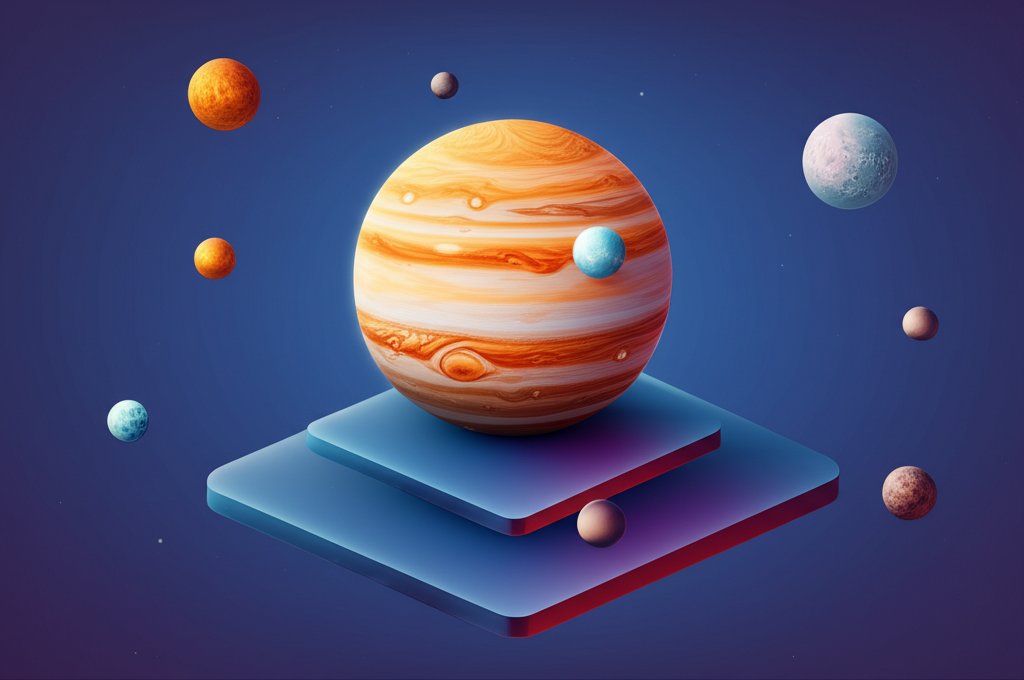
Keeping an accurate count of Jupiter’s moons isn’t as simple as looking it up once. New discoveries are always being made! As of late 2024, the official tally sits at over 95, but that number could change soon. Understanding why the count fluctuates and what these moons are like is a fascinating journey into our solar system.
At a glance:
- Discover the officially recognized number of Jupiter’s moons and why it changes.
- Learn about the different categories of Jovian moons, from the Galilean giants to the captured irregulars.
- Understand how the International Astronomical Union (IAU) determines if a celestial body qualifies as a moon.
- Explore the ongoing missions and discoveries that continue to reshape our understanding of Jupiter’s lunar system.
- Appreciate the potential for future moon discoveries around Jupiter.
The Ever-Changing Count: Why the Number of Jupiter’s Moons Isn’t Fixed
The question “How many moons does Jupiter have?” has a surprisingly dynamic answer. While the current official count stands at over 95, this number isn’t set in stone. It reflects our current observational capabilities and the rigorous process by which the International Astronomical Union (IAU) officially recognizes a celestial body as a moon. As technology improves and astronomers conduct more detailed surveys, it’s entirely possible that we’ll discover even more Jovian satellites.
What it boils down to is this: a moon needs to be confirmed to be a moon. A fuzzy image isn’t enough. Astronomers need to track the object, determine its orbit, and present compelling evidence that it’s gravitationally bound to Jupiter. This process can take years.
The Big Four and the Rest: Classifying Jupiter’s Moons

Jupiter’s moons aren’t a homogenous bunch. They can be broadly categorized into distinct groups based on their size, orbital characteristics, and origin stories. This classification helps us understand the diverse processes that have shaped Jupiter’s “hidden solar system”. To delve into the intricacies of Jupiter’s moons and ring system, Explore Jupiter’s hidden solar system.
Here’s a breakdown:
- The Galilean Moons: Io, Europa, Ganymede, and Callisto. These are the largest and most well-known, discovered by Galileo Galilei in 1610. Each is a unique world in its own right, with vastly different geological features and potential for harboring life (especially Europa).
- Io: The most volcanically active body in the solar system. Imagine a pizza constantly being baked…on a planetary scale!
- Europa: An icy moon with a subsurface ocean, a prime target in the search for extraterrestrial life. Many believe it to be the most promising place in the solar system (besides Earth) to find life.
- Ganymede: The largest moon in the solar system, even bigger than the planet Mercury, and the only moon known to have its own magnetic field.
- Callisto: Heavily cratered and ancient, a relatively inactive world compared to its siblings.
- The Inner Moons: Amalthea, Thebe, Adrastea, and Metis. These small moons orbit very close to Jupiter and are thought to be sources of material for Jupiter’s ring system. Think of them as the “shepherd moons”, gravitationally corralling dust and debris.
- The Irregular Satellites: This is the catch-all category for the vast majority of Jupiter’s moons. These are small, distant moons with eccentric and inclined orbits. They are believed to be captured asteroids or Kuiper Belt objects. Imagine Jupiter as a cosmic vacuum cleaner, hoovering up stray asteroids over billions of years.
How Does a Space Rock Officially Become a Moon?
The International Astronomical Union (IAU) serves as the gatekeeper for officially recognizing celestial bodies, including moons. The process isn’t arbitrary; it involves a rigorous evaluation based on several criteria:
- Sufficient Observation: An object must be observed over a long enough period to definitively establish its orbit around a planet. This typically involves multiple observations over months or even years.
- Orbital Determination: The object’s orbital parameters (e.g., semi-major axis, eccentricity, inclination) must be accurately determined. This requires precise measurements of its position over time.
- Gravitational Binding: It must be proven that the object is gravitationally bound to the planet. This means that it orbits the planet and isn’t just passing by.
- No Prior Designation: The object cannot have been previously designated as a minor planet (asteroid) or other type of celestial body.
Example: In 2003, a team of astronomers discovered several potential new moons of Jupiter. However, it took years of follow-up observations to confirm their orbits and officially announce their discovery, eventually recognized by the IAU.
Future Discoveries: The Hunt Continues
The exploration of Jupiter and its moons is far from over. Current and future missions promise to uncover even more secrets of this fascinating system.
- NASA’s Europa Clipper mission, launching in the near future, will conduct detailed flybys of Europa to assess its habitability and search for signs of life. This mission could potentially discover new, smaller moons orbiting Europa.
- ESA’s JUICE (Jupiter Icy Moons Explorer) mission is currently en route to Jupiter and will explore Ganymede, Callisto, and Europa. JUICE will be the first spacecraft to orbit a moon other than our own (Ganymede).
These missions will not only provide invaluable data about the existing moons but also increase the chances of discovering new ones. The enhanced resolution and sensitivity of their instruments will allow them to detect smaller and fainter objects that have previously eluded detection.
Why Does Knowing Moon Count Matter? A Quick Scenario
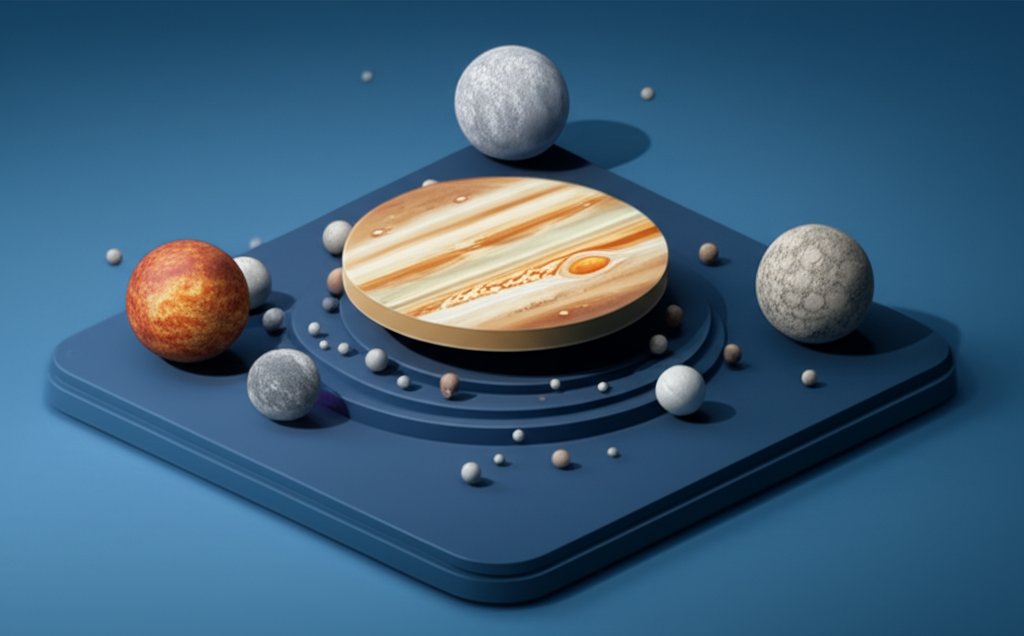
Imagine you’re a space mission planner. Knowing the precise number and orbital characteristics of Jupiter’s moons is critical for:
- Navigation: Avoiding collisions and planning safe trajectories for spacecraft.
- Gravity Assists: Using the gravitational pull of moons to alter a spacecraft’s trajectory and save fuel.
- Understanding the System’s Evolution: The number and distribution of moons provide clues about the formation and evolution of the Jovian system.
Without an accurate count, missions become riskier and less efficient.
Moon Count FAQs
Q: How often is the official moon count updated?
A: There’s no set schedule. The IAU announces new moon discoveries when sufficient evidence has been gathered and verified. These discoveries are often published on the IAU’s Minor Planet Center website.
Q: Are all of Jupiter’s moons named?
A: No. Once a moon is confirmed, it’s given a provisional designation (e.g., S/2003 J 16). If its orbit is well-determined, it may then be given a permanent name (typically derived from Greek or Roman mythology). Many of the smaller, irregular moons remain unnamed.
Q: What’s the smallest size an object must be to be considered a moon?
A: There is no strict size limit. The key criterion is that it’s gravitationally bound to the planet. However, the smallest known Jovian moon is only about 1-2 kilometers (0.62-1.2 miles) in diameter.
Q: Could Jupiter capture more moons in the future?
A: Absolutely. Jupiter’s immense gravity makes it a prime candidate for capturing passing asteroids or comets. It’s likely that the number of Jovian moons will continue to increase as our observational capabilities improve and more objects are discovered.
Your Jovian Moon Action Plan
Want to stay on top of the latest moon discoveries? Here’s your playbook:
- Bookmark the IAU’s Minor Planet Center website: This is the official source for new moon announcements.
- Follow space missions: Stay up-to-date on the Europa Clipper and JUICE missions.
- Dive into academic papers: Check out scientific journals for the latest research on Jupiter’s moons.
- Read reputable space news: Sites like Space.com and NASA’s website provide reliable updates on astronomical discoveries.
Knowing how many moons Jupiter has is just the starting point. It’s about appreciating the dynamic nature of space exploration and the ever-evolving understanding of our solar system.










