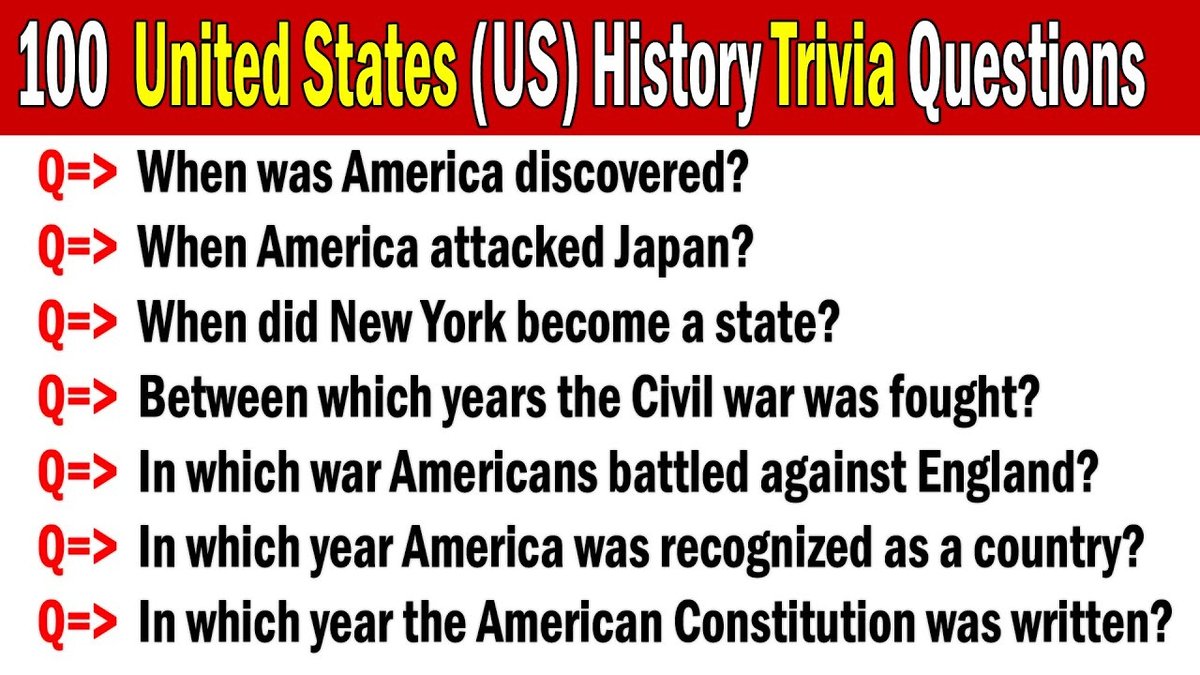
The best history trivia questions are the ones that make you say, “I should have known that!” They dig into the fascinating, forgotten, and often strange details that bring the past to life. Did you know one U.S. President kept a pet alligator in a White House bathtub? Or that the deadliest single day in American history wasn’t 9/11 or Pearl Harbor, but a Civil War battle fought on home soil? It’s these kinds of specifics that turn a dry subject into a compelling challenge.
This collection of history trivia questions is designed to go beyond the basics. We’ve organized them by theme, providing not just the answers, but the context that makes them stick.
At a Glance: What You’ll Discover
- Presidential Oddities: Uncover the unique firsts, lasts, and bizarre habits of the nation’s commanders-in-chief.
- Founding Facts vs. Fiction: Test your knowledge on the foundational documents, pivotal battles, and key figures who shaped the United States.
- Defining Moments: Dive into the details of the Civil War, World War II, the Civil Rights Movement, and other transformative eras.
- American Symbols and Expansion: Learn the stories behind the flag, national animals, and the relentless push westward.
The President’s Desk: Trivia Beyond the Oval Office
The 46 individuals who have served as U.S. President are a source of endless fascination and some of the best history trivia questions. Their careers, personalities, and even their pets have left an indelible mark on the White House. Ready to see how you stack up? For a broader challenge, you can always Test your US history knowledge with our comprehensive guide.
Presidential Firsts, Lasts, and Onlys
Question: Who is the only person to have served as both U.S. President and Chief Justice of the Supreme Court?
Answer: William Howard Taft. After his single term as president (1909-1913), Taft was appointed Chief Justice by President Warren G. Harding in 1921, a role he held until 1930 and often described as his true passion.
Question: Which president served the longest in U.S. history?
Answer: Franklin Delano Roosevelt (FDR). He was elected to an unprecedented four terms, serving from 1933 until his death in 1945. The 22nd Amendment, ratified in 1951, later limited presidents to two terms.
Question: Conversely, which president had the shortest term in office?
Answer: William Henry Harrison. He served for only 31 days in 1841. He famously delivered a 105-minute inaugural address in the freezing cold without a coat and died of pneumonia a month later.
Question: Only one president has ever resigned from office. Who was it?
Answer: Richard Nixon. He resigned on August 9, 1974, due to his involvement in the Watergate scandal.
Question: Who was the only president to serve two non-consecutive terms?
Answer: Grover Cleveland. He was the 22nd president (1885-1889) and the 24th president (1893-1897), making him a unique answer to presidential numbering questions.
Question: Who was the first president to be impeached by the House of Representatives?
Answer: Andrew Johnson in 1868. He was impeached over his clashes with the Republican-controlled Congress regarding Reconstruction policies but was acquitted by the Senate by a single vote.
Quirks and Nicknames of the Commanders-in-Chief
Question: Which early president was famous for keeping a pet alligator in a White House bathroom?
Answer: John Quincy Adams. The gator was a gift from the Marquis de Lafayette, and Adams reportedly enjoyed using it to frighten unsuspecting guests.
Question: Known as “Silent Cal,” which president was born on the Fourth of July?
Answer: Calvin Coolidge. His quiet and reserved demeanor was legendary, but his birthday made him a fitting symbol of American patriotism.
Question: Which president, a gifted polyglot, was also ambidextrous and could write in Greek with one hand while simultaneously writing in Latin with the other?
Answer: James A. Garfield. His remarkable intellectual abilities were a hallmark of his career, though his presidency was cut short by assassination after just 200 days.
Question: Only two U.S. presidents have been divorced. Donald Trump is one; who is the other?
Answer: Ronald Reagan. He divorced actress Jane Wyman in 1949 before marrying Nancy Davis in 1952, long before he entered presidential politics.
Forging a Nation: From Colonies to Constitution
The birth of the United States was a messy, complicated, and revolutionary affair. The details surrounding its founding documents, key battles, and early leadership are ripe for trivia.
Colonial Roots and Revolutionary Sparks
Question: While Jamestown (1607) was the first successful English settlement, what was the first permanent European settlement in the future United States?
Answer: St. Augustine, Florida. It was founded by the Spanish in 1565, more than 40 years before the English arrived in Virginia.
Question: The Battles of Lexington and Concord kicked off the Revolutionary War, but the Battle of Bunker Hill was its first major fight. On what hill did most of the fighting actually take place?
Answer: Breed’s Hill. The colonists originally intended to fortify Bunker Hill but chose the smaller, more strategically located Breed’s Hill instead. The name, however, stuck.
Question: Which battle is widely considered the turning point of the Revolutionary War, as it convinced France to officially join the fight on the American side?
Answer: The Battle of Saratoga in 1777. The decisive American victory proved to the French that the Continental Army was a credible force capable of defeating the British.
The Words That Built America
Question: In which city were both the Declaration of Independence and the U.S. Constitution signed?
Answer: Philadelphia, Pennsylvania. Both foundational documents were debated and signed in Independence Hall (then known as the Pennsylvania State House).
Question: Who is known as the “Father of the Constitution” for his pivotal role in drafting the document and the Bill of Rights?
Answer: James Madison. His detailed notes from the Constitutional Convention provide the most complete record of the proceedings.
Question: What was the collective pseudonym used by Alexander Hamilton, James Madison, and John Jay to write the 85 essays known as The Federalist Papers?
Answer: “Publius.” These essays were instrumental in arguing for the ratification of the U.S. Constitution.
Question: The Declaration of Independence was stored in a highly secure location during World War II. Where was it kept?
Answer: Fort Knox, Kentucky. From 1941 to 1944, it was stored alongside the U.S. Constitution in the bullion depository for safekeeping.
Trials and Triumphs: America’s Defining Conflicts
From a war that pitted brother against brother to a movement that reshaped the nation’s soul, these moments of conflict and change are central to the American story.
Question: What was the first state to secede from the Union in 1860, leading to the Civil War?
Answer: South Carolina. The state seceded in December 1860, following the election of Abraham Lincoln.
Question: Which Civil War battle remains the single bloodiest day in American history, with over 22,000 casualties?
Answer: The Battle of Antietam, fought on September 17, 1862. The narrow Union victory gave President Lincoln the political capital to issue the Emancipation Proclamation.
Question: What was the name of the top-secret U.S. program to develop the atomic bomb during World War II?
Answer: The Manhattan Project. It culminated in the atomic bombings of Hiroshima and Nagasaki in August 1945, ordered by President Harry S. Truman.
Question: The Montgomery Bus Boycott, a seminal event in the Civil Rights Movement, was sparked by the arrest of which activist in 1955?
Answer: Rosa Parks. Her refusal to give up her seat to a white passenger galvanized the Black community and launched a 381-day boycott that led to the desegregation of the city’s buses.
Question: Who was the first African American Supreme Court Justice?
Answer: Thurgood Marshall. Before his appointment in 1967, Marshall was a trailblazing lawyer for the NAACP, most famous for arguing the landmark Brown v. Board of Education case that desegregated public schools.
A Nation in Motion: Expansion, Innovation, and Symbols
The story of America is also one of movement—of people, ideas, and borders. This section covers the milestones of expansion and the symbols that define the nation.
Question: The Transcontinental Railroad, completed in 1869, connected the East and West coasts. At what location in Utah was the final “golden spike” driven?
Answer: Promontory Summit. The event marked a revolutionary moment in American transportation and commerce.
Question: The U.S. purchased Alaska from which country in 1867 in a deal derided at the time as “Seward’s Folly”?
Answer: Russia. Secretary of State William Seward negotiated the purchase for $7.2 million, which equates to about two cents per acre.
Question: The current 50-star American flag was designed by a high school student for a class project. Who was he?
Answer: Robert Heft. In 1958, he designed the flag in anticipation of Alaska and Hawaii gaining statehood. He received a B- for the project, but his teacher changed the grade to an A after Congress selected his design.
Question: While the Bald Eagle is the national bird, what is the official national mammal of the United States?
Answer: The American Bison. It was designated in 2016, recognizing its historical and cultural significance.
Quick Answers to Common American History Questions
Q: Who actually wrote the Declaration of Independence?
A: Thomas Jefferson was the principal author. While a committee of five was tasked with drafting it, Jefferson wrote the initial version, which was then edited by the other members and the Continental Congress.
Q: Did the Battle of Bunker Hill actually happen on Bunker Hill?
A: Mostly, no. The majority of the fighting in the 1775 battle took place on the adjacent Breed’s Hill, which was lower and closer to the British position in Boston.
Q: What were the Articles of Confederation?
A: The Articles of Confederation were the first governing document of the United States, adopted in 1781. They created a weak central government and were eventually replaced by the much stronger U.S. Constitution in 1789.
Q: What was the Trail of Tears?
A: The Trail of Tears refers to the forced removal of approximately 60,000 Native Americans from the Cherokee, Choctaw, Chickasaw, Creek, and Seminole nations from their ancestral lands in the Southeast to “Indian Territory” (now Oklahoma) in the 1830s, a policy enacted under President Andrew Jackson.
How did you do? Each of these questions reveals a piece of the intricate, contradictory, and remarkable puzzle of American history. The facts show us that behind every major event are countless human stories and surprising details waiting to be rediscovered. The next time you face a round of trivia, you’ll be armed with the specifics that separate the novices from the true history buffs.










