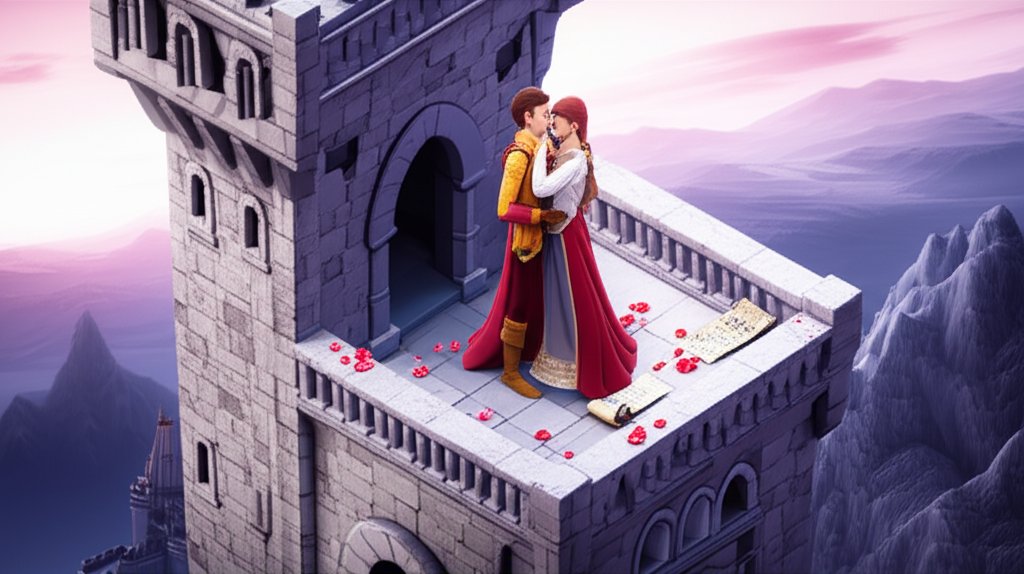
History isn’t just a timeline of battles, treaties, and dusty laws. At its heart, it’s a collection of human stories. And for history and biographies lovers, the most compelling narratives are often the ones whispered in private chambers, written in secret letters, or immortalized in stone—the epic love stories. These are the passions that toppled thrones, inspired transcendent art, and reveal the very human core of the icons who shaped our world.
Forget the dry footnotes. These romances are the main event, proving that love, in all its glorious and tragic forms, has always been one of history’s most powerful catalysts.
At a Glance: What You’ll Discover
- The Power Behind the Throne: Uncover the true stories of couples whose relationships forged empires, sparked revolutions, and redrew the map of the world.
- Art Born from Passion: Explore the romances that inspired timeless masterpieces, from the world’s most beautiful tomb to literature’s most famous monster.
- Partnerships That Endured: Go beyond the initial spark to see the intellectual and emotional bonds that created lasting legacies against all odds.
- Myth, Scandal, and Tragedy: Delve into the tales of forbidden love and destructive obsession, separating celebrated legends from historical reality.
Power, Politics, and Passion: Romances That Shaped Nations
For some of history’s most formidable leaders, love wasn’t a distraction from power—it was intertwined with it. These relationships were strategic alliances, public statements, and private obsessions that had very public consequences.
Cleopatra and Mark Antony: A Gamble for an Empire
It’s one of the most famous love affairs of all time, but the relationship between the Egyptian Queen Cleopatra and the Roman General Mark Antony was as much about political survival as it was about passion. She needed his military might to secure her throne; he needed her vast wealth to fund his ambitions in Rome. What began as a strategic alliance blossomed into a genuine, torrid love affair. They flaunted their union, presenting themselves as the new Isis and Dionysus. But their partnership was a direct challenge to Rome and Antony’s rival, Octavian. In the end, their love couldn’t overcome Roman legions. Facing capture after their defeat at the Battle of Actium, they chose to die together in 30 BCE, a tragic end to a romance that nearly created a new Eastern empire.
Henry VIII and Anne Boleyn: The Obsession That Remade a Kingdom
King Henry VIII’s desire for a male heir is legendary, but it was his infatuation with the sharp-witted and defiant Anne Boleyn that truly changed the course of English history. Unlike her sister, who had been the king’s mistress, Anne refused to be a royal concubine. She wanted to be queen. To marry her, Henry had to get a divorce—an act forbidden by the Pope. His relentless pursuit of Anne led him to break with the Roman Catholic Church, dissolve the monasteries, and declare himself the head of the new Church of England. This single-minded obsession set off decades of religious turmoil. Tragically for Anne, when she also failed to produce a male heir, the king’s passion turned to deadly fury, and she was executed on trumped-up charges.
King Edward VIII and Wallis Simpson: The Love That Cost a Crown
In 1936, King Edward VIII of the United Kingdom faced an impossible choice: the throne or the woman he loved. Wallis Simpson was an American, a commoner, and—most scandalously—a two-time divorcée. As head of the Church of England, the king could not marry a divorcée whose ex-husbands were still alive. The government, the church, and the public were vehemently opposed. In a stunning radio address to the nation, Edward announced his abdication, stating, “I have found it impossible to carry the heavy burden of responsibility… without the help and support of the woman I love.” He gave up an empire for her, and they lived the rest of their lives as the Duke and Duchess of Windsor, a symbol of ultimate romantic sacrifice, though later documents revealed unsettling ties to the Nazi regime.
Akhenaten and Nefertiti: A Shared Spiritual Vision
In ancient Egypt, the pharaoh’s marriage was a state institution. But the bond between Pharaoh Akhenaten and Queen Nefertiti appears to have been a true partnership of mind and spirit. Together, they overturned centuries of Egyptian religious tradition, abandoning the pantheon of gods to worship a single deity: the sun disk, Aten. This was a radical, monotheistic revolution. Temple carvings and sculptures depict them not just in formal poses but as an intimate family, ruling side-by-side and sharing their revolutionary vision. Their love story is etched into the art of the era, a testament to a shared belief so powerful it temporarily redefined a civilization.
The Ink and the Easel: Love Stories That Inspired Great Art
What drives a person to create a masterpiece? For many of history’s greatest artists, poets, and architects, the answer was love—in its most blissful, agonizing, and inspirational forms.
Shah Jahan and Mumtaz Mahal: A Monument to Grief
When Mumtaz Mahal, the beloved wife of Mughal Emperor Shah Jahan, died giving birth to their 14th child in 1631, the emperor was consumed by grief. His hair reportedly turned white overnight. To honor her memory and house her remains, he commissioned a mausoleum of unparalleled beauty on the banks of the Yamuna River in Agra. It took over 20 years and thousands of craftsmen to build the Taj Mahal, an exquisite monument of white marble inlaid with semi-precious stones. It was not just a tomb but the physical embodiment of his love and loss—a “teardrop on the cheek of time,” as the poet Rabindranath Tagore called it. Today, it stands as one of the Seven Wonders of the World, perhaps the most extravagant love letter ever written.
Mary Godwin and Percy Shelley: A Scandalous Muse
The daughter of proto-feminist Mary Wollstonecraft, Mary Godwin was a brilliant intellectual in her own right. She fell madly in love with the radical Romantic poet Percy Bysshe Shelley, who was already married. They eloped to Europe, creating a massive scandal that alienated them from polite society. It was during a trip with the infamous Lord Byron that Mary conceived the idea for her groundbreaking novel, Frankenstein. Their life together was one of intellectual fervor and constant turmoil. After Percy drowned in a boating accident in 1822, a devastated Mary dedicated her life to preserving his work and legacy, never remarrying.
Dante Alighieri and Beatrice: The Unattainable Ideal
Sometimes, the most influential love is one that is never physically realized. The Italian poet Dante Alighieri met Beatrice Portinari only twice, once when they were children and again as young adults. Yet from these brief encounters, she became his lifelong muse, the “glorious lady of my mind.” For Dante, Beatrice was the symbol of divine grace and spiritual purity. She is the central figure in his masterwork, The Divine Comedy, guiding him through Paradise. His unrequited devotion transformed a fleeting real-life acquaintance into one of literature’s most powerful symbols of transcendent love.
John Keats and Fanny Brawne: Poetry Born of Pain
The passionate, fraught romance between the poet John Keats and his neighbor Fanny Brawne burned brightly and briefly. His most famous love poems, including “Bright Star,” were inspired by her. But their relationship was plagued by his failing health from tuberculosis, his lack of money, and his intense jealousy. Knowing he was dying and unable to provide for her, Keats broke off their engagement before leaving for the warmer climate of Rome, where he died at just 25. His heartbreaking letters to her remain a raw and powerful testament to a love affair cut short by tragedy.
Beyond the Romance: Partnerships of Intellect and Devotion
Not all great historical love stories are about whirlwind passion or tragic ends. Some of the most powerful are quiet, steady partnerships built on mutual respect, intellectual equality, and unwavering support.
John and Abigail Adams: A Revolutionary Partnership
Long before he was the second President of the United States, John Adams had a partner who was every bit his intellectual equal: his wife, Abigail. During the long, frequent absences demanded by his work building a new nation, they maintained their connection through a rich correspondence of over 1,000 letters. She was his most trusted political advisor and confidante, debating policy, managing the family farm, and famously urging him to “remember the ladies” when crafting the new country’s laws. Their 54-year marriage was a masterclass in partnership, a bond that helped shape a new republic. For those wanting to dig deeper into such foundational figures, it’s rewarding to Explore American lives that defined a nation’s character.
Gertrude Stein and Alice B. Toklas: A Parisian Salon and a 40-Year Love
For nearly four decades, the writer Gertrude Stein and her partner Alice B. Toklas were the center of the Parisian avant-garde. From their home at 27 rue de Fleurus, they hosted one of history’s most famous literary salons, welcoming artists and writers like Pablo Picasso, Ernest Hemingway, and F. Scott Fitzgerald. They were an inseparable team. While Stein held court with the “geniuses,” Toklas would entertain their wives and partners, all while managing their household and typing up Stein’s famously difficult manuscripts. Their devotion was memorialized in Stein’s most accessible book, The Autobiography of Alice B. Toklas, written from Toklas’s perspective.
Elizabeth Barrett and Robert Browning: A Meeting of Literary Giants
When the poet Robert Browning first read the work of the established, semi-reclusive poet Elizabeth Barrett, he was so impressed he wrote her a fan letter. “I love your verses with all my heart, dear Miss Barrett,” it began. That letter sparked one of literature’s great romances. They corresponded in secret, as Elizabeth’s domineering father disapproved of any suitor. Their shared love for poetry blossomed into a deep personal love, and they eventually eloped in 1846, moving to Italy where they lived and wrote for the rest of their married life.
Love on the Edge: Tales of Scandal, Myth, and Heartbreak
History is also filled with stories where love defies all convention, leading to scandal, ruin, and sometimes, deification. These are the tales that blur the line between historical fact and enduring legend.
Paris and Helen: The Face That Launched a Thousand Ships
Did a decade-long war truly start because a Trojan prince ran away with a Greek queen? The story of Paris and Helen is more myth than verifiable history, but its power is undeniable. Helen of Sparta, said to be the most beautiful woman in the world, left her husband, King Menelaus, for the handsome Prince Paris of Troy. Whether she was abducted or went willingly is a debate for the ages. The Greeks, bound by an oath, launched a massive fleet to get her back, leading to the Trojan War. Helen remains a fascinating figure—a prize, a traitor, or a woman who simply followed her heart, with catastrophic results.
Emperor Hadrian and Antinous: A God Born from Grief
The Roman Emperor Hadrian’s love for a beautiful young Greek man named Antinous was profound and all-consuming. Antinous was the emperor’s constant companion on his travels across the empire. But in 130 CE, the young man drowned under mysterious circumstances in the Nile River. Utterly devastated, Hadrian’s grief was monumental. He had Antinous deified, creating a new god that was worshipped across the empire. He founded the city of Antinoöpolis near where he died, and even named a star in his honor. It was an unprecedented public display of same-sex love and mourning from one of the most powerful men in the world.
Henry II and Rosamund Clifford: The Labyrinth of Secrets
King Henry II of England’s affair with Rosamund Clifford, known as “Fair Rosamund,” is a tale steeped in folklore. To keep their trysts secret from his formidable wife, Queen Eleanor of Aquitaine, the king supposedly built an intricate hedge maze around Rosamund’s bower at Woodstock Palace. Legend holds that the queen eventually navigated the maze, found her rival, and forced her to choose between a dagger and a cup of poison. Rosamund chose the poison. While the maze and the murder are likely fictional embellishments, the affair was real—and when Eleanor found out, her rebellion against Henry led to her being imprisoned by him for 16 years.
Myth vs. Reality: What Can We Really Know?
As a lover of biographies, you know that separating the person from the persona is the ultimate challenge. The same is true for these romances.
How do we know these stories are true?
Our knowledge comes from a patchwork of sources. For figures like John and Abigail Adams, we have their own words in thousands of letters. For Shah Jahan, we have the Taj Mahal itself. For others, like Cleopatra or Nero, we rely on the accounts of contemporary historians (who often had their own political biases). And for legends like Helen or Lancelot, the stories come from epic poems and romances, which prioritize a good narrative over historical accuracy.
What makes a historical romance ‘epic’?
It’s about impact. An epic romance is one that had consequences far beyond the two people involved. It might change the line of succession, inspire a masterpiece that lasts for centuries, or become a foundational myth for a culture.
Did ‘happily ever after’ exist?
Rarely. Many of these stories end in tragedy, execution, or heartbreak. They remind us that even for the most powerful people, life was often brutal and constrained by the politics, diseases, and social conventions of their era. Their stories are powerful not because they are perfect, but because they are so intensely human.
Beyond the Footnotes: Finding the Human Story
The love stories of history are more than just romantic trivia. They are a powerful lens through which to understand the past. They show us that the great figures we read about in textbooks were not marble statues, but flesh-and-blood people driven by the same desires, jealousies, and devotions that we experience today.
To study the love between Shah Jahan and Mumtaz Mahal is to understand the Mughal Empire’s concept of beauty and power. To read the letters of the Brownings is to get a masterclass in Victorian intellectual life. And to untangle the myth of Helen is to explore ancient Greek ideas about fate, beauty, and war.
For anyone who loves digging into the past, these stories are an invitation. They ask us to look beyond the dates and decrees and find the beating heart of history itself.










