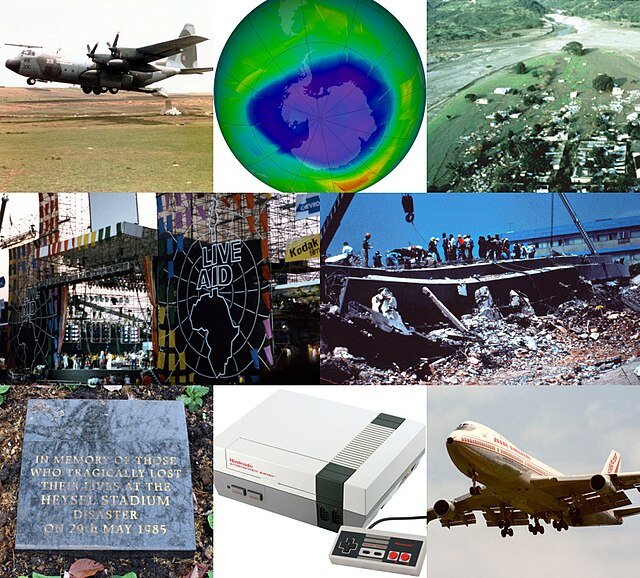
Nineteen eighty-five wasn’t just another year; it was a launchpad, a crucible where emerging tech, global politics, and human resilience intersected, forging a new trajectory for the world. Examining the historical events of 1985, particularly those packed into its opening month, reveals a startling pace of change, juxtaposing moments of profound innovation with heartbreaking tragedy. This was a year when the seeds of our digital future were sown, when humanitarian crises galvanized global action, and when the fault lines of geopolitics were starkly illuminated.
At a Glance: January 1985’s Defining Moments
- Connectivity Unleashed: The birth of the commercial mobile phone network and the Domain Name System (DNS) laid foundational stones for modern digital life.
- Humanitarian Intervention: Covert operations rescued thousands from famine, while a global music initiative sparked unprecedented charitable giving.
- Geopolitical Ripples: New leaders emerged, apartheid struggles intensified, and international legal frameworks faced challenges.
- Nature’s Fury: Extreme weather and a devastating rail accident served as stark reminders of vulnerability.
- Cultural and Sporting Milestones: From new music channels to iconic sporting achievements, entertainment cemented its role in the global consciousness.
The Dawn of Digital Connectivity: A Quiet Revolution
January 1985 opened with little fanfare for what would become two of the most transformative technological advancements of the late 20th century. On New Year’s Day, the UK witnessed its first commercial mobile phone call, a seemingly innocuous conversation between Ernie Wise and Vodafone’s chairman, Sir Ernest Harrison. This wasn’t just a gimmick; it marked the public debut of a technology that would shrink the world, making instant, untethered communication a reality for millions. The Motorola DynaTAC 8000X, a hefty brick of a device, symbolized a future where conversations wouldn’t be tethered to landlines, paving the way for the smartphones we now carry in our pockets.
Concurrently, the Internet’s Domain Name System (DNS) was formally created. While invisible to most users, DNS established the human-readable naming convention for websites (like lolaapp.com) that translates to computer-readable IP addresses. This fundamental infrastructure made the burgeoning internet accessible and scalable, moving beyond arcane numerical addresses to a user-friendly system. Without DNS, navigating the web would be a monumental task, underscoring its quiet but profound impact on how we interact with digital information.
These initial steps in 1985 weren’t about flashy launches, but rather the establishment of critical foundational layers for a hyper-connected world. They illustrate how technological breakthroughs often begin with practical, almost understated implementations that later explode into global phenomena.
Global Outreach and Humanitarian Crises
Amidst the tech innovations, the early days of 1985 also highlighted humanity’s capacity for both suffering and immense compassion. Operation Moses, a clandestine Israeli mission launched in November 1984, concluded on January 5th. This complex operation, involving the Israel Defense Forces, the CIA, and Sudanese state security forces, successfully airlifted approximately 8,000 Ethiopian Jews (Falashas) from famine-stricken refugee camps in Sudan to Israel. It was a race against time to save lives amidst a severe Ethiopian famine that had already claimed hundreds of thousands. The operation’s public confirmation by Israeli Prime Minister Shimon Peres brought it to a halt, but not before thousands found new homes and hope.
The crisis in Ethiopia continued to resonate globally. By late January, a group of music’s biggest stars gathered to record “We Are the World” as USA for Africa. Recorded on January 28th, this charity single became a cultural touchstone, raising millions for Ethiopian famine relief. It showcased the power of popular culture to mobilize resources and attention for humanitarian causes on an unprecedented scale, turning a song into a global act of solidarity.
These events demonstrated a growing global awareness and interconnectedness regarding humanitarian emergencies. They underlined the moral imperative to act and the effectiveness of concerted international efforts, whether covert diplomatic missions or mass-market appeals, in addressing catastrophic human suffering.
Political Crossroads and Shifting Alliances
The geopolitical landscape in January 1985 was marked by significant shifts and persistent tensions. On January 10th, Daniel Ortega was inaugurated as Nicaragua’s first elected President since the Sandinista revolution. His offer of amnesty to US-backed rebels and his pledge to continue the transformation to socialism, aligning with the Soviet Union and Cuba, signaled a defiant stance that would define much of the US-Nicaraguan relationship for years to come. This inaugurated a period of heightened Cold War proxy conflict in Central America, with profound implications for regional stability.
In South Africa, the apartheid regime continued to face internal and external pressure. The African National Congress (ANC) marked its 73rd anniversary on January 8th, issuing a strong statement emphasizing the anti-apartheid struggle and calling for international solidarity. By January 31st, South African President P. W. Botha made a conditional offer to free Nelson Mandela if he denounced violence. This seemingly conciliatory move was largely seen as an attempt to legitimize the regime while attempting to defuse growing international condemnation, but Mandela’s steadfast refusal cemented his status as a symbol of resistance.
Further afield, the US renounced the jurisdiction of the World Court on January 18th, a move that stirred international debate about the role of global legal institutions and American foreign policy unilateralism. It was a clear signal of the Reagan administration’s approach to international law and its sovereignty. These political maneuvers and developments reveal a world navigating complex ideological divides and humanitarian responsibilities. For a broader perspective on how these events fit into the wider context of that pivotal year, you can Discover 1985’s world-changing moments.
Cultural Milestones and Sporting Triumphs
Beyond politics and technology, January 1985 also delivered a rich tapestry of cultural and sporting moments that captured public imagination. On January 1st, VH-1, MTV’s sister channel, made its broadcasting debut, targeting an older demographic with a focus on adult contemporary music videos and classic rock. This expansion in music television signaled a growing segmentation in media and a deeper entrenchment of music videos in popular culture.
The inaugural Rock in Rio music festival kicked off on January 11th in Brazil, drawing an astonishing 1.38 million attendees over ten days. Featuring legendary acts like Queen and AC/DC, it demonstrated the global reach and unifying power of music, establishing itself as one of the world’s largest music festivals. This event wasn’t just a concert; it was a cultural phenomenon that put Brazil on the global music map.
In the world of sports, January was packed with record-breaking performances. On January 13th, Wayne Gretzky scored his 400th career NHL goal in an astounding 436th game, cementing his reputation as an unparalleled scoring machine. Just a week later, on January 20th, Super Bowl XIX saw the San Francisco 49ers defeat the Miami Dolphins 38-16, with Joe Montana named MVP. This high-stakes game capped off an NFL season and provided a communal viewing experience that remains a hallmark of American culture. These moments, whether on stage or on the ice, showcased the enduring human pursuit of excellence and entertainment.
Tragedies and Nature’s Unforgiving Hand
Not all events of January 1985 were triumphs. The month also bore witness to profound tragedies and the immense destructive power of nature. On January 13th, Ethiopia suffered one of Africa’s worst railroad disasters when an express train derailed and plunged into the Awash River gorge, killing at least 428 people and injuring over 500. Attributed to excessive speed, this accident underscored the fragility of infrastructure and the devastating human cost when systems fail.
Concurrently, a severe Arctic cold wave gripped the United States, starting around January 18th and persisting for days. This cold snap brought record-low temperatures, particularly to the Southeast, causing widespread disruption and immense suffering. Chicago recorded its coldest temperature ever at O’Hare International Airport (-27°F with wind chills down to -60°F) on January 20th. States like South Carolina (-19°F) and North Carolina (-34°F) also saw historic lows. The cold wave was responsible for at least 126 fatalities and caused an estimated $1.2 billion in damage to Florida’s vital citrus industry, destroying 90% of the crop. President Ronald Reagan’s second inauguration ceremony on January 21st was even moved indoors due to the extreme conditions, a rare occurrence.
These events served as harsh reminders of the unpredictable forces of nature and the vulnerability of human systems to extreme conditions. They highlighted the immediate and long-term economic and social consequences of natural disasters, from agricultural devastation to the tragic loss of life.
Practical Lessons from 1985’s Opening Act
The historical events of January 1985 offer more than just a chronological recounting; they provide insights into enduring global dynamics:
- Innovation’s Pacing: Major technological shifts often begin with seemingly small, foundational developments (like DNS or the first mobile call) that only much later reveal their true disruptive potential. Understanding this allows us to better anticipate future trends.
- Interconnected Crises: Humanitarian crises, like the Ethiopian famine, rarely exist in isolation. They are often compounded by political instability or lack of infrastructure, demanding multifaceted international responses, as seen with Operation Moses and “We Are the World.”
- The Power of Pop Culture: Popular music and mass media, even in 1985, demonstrated an incredible capacity to unite people, raise awareness, and mobilize resources for social causes. This legacy continues today with digital campaigns and viral movements.
- Geopolitical Undercurrents: Political decisions, like Nicaragua’s shift or the US stance on the World Court, reveal deeper ideological battles and power dynamics that shape international relations for decades. Paying attention to these early signals can help anticipate future conflicts or alliances.
- Vulnerability to Nature: Despite technological advances, humanity remains susceptible to natural disasters. The 1985 cold wave underscores the importance of resilient infrastructure, early warning systems, and robust emergency response plans.
Quick Answers: Common Questions about January 1985
Q: What were the most significant technological breakthroughs in January 1985?
A: The most significant breakthroughs were the launch of the first commercial mobile phone network in the UK and the formal creation of the Internet’s Domain Name System (DNS). These laid crucial groundwork for modern communication and internet infrastructure. Japan also launched Sakigake, its first deep space probe to study Halley’s Comet, marking a significant step in space exploration outside the US/USSR.
Q: How did global humanitarian efforts manifest in early 1985?
A: Global humanitarian efforts were prominently featured through “Operation Moses,” a covert airlift of thousands of Ethiopian Jews to Israel from famine-stricken Sudan. Later in the month, music’s biggest stars recorded the charity single “We Are the World” to raise funds for Ethiopian famine relief, demonstrating the power of popular culture in galvanizing aid.
Q: What major political developments occurred internationally in January 1985?
A: Daniel Ortega was inaugurated as the first elected President of Nicaragua since the Sandinista revolution, signaling a socialist alignment. South African President P. W. Botha offered to free Nelson Mandela if he renounced violence (which Mandela refused). The US also notably renounced the jurisdiction of the World Court.
Q: Were there any major natural disasters or tragedies in January 1985?
A: Yes, a devastating express train derailment in Ethiopia resulted in at least 428 fatalities, making it one of Africa’s worst railroad accidents. Additionally, a severe Arctic cold wave impacted the United States, causing record-low temperatures, over 126 fatalities, and an estimated $1.2 billion in damage to Florida’s citrus industry.
Q: What notable cultural or sports events took place during this month?
A: VH-1 made its broadcasting debut, expanding music television. The inaugural Rock in Rio music festival began in Brazil, attracting over a million attendees with major international acts. In sports, Wayne Gretzky scored his 400th NHL goal, and the San Francisco 49ers won Super Bowl XIX against the Miami Dolphins.
The Enduring Echoes of 1985
The historical events of 1985, particularly those concentrated within its opening month, serve as a microcosm of a year defined by its profound contrasts. We witnessed the embryonic stages of a digitally connected world alongside heartbreaking human suffering and the powerful global responses it inspired. We saw political realignments that shaped regional conflicts and cultural milestones that united millions.
These moments weren’t isolated incidents; they were threads in a larger tapestry, each contributing to the fabric of the modern world. Understanding them isn’t just about revisiting the past, but recognizing the foundational shifts that continue to influence our present, from the way we communicate to how we respond to global crises. The breakthroughs of January 1985 continue to resonate, reminding us that even in tragedy, the human spirit, driven by innovation and compassion, finds ways to move forward.










